

Augmented Reality in Healthcare: Use Cases, Real-World Examples, and Emerging Trends (2026 Guide)
Augmented Reality in Healthcare: Use Cases, Real-World Examples, and Emerging Trends (2026 Guide)
 Pushpa

Summarize with AI
Not enough time? Get the key points instantly.


Table of Contents
What Is Augmented Reality in Healthcare?
Why Healthcare Leaders Can’t Afford to Ignore AR Right Now
Real-World Use Cases and Examples
Where AR in Healthcare Is Headed Next
Why Healthcare Organizations Are Investing in AR
Cost and ROI Considerations
Common Barriers to AR Adoption
How to Choose the Right AR Development Partner
Lumestea Process
How Lumestea Can Help
FAQs
Picture a surgeon walking into an operating theatre wearing a lightweight headset that quietly overlays a patient’s CT scan directly onto their body — no second monitor to glance at, no assistant reading vitals aloud. That isn’t a research-lab demo. It’s happening in hospitals today, and augmented reality (AR) is the technology making it possible.
AR blends digital information — 3D models, patient data, instructions, visual cues — with what a clinician or patient sees in the real world, in real time. Unlike virtual reality, which replaces your surroundings entirely, AR keeps you anchored in the physical world while adding a useful digital layer on top of it.
The pace of adoption reflects that usefulness. The augmented reality in healthcare market is estimated at $1.91 billion in 2026, growing at a CAGR of 26.29% to reach $6.13 billion by 2031 — among the fastest-growing corners of health-tech investment. Hospitals, medical schools, device makers, and digital health startups are racing to apply it, not because AR is trendy, but because it solves expensive problems: diagnostic errors, long training cycles, missed IV attempts, and patients who leave a consultation more confused than when they arrived.
Here’s the uncomfortable truth for healthcare leaders sitting on the sidelines: every quarter you wait, a competing hospital network, clinic chain, or med-tech company is piloting an AR use case that will become their differentiator in patient trust and clinical outcomes. The organizations building now will be the ones setting the standard in 2027 and beyond.
Healthcare providers exploring digital transformation more broadly often find AR sits naturally alongside other modernization efforts — cloud-based records, AI-assisted diagnostics, connected devices — as one more layer that makes care faster, safer, and more precise.
If you’re evaluating whether AR belongs in your 2026 technology roadmap, this guide walks through exactly where it delivers value, what it costs, and how to get started without wasting a budget cycle on the wrong pilot.
What Is Augmented Reality in Healthcare?
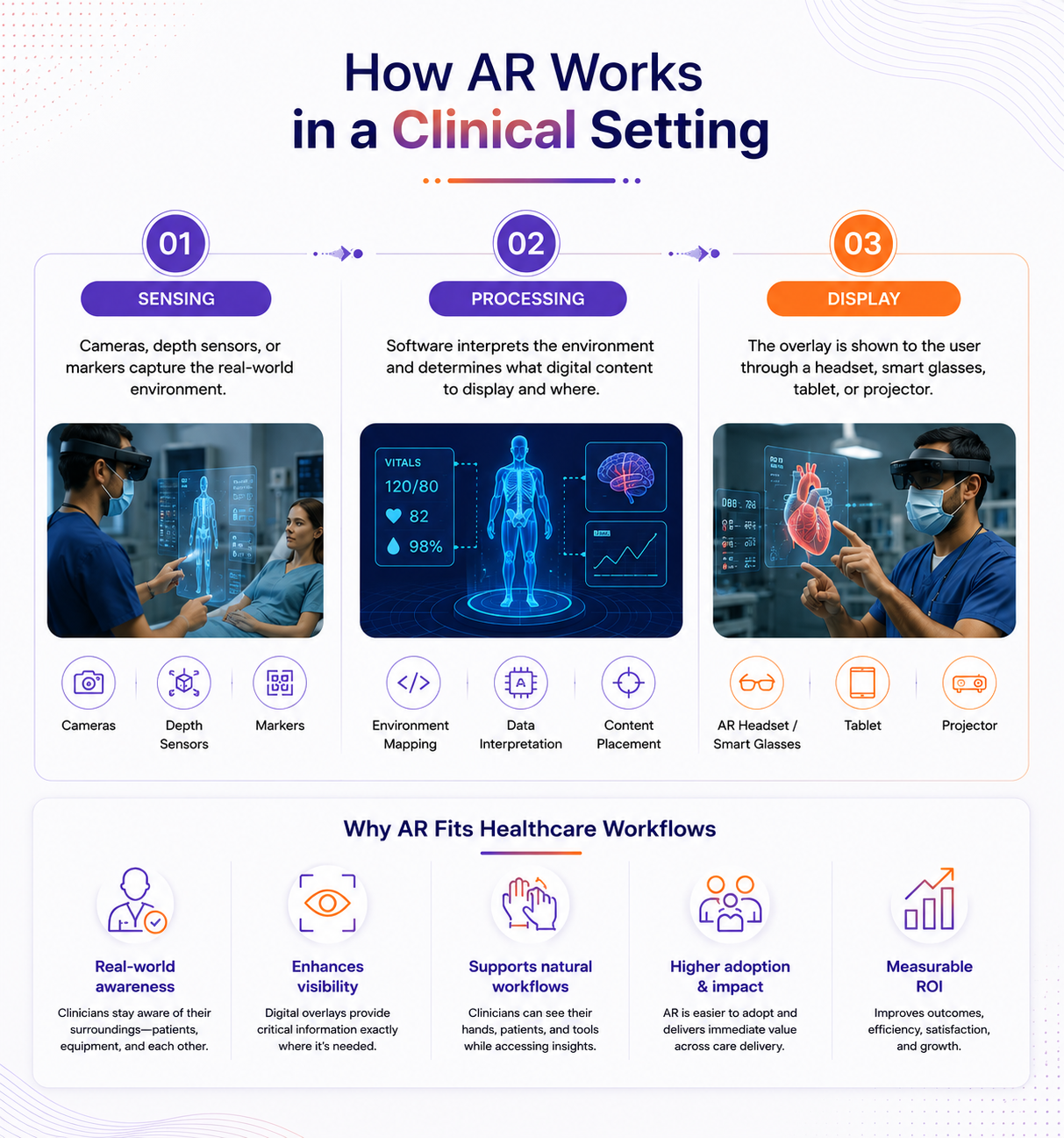
AR in a clinical setting works through three connected layers:
- Sensing — cameras, depth sensors, or markers that read the physical environment (a patient’s body, a hospital corridor, a piece of equipment)
- Processing — software that interprets that environment and decides what digital content to display, and where
- Display — a headset, smart glasses, tablet, or projector that shows the overlay to the user
Because AR doesn’t replace a clinician’s field of view, it fits into workflows VR simply can’t — a nurse can still see a patient’s face while checking vitals through a headset; a surgeon can still see their own hands. That combination of real-world awareness plus digital enhancement is why AR has found a foothold across so much of care delivery — and why it’s proving far easier to get clinical staff to actually adopt than earlier generations of hospital software.
Why Healthcare Leaders Can’t Afford to Ignore AR Right Now
Three forces are converging to make 2026 the tipping point for AR in healthcare:
- 1. Hardware has gotten cheaper and lighter. Headsets and smart glasses that cost tens of thousands of dollars five years ago are now enterprise-affordable, and handheld/mobile-based AR needs no special hardware at all.
- 2. Clinical evidence is stacking up. First-attempt vein-access rates, surgical accuracy, and training-time reductions are no longer theoretical — they’re published, repeatable outcomes hospitals can point to when justifying budget.
- 3. Patients expect it. A generation raised on smartphone AR filters and immersive apps now expects their care providers to explain conditions and procedures visually, not just verbally.
The organizations that treat AR as a 2026 priority — not a “someday” experiment — are the ones who’ll own the patient-experience and clinical-efficiency narrative in their market. Our healthcare technology team can help you figure out exactly where to start.
Real-World Use Cases and Examples of AR in Healthcare
Surgical and Clinical Use Cases
1. Surgical Navigation and Preoperative Planning — Surgeons use AR to rehearse a procedure digitally before the first incision, overlaying imaging data onto the surgical field so vessels, tumors, or spinal structures are visible without looking away to a separate screen.
Systems like Augmedics’ xvision Spine System give surgeons near X-ray vision through skin and tissue during spinal work, improving instrument placement accuracy and reducing the need for repeat imaging mid-procedure.
2. Robotic-Assisted Surgery Enhanced by AR — Robotic-assisted surgery already improves precision for minimally invasive procedures; pairing it with AR adds situational awareness that helps surgeons make split-second calls with more confidence, especially in liver resections, reconstructive procedures, and ultrasound-guided work.
3. Vein Visualization for Blood Draws and IV Starts — Missed veins mean repeated needle sticks, frustrated patients, and wasted clinician time. Handheld AR scanners — AccuVein being the best-known — project a live image of a patient’s vasculature onto their skin using near-infrared light, and deployments have reported first-attempt success rates climbing several-fold over unaided sticks.
4. Non-Invasive Wound Assessment — Traditional wound measurement is rough, inconsistent between clinicians, and uncomfortable for the patient. AR-based 3D wound mapping gives objective, repeatable healing measurements without physical contact — useful both for clinical documentation and for showing patients tangible proof of recovery.
5. Advanced Medical Imaging — AR platforms convert CT and MRI scans into layered 3D holograms a surgical team can view directly over the patient during a procedure, giving a far more intuitive sense of anatomy than a flat screen ever could.
Patient-Facing Use Cases
6. Patient Symptom Communication and Self-Assessment — Not every patient describes symptoms clearly, and inconsistent self-reporting drives misdiagnosis. AR apps that simulate conditions visually let patients and doctors compare symptoms against a reference, closing the communication gap between what a patient feels and what a clinician needs to know.
7. Chronic Condition Self-Management — Consumer AR apps help patients monitor conditions like atrial fibrillation through a guided self-pulse check, flagging irregularities that warrant medical attention between appointments — effectively turning a smartphone into an early-warning system.
8. Physiotherapy and Rehabilitation — AR turns repetitive exercises into guided, visually engaging sessions, measurably improving adherence, and opening the door to low-cost, at-home rehab programs that don’t require a therapist present for every session.
9. Hospital Wayfinding — Smartphone AR navigation overlays directional arrows onto a live camera view, guiding patients and visitors through confusing hospital campuses without decoding a floor map — a small feature with an outsized effect on first-impression patient satisfaction scores.
Training, Education, and Operational Use Cases
10. Immersive Medical Education and Anatomy Training — Facing well-documented physician shortages, medical schools are using AR to compress training timelines. Instead of relying only on cadavers and flat diagrams, students using headset platforms can view one life-sized 3D anatomical model together, walking around a heart or skeleton from every angle.
11. Training Clinicians on New Drugs and Therapies — Pharma and life-sciences teams use AR to visually demonstrate how a disease progresses and how a new treatment intervenes, turning dense clinical trial data into something a physician grasps in minutes instead of hours of reading.
12. Hands-Free Access to Patient Records — Clinicians wearing AR glasses can scan a patient’s wristband and pull up EMR history directly in their field of view, keeping attention on the patient instead of a screen. This is the same principle behind AI-driven chatbot interfaces streamlining enterprise data access — get the right information in front of the right person, at the right moment, with the least friction possible.
Not sure which of these 12 use cases fits your organization’s biggest pain point? That’s exactly the conversation our team has with hospital and clinic leaders every week — reach out and we’ll map it out together.
Where AR in Healthcare Is Headed Next
AR in dental care is expanding beyond training into live procedures — helping practitioners plan implant placement and position orthodontic brackets with sub-millimeter precision.
Psychomotor skills training is being reshaped by AR-guided practice tools; pilot programs teaching hand hygiene technique have shown most participants reaching proficiency after just a couple of short sessions.
Consumer wellness gamification is bringing AR outside the hospital — fitness and rehab apps that turn a daily walk into an interactive, motivating experience.
Convergence with AI is the biggest shift on the horizon, and it’s where the real competitive advantage will be won. As AI increasingly powers faster, data-driven clinical decisions, pairing that intelligence with AR’s visual interface means clinicians won’t just see data overlaid on a patient — they’ll see AI-generated recommendations, risk flags, and next-best-actions in the same view. This mirrors what we’re already seeing in adjacent fields — our own work on building AI companion platforms shows how quickly conversational AI and immersive interfaces are converging into a single experience layer. It’s also a natural extension of the shift toward more intentional, less intrusive interface design that’s defining 2026 — technology that helps without demanding attention.
Why Healthcare Organizations Are Investing in AR
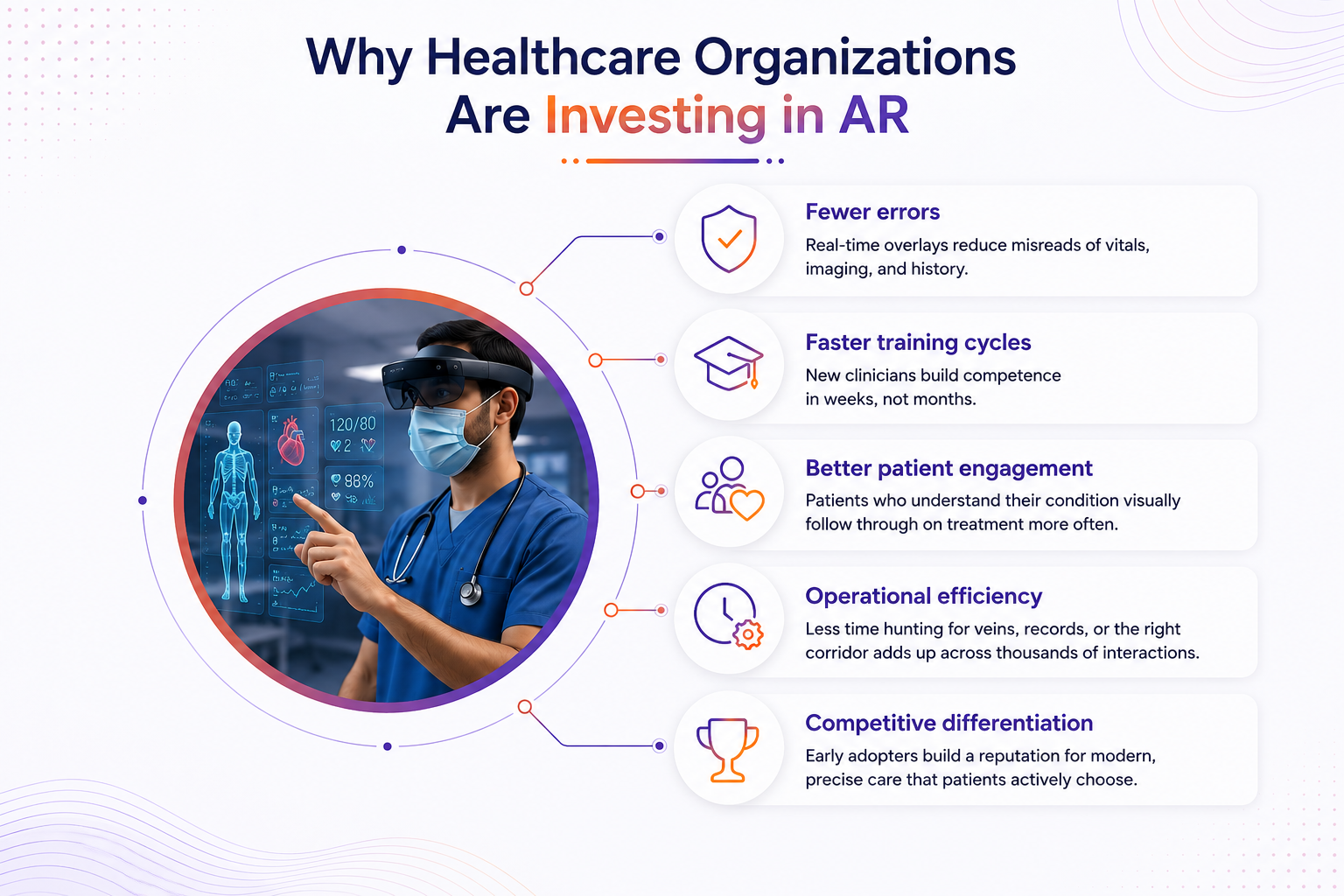
- Fewer errors — real-time overlays reduce misreads of vitals, imaging, and history
- Faster training cycles — new clinicians build competence in weeks, not months
- Better patient engagement — patients who understand their condition visually follow through on treatment more often
- Operational efficiency — less time hunting for veins, records, or the right corridor adds up across thousands of interactions
- Competitive differentiation — early adopters build a reputation for modern, precise care that patients actively choose
Every one of these benefits translates directly into measurable ROI — fewer readmissions, shorter training budgets, higher patient satisfaction scores, and stronger referral rates. If you want a rough sense of what that ROI could look like for your organization specifically, our team can walk you through comparable numbers from past AI and automation projects — the same efficiency principles apply.
Cost and ROI Considerations Before You Build
One of the most common questions we hear from healthcare leaders is: “What does an AR pilot actually cost, and when does it pay for itself?” A few honest considerations:
- Scope drives cost more than technology does. A single-use, mobile-based AR tool (like a wayfinding app) is dramatically cheaper to build and deploy than a headset-based surgical navigation system — and often delivers value faster.
- Architecture decisions made early are expensive to reverse later. Choosing the right technical foundation — cloud infrastructure, data compliance layer, device compatibility — up front avoids costly rebuilds. This is the same lesson we cover in SaaS architecture decisions you can’t easily walk back, and it applies just as directly to healthcare AR platforms.
- Compliance isn’t optional — build it in from day one. HIPAA, data residency, and device security requirements should shape your architecture from the very first sprint, not get bolted on before launch.
- Pilot small, scale fast. The healthcare organizations that see the best ROI typically start with one well-defined use case (vein visualization, wayfinding, or a training module), prove the value, and then expand — rather than trying to build an enterprise-wide AR platform on day one.
Want a realistic cost estimate for your specific use case? Book a free scoping call with our team — no obligation, just a clear picture of what it would take.
Common Barriers to AR Adoption (and How to Get Past Them)
AR adoption isn’t friction-free — but every barrier below has a proven workaround:
- Upfront hardware cost → Start with mobile/handheld AR before investing in headsets
- Clinician unfamiliarity → Build training and change-management into the rollout plan, not as an afterthought
- Eye strain / extended-use concerns → Design sessions and interfaces around realistic clinical use windows, not marathon sessions
- Shortage of healthcare-specific content → Partner with a team that’s built clinical software before, not a generalist AR studio
- Evolving regulatory landscape → Bake compliance into the architecture from day one, as covered above
None of these are dealbreakers. They’re exactly why so many promising healthcare technology projects stall — and exactly what a experienced delivery partner should be solving for you before you write a single line of code.
How to Choose the Right AR Development Partner
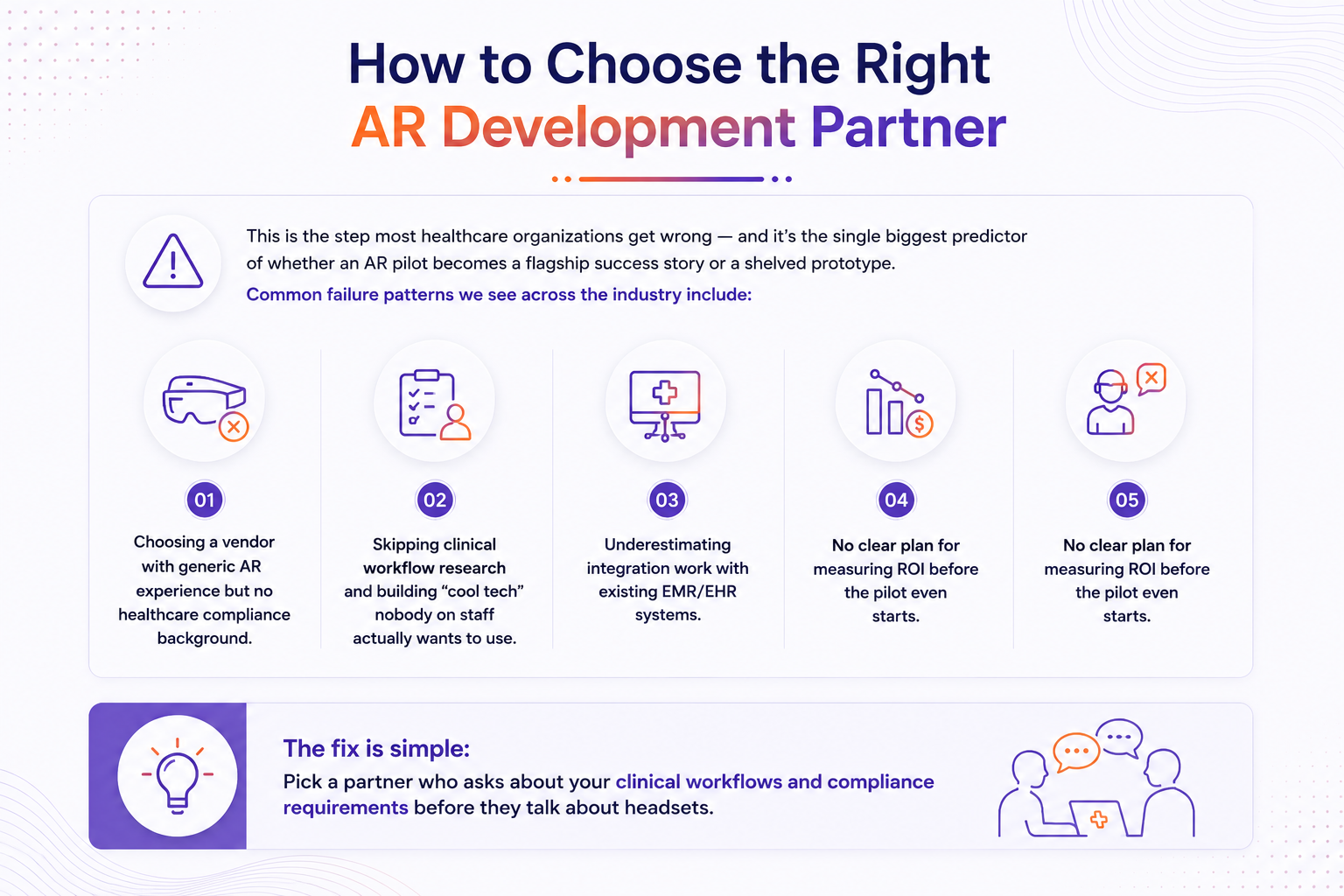
This is the step most healthcare organizations get wrong — and it’s the single biggest predictor of whether an AR pilot becomes a flagship success story or a shelved prototype. Common failure patterns we see across the industry — and break down in detail in our analysis of why software product engineering projects fail — include:
- Choosing a vendor with generic AR experience but no healthcare compliance background
- Skipping clinical workflow research and building “cool tech” nobody on staff actually wants to use
- Underestimating integration work with existing EMR/EHR systems
- No clear plan for measuring ROI before the pilot even starts
The fix is simple: pick a partner who asks about your clinical workflows and compliance requirements before they talk about headsets.
Our Process: How Lumestea Builds AR Solutions for Healthcare
- 1. Discovery & Workflow Mapping — We sit down with your clinical and IT teams to identify the highest-impact, lowest-friction use case for your organization
- 2. Compliance-First Architecture — HIPAA, data residency, and security requirements are built into the technical foundation from day one
- 3. Rapid Prototyping — A working proof-of-concept your clinicians can actually test, not a slide deck
- 4. Pilot Deployment — Real-world testing with a defined group, measured against clear success metric
- 5. Scale & Support — Once the pilot proves value, we help you expand across departments or facilities, with ongoing support built in
We’ve applied this same disciplined, compliance-aware approach across AI and emerging technology projects for a range of industries — see the results in our case studies.
How Lumestea Innovex Can Help You Build AR Solutions for Healthcare
At Lumestea Innovex Private Limited, we help healthcare organizations move from “AR sounds interesting” to a working solution clinicians actually use. Our AI and emerging technology team builds custom AR applications — surgical planning tools, immersive training modules, patient-facing self-care apps — designed around your clinical workflows and compliance requirements, not a one-size-fits-all template.
Here’s what working with us looks like:
- A dedicated team that understands both healthcare compliance and AR/AI engineering
- Transparent, scope-based pricing — no surprise costs mid-project
- A pilot-first approach that proves ROI before you commit to scale
- Ongoing support long after launch day
Ready to explore what AR could do for your hospital, clinic, or health-tech product? Talk to our healthcare technology team today — the first conversation costs you nothing but could save you a year of trial and error.
Frequently Asked Questions
1) What is augmented reality used for in healthcare?
AR is used across surgical navigation, medical training, vein visualization, patient symptom communication, hands-free EMR access, wound assessment, physiotherapy, and hospital wayfinding.
2) How does AR improve patient care?
It helps patients understand their conditions through visual, 3D explanations rather than verbal descriptions alone, improving treatment adherence, and reduces communication gaps between patients and clinicians.
3) How is AR used in surgery?
Surgeons overlay CT/MRI imaging directly onto the patient during a procedure, giving near X-ray vision through skin and tissue — improving instrument placement accuracy in spine, liver, and other minimally invasive procedures.
4) Is augmented reality the same as virtual reality?
No. AR overlays digital content onto the real world while keeping the user aware of their surroundings; VR replaces the environment entirely. Healthcare uses both, but AR is more common in live clinical settings since it doesn’t block the clinician’s view of the patient.
5) How much does it cost to build an AR solution for a hospital or clinic?
Cost depends heavily on scope — a mobile-based wayfinding app costs a fraction of a headset-based surgical navigation system. Most organizations get the best ROI by piloting one well-defined use case before scaling. A scoping call with a healthcare-experienced development partner is the fastest way to get an accurate number.
6) What’s stopping wider AR adoption in hospitals today?
Hardware cost, limited clinician familiarity, a shortage of healthcare-specific content, and an evolving regulatory landscape — all of which ease significantly with the right implementation partner.
7) Can smaller clinics adopt AR, or is it only for large hospitals?
Handheld and mobile-based AR tools offer smaller clinics a far lower-cost entry point than headset-based systems, making adoption realistic beyond large hospital systems.
8) How long does it take to build and launch an AR healthcare pilot?
With a focused, single-use-case pilot, most organizations can move from discovery to a testable prototype in a matter of weeks — not months — provided compliance requirements are addressed early rather than at the end.
Ready to Get Started?
AR in healthcare isn’t a distant future technology anymore — it’s a 2026 competitive advantage that’s already being built by organizations willing to move first. Whether you’re exploring a single pilot or planning an enterprise-wide rollout, Lumestea Innovex is ready to help you turn the right use case into a working solution.
Schedule your free consultation today
And find out exactly where AR fits into your organization’s roadmap.