
AI Order Processing: The Complete 2026 Guide to Smarter, Faster, More Accurate Order Management
AI Order Processing: The Complete 2026 Guide to Smarter, Faster, More Accurate Order Management
 Pushpa

Summarize with AI
Not enough time? Get the key points instantly.


Table of Contents
What Is AI Order Processing?
Why Traditional Order Automation Falls Short
AI Order Processing vs. Traditional Automation vs. Manual Entry
The Real Cost of Manual Order Processing
How AI Order Processing Works: Step by Step
Inside Lumestea OrderIQ: An AI Order Processing Agent Architecture
Key Benefits of AI Order Processing
Industry-Specific Use Cases
Case Spotlight: Visibility and Exception Handling in Logistics
AI Order Processing and the Order-to-Cash Cycle
Choosing the Right AI Order Processing Solution: A Buyer’s Checklist
Implementation Roadmap: Rolling Out AI Order Processing
Common Challenges and How to Overcome Them
Measuring ROI: What to Track Before and After
Security, Compliance, and Data Governance
The Future of AI Order Processing
Why Businesses Choose Lumestea for AI Order Processing
The Technology Stack Behind AI Order Processing
Build vs. Buy: Custom AI Order Processing Agent or Off-the-Shelf Software?
AI Order Processing by Business Size
A Sample 90-Day Rollout Timeline
The Vendor Landscape: Categories of AI Order Processing Tools
Signs Your Business Is Ready for AI Order Processing
Common Myths About AI Order Processing, Debunked
Glossary of Key Terms
FAQs
Conclusion
Every order that gets stuck — in an inbox, a spreadsheet, a mis-typed field, or a system that two departments interpret differently — is a small tax on growth. Most companies don’t notice it in any single order. They notice it in the aggregate: the customer service backlog that never quite clears, the shipment that went out with the wrong quantity, the finance team that closes the month later than it should, the operations lead who can describe exactly where the bottleneck is but can’t get budget to fix it because “it’s just data entry.”
AI order processing is the set of technologies and workflows that removes that tax. Instead of a person reading an email, a PDF, or a web form and retyping it into an ERP or order management system, an AI agent reads it, understands it, checks it against your business rules, and moves it forward — flagging only the orders that genuinely need a human decision. It is not a chatbot bolted onto a support inbox, and it is not the same thing as the rule-based automation many teams already have. It is a shift from automating keystrokes to automating judgment, within guardrails a business defines and controls.
This guide is a deep, practical walkthrough of what AI order processing actually is, how it works under the hood, where it delivers real return on investment, and how to evaluate and roll it out without turning your order operations upside down. It draws on how Lumestea Innovex Private Limited — an AI-first digital services company — designs and builds AI order processing systems for logistics, e-commerce, distribution, and enterprise clients, including our own AI order processing agent, Lumestea OrderIQ.
Whether you’re an operations leader trying to quantify what manual order entry is really costing you, a technical decision-maker comparing AI order processing software, or a founder trying to understand whether this is a “nice to have” or a “have to have” in 2026, this guide is built to answer the questions you actually have — in the order you’re likely to ask them.
What Is AI Order Processing?
AI order processing is the use of AI agents to automatically capture, read, validate, and act on customer or business orders — across emails, PDFs, portals, EDI files, chat, and voice — with minimal human intervention. Instead of following a fixed script, the system understands context, applies business rules, resolves ambiguity where it reasonably can, and routes only genuine exceptions to a person.
That single sentence is the answer most people are searching for. The rest of this section unpacks what each part of it actually means in practice, because “AI order processing” gets used loosely, and the differences matter when you’re evaluating vendors or planning a build.
The Building Blocks of AI Order Processing
At a functional level, AI order processing combines four capabilities that used to live in separate tools:
- Multi-channel capture — ingesting orders regardless of format or channel: an email with a spreadsheet attached, a scanned purchase order, a structured EDI 850 transaction, a web form submission, or a message typed into a chat window.
- Intelligent extraction — using optical character recognition (OCR), natural language processing (NLP), and layout-aware machine learning models to pull out the fields that matter: SKUs, quantities, prices, delivery dates, shipping addresses, special instructions.
- Contextual validation — checking extracted data against inventory levels, pricing agreements, customer credit status, and business rules, and understanding when something is unusual rather than simply different from a template.
- Autonomous action — updating the order management system (OMS), enterprise resource planning (ERP) platform, customer relationship management (CRM) tool, or transportation management system (TMS), and triggering the next step in the fulfillment workflow, without waiting for a person to press “submit.”
The word doing the real work in that list is contextual. A traditional automation script can extract a field if it always appears in the same place. An AI order processing agent can find the delivery date whether it’s in a table, a sentence, or a subject line, and can recognize when a customer has quietly changed their usual order pattern in a way that’s worth flagging.
AI Order Processing vs. AI-Assisted Order Processing
It’s worth separating two terms that are often used interchangeably:
- AI-assisted order processing uses AI to help a human do the work faster — surfacing suggested fields, flagging likely errors, or auto-filling a form that a person still reviews and submits.
- AI order processing (sometimes called agentic order processing) goes further: the AI agent completes the workflow end-to-end for the orders it can handle confidently, and only escalates the ones it can’t. The human moves from “processor” to “reviewer of exceptions.”
Most organizations don’t jump straight to full autonomy, and they shouldn’t. The healthiest rollouts start with AI-assisted workflows, build a track record of accuracy, and expand autonomy for well-understood order types — a point we’ll return to in the implementation roadmap later in this guide.
Why “Order Processing” Is a Bigger Category Than It Sounds
Order processing is often mentally filed under “data entry,” but the workflow it sits inside touches nearly every operational system a business runs:
| Order processing touches… | Examples |
| Inventory & warehouse systems | Stock allocation, backorder handling, warehouse management system (WMS) updates |
| Pricing & contracts | Customer-specific price lists, volume discounts, promotional codes |
| Finance & billing | Invoice generation, credit checks, tax calculation |
| Logistics | Carrier selection, shipment scheduling, delivery date commitments |
| Customer experience | Order confirmations, status updates, exception communication |
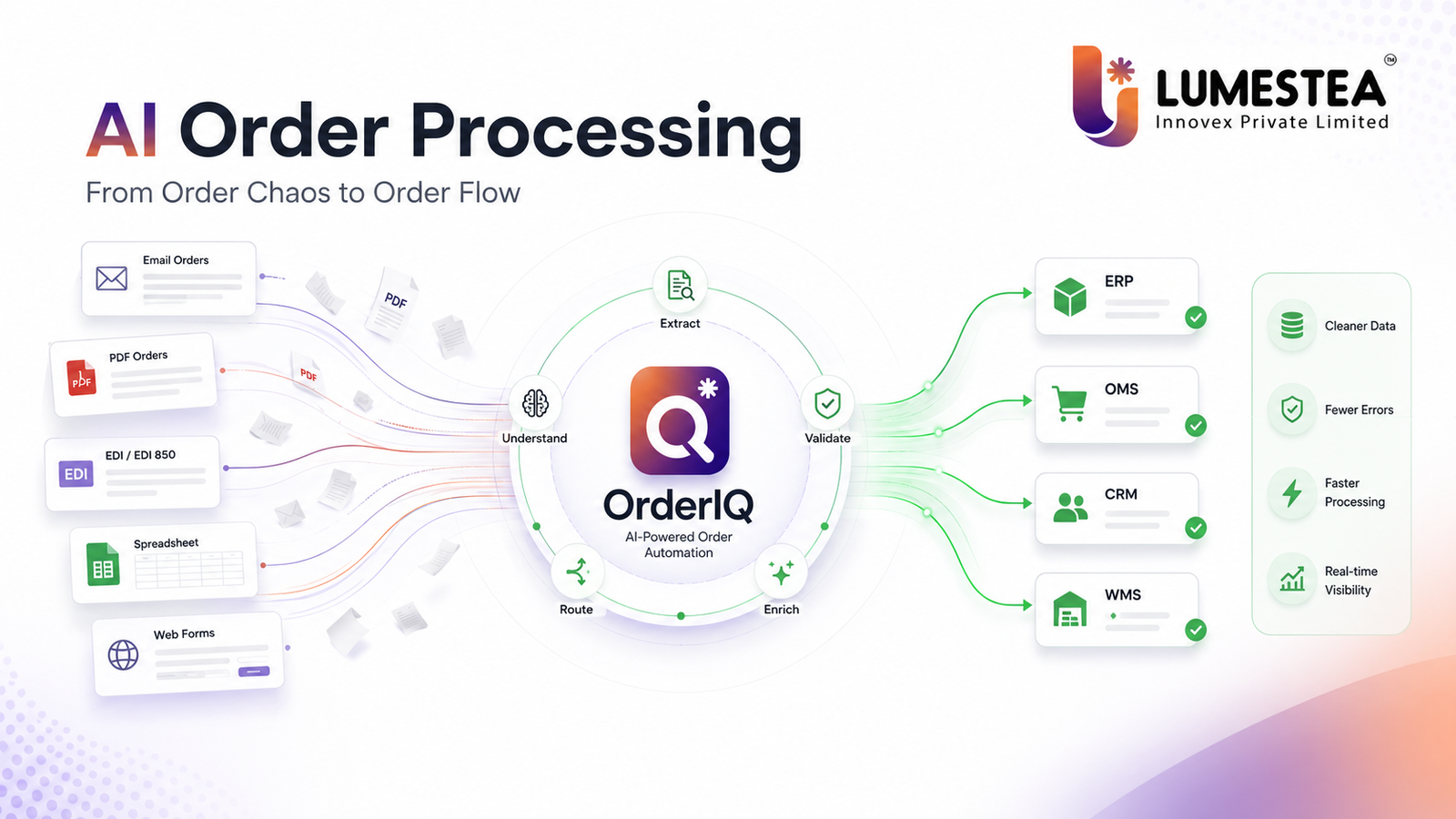
An AI order processing system that only “reads and types” without understanding these downstream dependencies isn’t solving the real problem. That’s why the strongest solutions are built as AI agents with system integrations, not standalone extraction tools — a distinction covered in more depth in how AI order processing works.
Why Traditional Order Automation Falls Short
Most mid-sized and enterprise businesses already have some automation in their order workflow — a rules engine in the ERP, an EDI connection with a few key accounts, maybe a web form that feeds directly into the order management system. If that’s true for your business, it’s fair to ask: why isn’t that enough?
The honest answer is that traditional automation was built for a world where orders arrive in predictable, structured formats. It works extremely well for exactly that slice of volume — and falls apart everywhere else.
Rule-Based Automation Needs the World to Behave
A traditional order automation script typically works like this: if the order comes in through this exact channel, in this exact format, with these exact fields in these exact positions, then process it automatically. The moment any one of those conditions isn’t met, the order drops out of automation and lands in a queue for a person to handle manually.
In practice, orders rarely behave that consistently:
- A regular customer emails a PO as a scanned image instead of a native PDF.
- A distributor sends a spreadsheet with an extra column this month.
- A buyer writes “usual order, but add 20 more of the blue ones” instead of listing every line item.
- A wholesale account calls in a rush order that needs to be manually keyed because there’s no time to use the portal.
None of this is unusual — it’s simply how humans communicate. But to a rules engine, every one of these is an exception, which is why so many “automated” order pipelines still quietly depend on a team of people re-entering a large share of total volume by hand. Industry benchmarks bear this out: one widely cited analysis found that only about 5% of purchase orders match correctly on the first attempt in typical B2B environments, and that close to 40% of invoices contain some kind of error before automation is applied — a strong sign that the problem sits upstream, in how orders are captured and interpreted, not just in how they’re keyed in (Infrrd, 2026).
Traditional Automation Doesn’t Understand, It Matches
The deeper limitation is architectural. Rule-based systems match patterns; they don’t interpret meaning. That distinction shows up constantly in order processing:
- A missing field is either present or absent to a rules engine — it can’t infer a shipping address from a previous order or a signature block.
- A partial cancellation (“cancel line 3, keep the rest”) requires actual comprehension of the order’s structure, not string matching.
- A price that’s slightly outside contract terms might be a legitimate special-case discount, a data entry mistake, or fraud — and telling those apart requires context a static rule can’t hold.
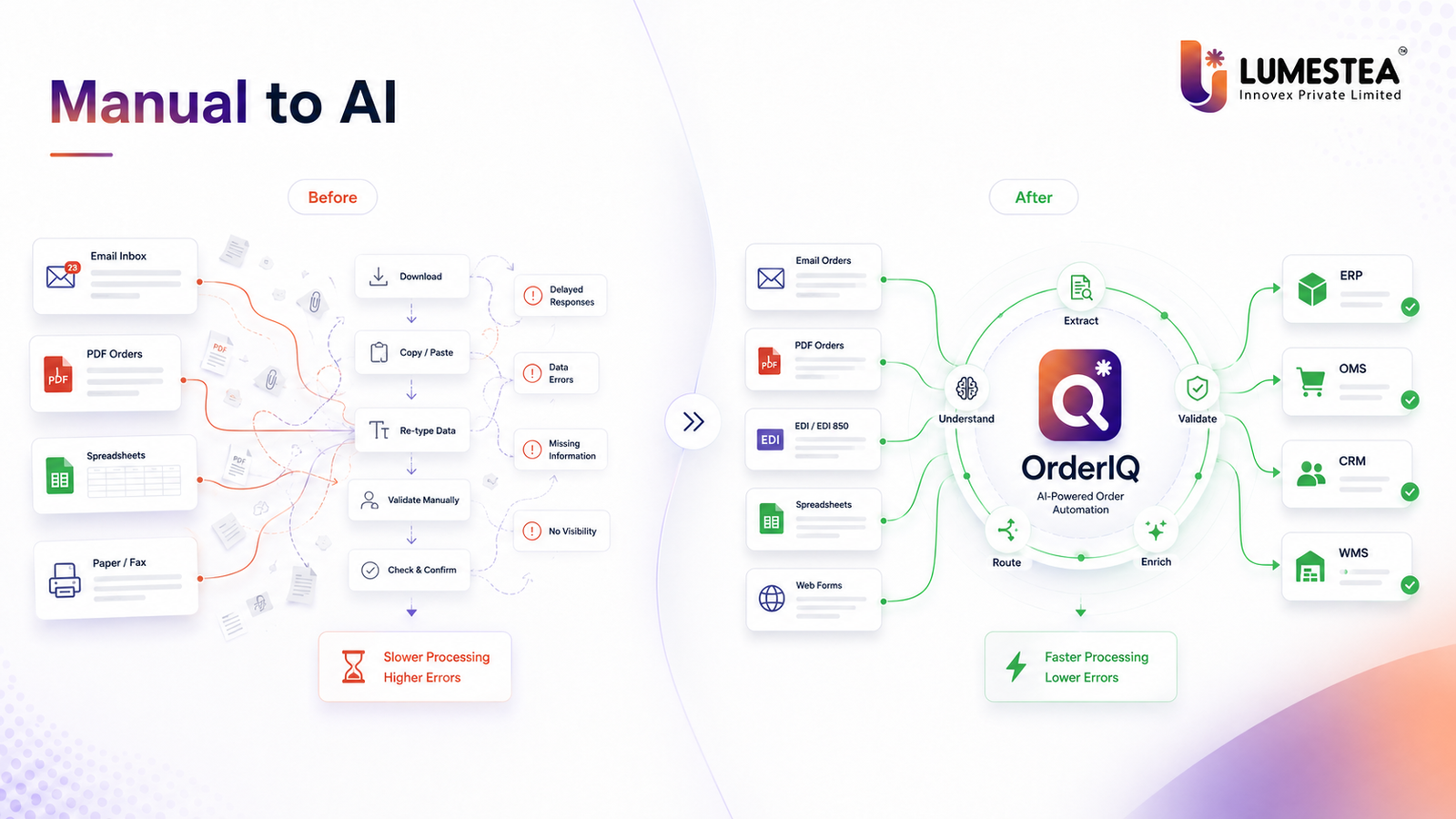
This is precisely the gap AI order processing is built to close. Where rule-based automation asks “does this match the template?”, an AI agent asks “does this make sense, given everything else I know about this customer, this SKU, and this business’s rules?” That reframing is what allows AI order processing to handle unstructured, inconsistent, real-world order volume — not just the clean slice that was already easy to automate.
The Result: A Ceiling on How Much Volume You Can Automate
Because of these limits, many companies find that their existing automation plateaus at somewhere between 20% and 50% of total order volume — the cleanest channels and largest, most standardized accounts. Everything else still routes to a person. That ceiling is exactly why so many operations teams feel like they “already automated this” and are still buried: they automated the easy 30%, and the hard 70% is where the actual labor cost lives.
AI order processing doesn’t just add a new channel to the same rules engine — it changes what’s automatable in the first place, which is why organizations that adopt it typically report much higher straight-through processing (STP) rates than rule-based automation alone ever achieved. We’ll quantify that gap in the next section.
AI Order Processing vs. Traditional Automation vs. Manual Entry
Businesses evaluating order management options are usually choosing between three real approaches, not two. It helps to lay them side by side before deciding where to invest.
| Handles unstructured formats (email, scans, free text) | Yes, slowly | No — needs standardized input | Yes, natively |
| Understands context (implied fields, partial changes) | Yes, inconsistently | No | Yes |
| Typical straight-through processing rate | N/A (fully manual) | 20–50% of volume | 70–90%+ of volume |
| Error rate | 1–2%+ per entry, higher under volume pressure | Low for matched formats, but silent failures on edge cases | Low across formats, with confidence scoring on every field |
| Scales with order volume | No — requires proportional headcount | Partially — breaks on new formats/customers | Yes — learns new patterns over time |
| Exception handling | Manual by default | Drops to a manual queue | Routes only genuine exceptions, with context attached |
| Time to onboard a new customer/format | Immediate but labor-heavy | Days to weeks of rule configuration | Hours to days, often with no new rules needed |
| Visibility into “why” a decision was made | Full (a person did it) | Limited (rule fired or didn’t) | High (agents can explain reasoning and confidence) |
What This Table Means in Practice
The comparison isn’t really “automation vs. no automation.” Most companies already have some rule-based automation and some manual fallback. The real question is: what share of your total order volume is actually flowing through automatically today, versus quietly landing on someone’s desk?
That’s the number worth measuring before evaluating any AI order processing agent, because it’s the number that tells you the size of the opportunity. If your rule-based automation is already handling 45% of volume, the remaining 55% is where AI order processing earns its budget — not by replacing what already works, but by extending automation into the formats, customers, and edge cases that rules can’t reach.
A Note on “AI-Washing”
Not every product marketed as “AI order processing” in 2026 actually uses AI agents in the sense described in this guide. Some tools are rule-based automation with a chatbot interface layered on top, or OCR with a marketing label. When evaluating vendors, it’s worth asking directly:
- Does the system extract structured data from genuinely unstructured formats (a handwritten note, a rambling email), or only from templates it’s been explicitly configured for?
- Can it explain its confidence level on a given field, or does it simply pass or fail?
- Does accuracy improve over time as it processes more of your specific order volume, or is it static?
These questions separate systems built around large language models and agentic reasoning from automation that’s been re-labeled for a hotter market category — a distinction covered further in the buyer’s checklist.
The Real Cost of Manual Order Processing
Manual order processing rarely shows up as a line item on a P&L labeled “cost of manual order processing.” It hides inside labor costs, customer service overhead, shipping corrections, and — most expensively — in the deals and customers a business can’t take on because operations can’t scale to support them. Before looking at what AI order processing costs to implement, it’s worth being precise about what the status quo already costs.
Direct Labor Cost
Order entry is repetitive, detail-heavy work, and it takes real time even for a skilled team member. For a business processing a meaningful volume of orders through email, PDF, and spreadsheet channels, order entry frequently consumes multiple full-time roles’ worth of hours every week — hours spent transcribing, not selling, servicing, or solving problems. One analysis of distributor operations put the fully loaded cost of manual order entry at well into six figures annually for a business processing around 15,000 orders a year — before counting the opportunity cost of using skilled staff as typists (Bizowie, 2025).
The Cost of Errors
Errors are where manual processing gets expensive in ways that are easy to underestimate. A single mistyped SKU or quantity doesn’t just cost the time to fix it — it can trigger a wrong shipment, a return, a credit note, expedited freight to correct the mistake, and a support interaction that damages the relationship. Even well-trained, careful staff working under normal volume pressure introduce errors at meaningful rates simply because manual data entry is not a task humans are built to perform with zero error over long stretches.
The Cost of Slow Cycle Times
Every order sitting in a queue waiting for manual entry adds latency to the order-to-cash cycle. That latency compounds:
- Customer experience suffers. Nearly 90% of U.S. shoppers now expect delivery within two to three days, and order entry delays eat directly into the fulfillment window before a shipment has even left the warehouse (Infrrd, 2026).
- Cash flow slows. The longer an order takes to move from received to invoiced, the longer revenue sits unrecognized.
- Peak periods break first. Manual processes that hold up “fine” at normal volume are usually the first thing to collapse during a seasonal spike, a promotion, or unexpected demand — exactly when the business can least afford it.
The Cost of the Ceiling on Growth
Perhaps the least visible cost is the one that shows up as a decision never made: the new sales channel not opened because operations can’t support another order format, the enterprise account not pursued because its EDI requirements would overwhelm the team, the promotion not run because the fulfillment team is already at capacity. Manual order processing puts a soft ceiling on how fast a business can grow without proportionally growing headcount — which is exactly the constraint AI order processing is designed to remove.
Putting a Number on It
Businesses that have automated order entry with modern tooling report substantial, measurable swings across every category above. A McKinsey analysis cited in industry research found that automating order processing workflows can cut related costs by 10–15% and compress order processing time from two to three days down to one to two hours (Nanonets, 2025). Separately, teams that combine document automation with validation and ERP integration have reported reducing manual data entry errors by up to 88% (ThinkAutomation, 2026), and sales-order-automation deployments have driven order processing costs down by 50–70% while improving customer satisfaction scores at the same time (Apollo, 2026).
None of these numbers will match your business exactly — costs depend heavily on order volume, channel mix, and how much manual rework already happens downstream. But they establish the right frame: manual order processing is not a fixed, unavoidable cost of doing business. It’s a variable cost with a clear, measurable path down — which is the subject of the ROI section later in this guide.
How AI Order Processing Works: Step by Step
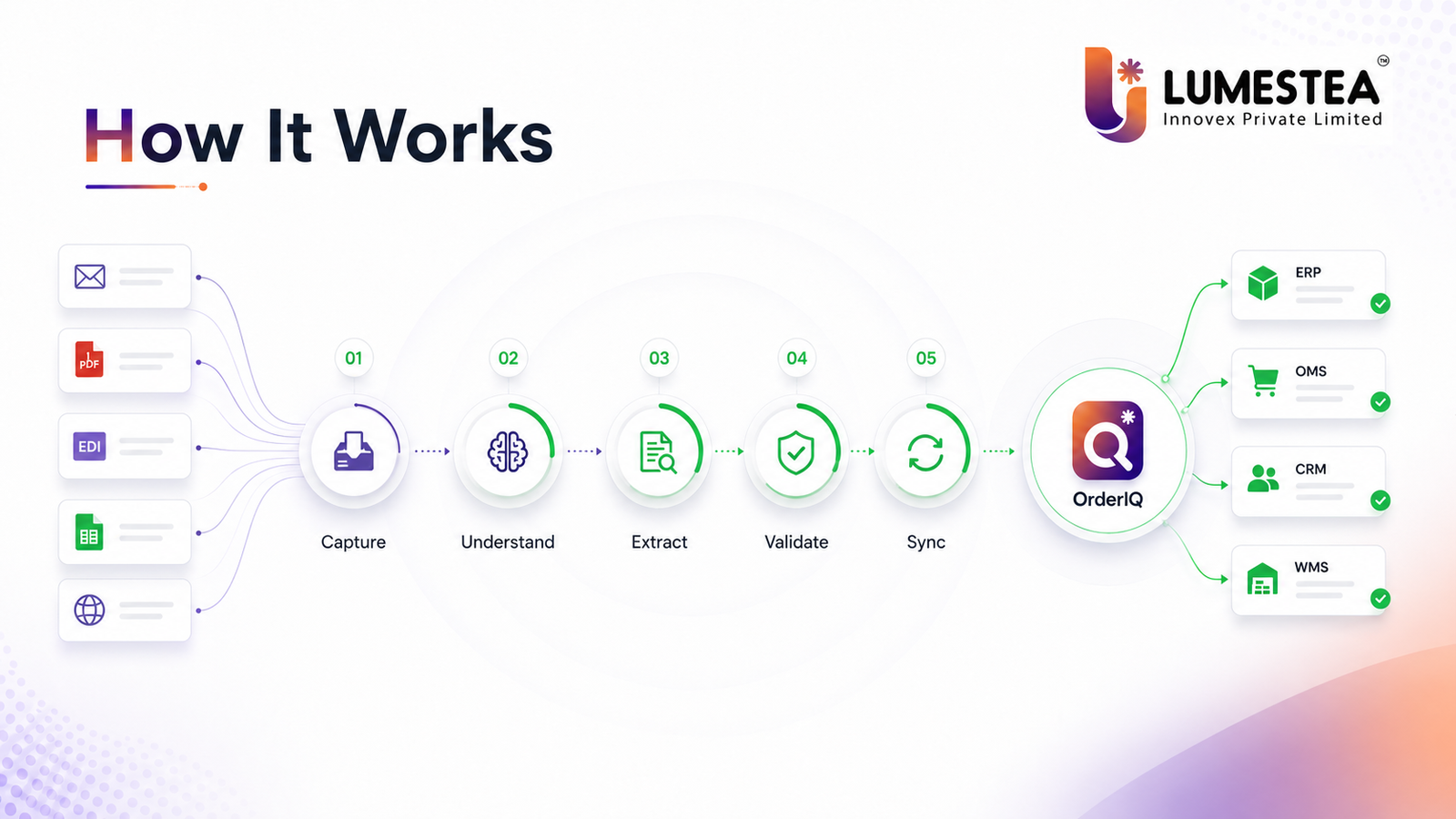
It helps to walk through an AI order processing system the way an order actually moves through it — from the moment it arrives to the moment it’s confirmed in every downstream system. While implementations differ, most mature AI order processing agents follow the same seven-stage flow.
Step 1: Multi-Channel Capture
The system continuously monitors every channel an order can legitimately arrive through: a shared inbox, a web portal, an EDI connection, a chat widget, a fax-to-email gateway, even a voice line transcribed in real time. As soon as something arrives, it’s picked up — there’s no polling delay, no waiting for someone to notice a new email.
This matters more than it sounds. In most order operations, the channel an order arrives through is itself a signal: a regular wholesale account might always use EDI, while a smaller or newer account emails a PDF. An AI order processing agent treats channel as context, not just intake mechanics.
Step 2: Document and Content Understanding
Next, the system determines what it’s actually looking at. Is this a purchase order, a change request, a cancellation, a question, or something unrelated that landed in the same inbox? This classification step uses natural language processing to read the intent of a message, not just its structure — which is why an email that says “please add 15 more units to yesterday’s order” gets correctly identified as an order amendment rather than a new, standalone order.
Step 3: Intelligent Data Extraction
Once the document type is known, the system extracts the specific fields that matter: customer identifier, SKUs or product descriptions, quantities, unit prices, requested delivery date, shipping and billing details, and any special instructions. This is where OCR, layout-aware machine learning, and large language models work together — OCR handles the raw text recognition, layout models understand where fields typically sit even in inconsistent document designs, and language models resolve ambiguity (“the blue ones” mapped to a specific SKU based on order history).
Every extracted field carries a confidence score. High-confidence fields move forward automatically. Low-confidence fields are flagged for the exception step below, rather than silently guessed at.
Step 4: Validation Against Business Rules
Extracted data is checked against the systems of record: is the SKU active and in stock? Does the price match the customer’s contract or a valid promotion? Is the customer’s account in good standing? Is the requested delivery date achievable given current capacity? This step is where AI order processing prevents the downstream costs described in the previous section — catching a pricing mismatch or an inventory shortfall before the order reaches the warehouse floor, not after.
Step 5: Decisioning and Routing
Based on validation results and confidence scores, the system makes a decision: process automatically, route for approval (for orders above a threshold, discounted below contract terms, or from a new customer), or escalate as a genuine exception with full context attached — what was found, what’s uncertain, and why. This is the core difference from rule-based automation: instead of a binary “matched the template or didn’t,” the AI agent reasons about how confident it is and what specifically needs a human judgment call.
Step 6: System Synchronization
Approved orders are written directly into the relevant systems — the OMS, ERP, CRM, and, where relevant, the WMS and TMS — through API or EDI integration. Inventory is allocated, the order enters the fulfillment queue, and any downstream triggers (invoicing, shipping label generation, customer notification) fire automatically. Because the AI agent updates every connected system in the same pass, teams avoid the classic problem of one system reflecting the order and another lagging behind.
Step 7: Continuous Learning
Every order the system processes — including the exceptions a human resolves — becomes a training signal. If a person consistently corrects the same type of ambiguity in the same way, the system incorporates that pattern, so the same exception is less likely to recur. This is what allows straight-through processing rates to climb over time rather than plateauing the way rule-based automation does.
A Simple Illustration
Imagine a regional distributor receives a Monday-morning email from a longtime wholesale customer: a scanned PDF purchase order for 40 SKUs, followed thirty minutes later by a short reply: “actually please bump item 12 to 50 units, thanks.” A rule-based system would likely fail on the scanned PDF (no clean text layer), then fail again on the follow-up email (it doesn’t know what “item 12” refers to without re-parsing the whole order). An AI order processing agent extracts the original 40-line order from the scan, matches “item 12” to the correct SKU using the order’s own line numbering, applies the quantity update, re-validates pricing and inventory for the revised quantity, and writes the finalized order into the OMS — with no manual intervention unless something about the revised quantity trips a business rule (for example, exceeding available stock).
That end-to-end flow — capture, understand, extract, validate, decide, sync, learn — is exactly the architecture behind Lumestea’s own AI order processing agent, covered in detail next.
Inside Lumestea OrderIQ: An AI Order Processing Agent Architecture
Lumestea OrderIQ is Lumestea Innovex’s AI order processing agent, built as part of our broader Generative AI & AI Agents practice. Rather than a single monolithic model trying to do everything, OrderIQ is designed as a multi-agent system — a small team of specialized AI agents, each responsible for one part of the order lifecycle, coordinated by an orchestration layer. This mirrors how the strongest agentic AI platforms are architected in 2026, and it’s a deliberate choice: a single do-everything model tends to be harder to govern, harder to debug, and harder to trust with autonomous action than a set of narrow, well-scoped agents working together.
The Agent Roles Inside OrderIQ
- Capture Agent — watches every connected channel (inbox, portal, EDI gateway, chat) and normalizes incoming orders into a common internal format, regardless of source.
- Extraction Agent — applies OCR, layout understanding, and language models to pull structured fields out of unstructured input, attaching a confidence score to every field it produces.
- Validation Agent — cross-checks extracted data against connected systems of record: inventory, pricing, customer credit standing, and configurable business rules specific to the client.
- Orchestration Agent — the coordination layer. It decides, based on validation results and confidence thresholds, whether an order proceeds automatically, needs approval, or should be escalated — and it’s the agent responsible for writing final, validated orders into downstream systems.
- Exception & Learning Agent — packages genuine exceptions with full context for human review, then feeds the resolution back into the system so recurring patterns are recognized automatically in the future.
Why Multi-Agent Architecture Matters for Order Processing Specifically
Order processing isn’t one task — it’s a chain of distinct decisions (what is this document, what does it say, is it valid, what should happen next, who needs to know). Splitting these into specialized agents brings three practical advantages that matter to operations and IT leaders evaluating a system like this:
- Explainability. Because each agent has a narrow, well-defined job, it’s possible to see exactly which stage of the pipeline made which decision — useful for audits, for building trust with a skeptical operations team, and for debugging when something goes wrong.
- Selective autonomy. A business can grant full autonomy to the Capture and Extraction agents (low risk — they’re reading and structuring data, not committing anything) while keeping human-in-the-loop approval on the Orchestration Agent for high-value or unusual orders, and loosen that constraint gradually as trust builds.
- Easier integration work. Because the Validation and Orchestration agents are the ones that touch connected systems, integration work concentrates there — which keeps the Extraction Agent reusable across clients with very different ERP, OMS, and CRM stacks. This is also where our CRM & ERP Solutions team gets directly involved during implementation, since most of the real integration complexity in order processing lives at the boundary between the AI agent and a client’s existing systems of record.
Integration Surface
OrderIQ is built to sit on top of a business’s existing technology, not replace it. Typical integration points include:
| System Type | What OrderIQ Does There |
| ERP (e.g., SAP, NetSuite, Microsoft Dynamics, or industry-specific platforms) | Writes finalized orders, checks pricing and credit terms, triggers invoicing |
| OMS | Updates order status in real time, manages order lifecycle stages |
| WMS | Triggers pick/pack/ship workflows once an order is validated |
| TMS | Feeds shipment scheduling and carrier selection logic once fulfillment begins |
| CRM | Logs order activity against the customer record, supports account teams with visibility |
| EDI networks | Sends and receives structured transactions (850, 855, 856, 810) alongside unstructured channels |
Because these are largely API- or EDI-based integrations, OrderIQ typically layers onto an existing tech stack within weeks, not months — a point covered further in the implementation roadmap.
Human Oversight by Design
Every OrderIQ deployment ships with a review dashboard where operations teams can see orders in flight, review flagged exceptions with the reasoning attached, adjust confidence thresholds, and audit historical decisions. This isn’t an afterthought — it reflects a broader position we hold across all of Lumestea’s AI agent work: autonomy should be earned incrementally, with full visibility, not granted as an all-or-nothing switch on day one.
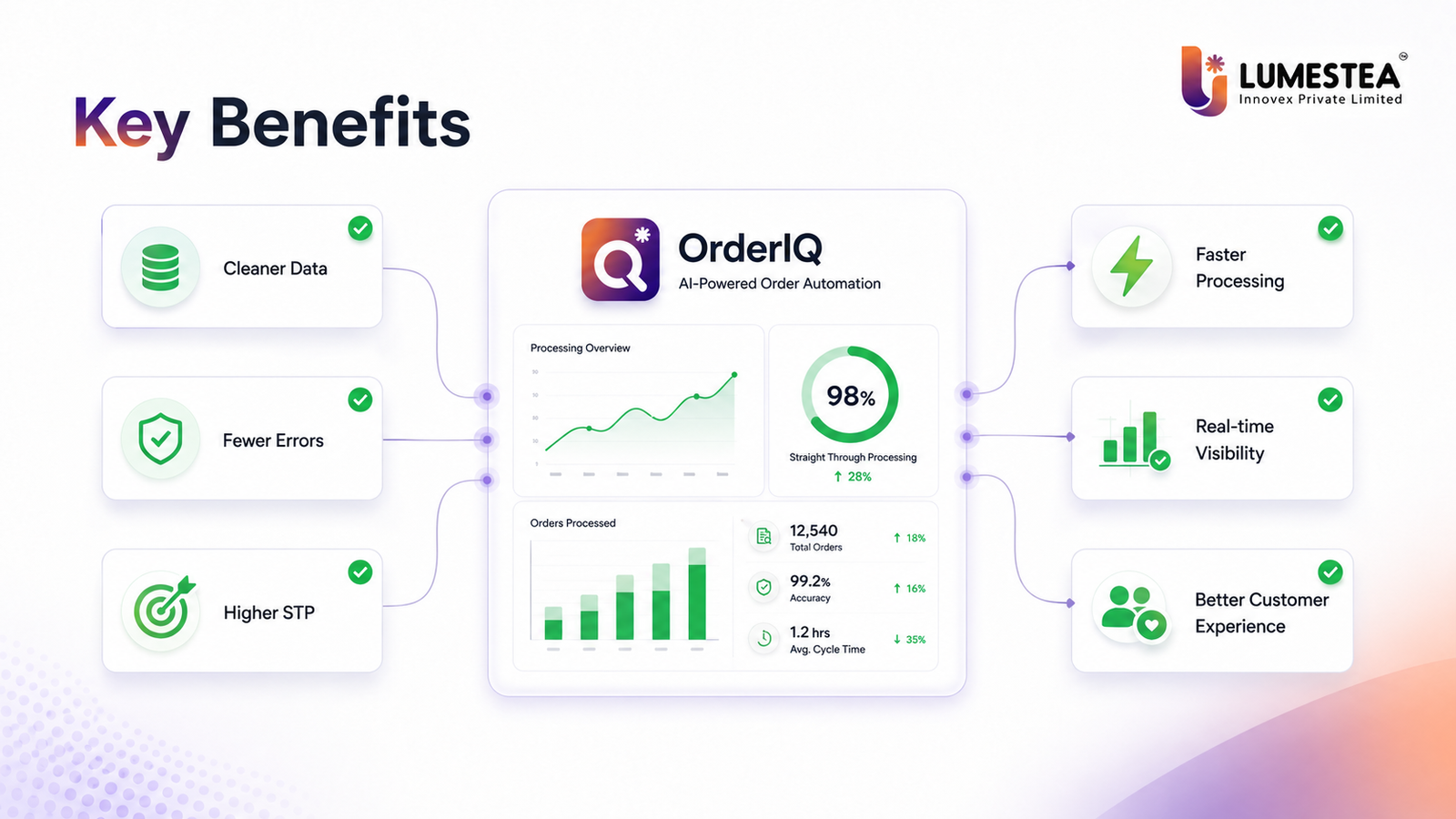
Key Benefits of AI Order Processing
The case for AI order processing tends to be made with a handful of headline stats — faster, cheaper, fewer errors — and those are real. But the benefits worth understanding go deeper than a percentage improvement on any single metric. Here’s a fuller picture of what changes across a business once order processing moves from manual to AI-driven.
Speed: Orders Move at the Speed of Arrival, Not the Speed of Staffing
When order processing depends on people, it’s gated by working hours, headcount, and queue depth. An AI order processing agent processes an order the moment it arrives — nights, weekends, and peak-season spikes included — without the cost of overtime or temporary staffing. Businesses that automate order entry commonly report cycle-time reductions from a multi-day process down to a matter of hours, sometimes minutes, for the majority of standard orders (Nanonets, 2025).
Accuracy: Fewer Errors, Caught Earlier
Because every field is validated against live systems of record before it’s committed, the errors that traditionally surface downstream — the wrong SKU shipped, the price that didn’t match a contract, the delivery date the warehouse can’t actually hit — get caught at the point of entry instead of after the fact. Businesses combining document automation with validation have reported cutting order errors by roughly half and reducing manual touches on order entry by around 85%, with the large majority of transactions requiring no manual handling at all (Conexiom, 2026).
Scalability Without Proportional Headcount
Perhaps the most strategically important benefit: order volume and headcount stop being linked. A business that doubles its order volume through a new sales channel, a new market, or a strong quarter doesn’t need to double its order processing team — the AI agent absorbs the additional volume, and the team’s time goes to the exceptions and relationships that actually need a person.
Cost Reduction
Combining faster cycle times, fewer errors, and reduced headcount pressure, the total cost impact tends to be substantial. Reported outcomes across sales-order and business-process automation initiatives commonly land in the 50–70% cost-reduction range for the automated portion of the workflow, with many organizations recovering their investment within the first 12 months (Apollo, 2026; ThinkAutomation, 2026).
A Better Job for the People Who Used to Do This Manually
This benefit gets less airtime than it deserves. Order entry is not, for most people, engaging work — it’s repetitive, detail-obsessive, and unforgiving of the smallest lapse in attention. Moving that work to an AI agent doesn’t eliminate the need for skilled operations staff; it frees them to do the parts of the job that actually require judgment: handling a genuinely unusual order, managing a difficult customer situation, improving the process itself. Businesses that automate repetitive back-office work consistently report meaningfully higher job satisfaction on the affected teams, alongside the operational gains (ThinkAutomation, 2026).
Better Customer Experience
Faster, more accurate order processing shows up directly in the customer relationship: fewer “where is my order” calls, fewer wrong shipments, faster confirmation, and — for B2B accounts — the ability to place complex orders however is most convenient for them (a scanned PO, a quick email, a portal) without being pushed into a rigid format just so it can be automated on your end.
Real-Time Visibility for Leadership
Because every order passes through a system that logs its status, confidence level, and any exceptions, operations leaders get a live, accurate view of order flow — not a snapshot reconstructed from spreadsheets at the end of the week. That visibility becomes the foundation for the ROI tracking covered later in this guide, and it’s one of the most consistently underrated benefits by teams before they adopt AI order processing, and one of the most consistently cited benefits after.
Industry-Specific Use Cases
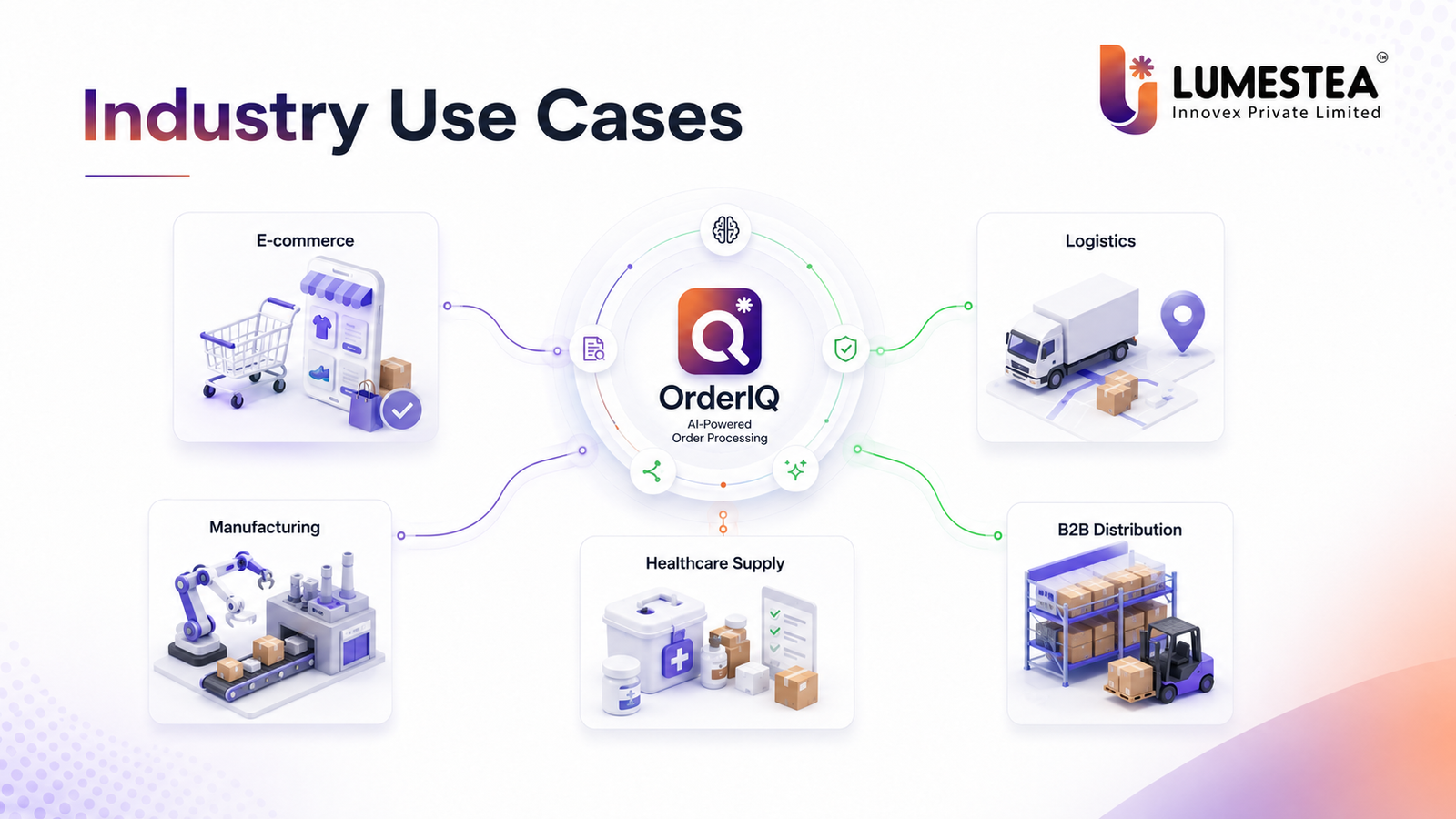
AI order processing looks different depending on what a business sells and how its customers order. Below is a walk-through of how it applies across the industries where Lumestea sees the most consistent demand.
E-Commerce and Retail
For e-commerce and retail businesses, order volume is often high and per-order value is comparatively low, which makes speed and automation rate the priority over deep customization. AI order processing in this context typically focuses on:
- Reconciling orders across multiple marketplaces and storefronts (a business selling on its own site, Amazon, and a regional marketplace needs one unified order view, not three).
- Handling split shipments and partial fulfillment automatically when a single order needs to ship from multiple warehouses.
- Managing high-volume promotional spikes — Black Friday, festival sales, flash discounts — without the order queue backing up.
- Catching pricing or discount-code errors before they reach fulfillment, which matters enormously at retail volume where even a small error rate becomes a large absolute number of affected orders.
Because retail and e-commerce order data is closely tied to inventory and demand patterns, AI order processing here often pairs naturally with the kind of predictive inventory and demand modeling covered in our earlier piece on machine learning in e-commerce.
Logistics, Distribution, and Supply Chain
For logistics and supply chain businesses, order processing is inseparable from shipment visibility, carrier coordination, and proof-of-delivery — the order isn’t “done” when it’s entered, it’s done when it’s delivered and confirmed. AI order processing in this space typically extends into:
- Extracting and validating purchase orders that arrive through highly inconsistent formats — a persistent reality across freight, distribution, and 3PL relationships, where large customers dictate their own document formats.
- Coordinating with transportation management systems to schedule shipments the moment an order is validated, rather than waiting for a batch cutoff.
- Flagging exceptions that affect delivery commitments — an inventory shortfall, a carrier capacity constraint — early enough that customer service can proactively communicate rather than react to a complaint.
- Feeding clean, validated order data into route planning and warehouse workflows, reducing the downstream errors that come from bad data entering a WMS.
This is closely related to the work we cover in our logistics software development guide, and it’s the space where our own case study spotlight, below, comes from.
Manufacturing and Wholesale Distribution
Manufacturers and wholesale distributors deal with some of the most document-heavy order processing of any industry — purchase orders with dozens or hundreds of line items, part numbers, specifications, and delivery schedules, often negotiated over email before a final PO is issued. Here, AI order processing focuses on:
- Extracting complex, multi-line orders accurately, including part numbers and specification notes that determine whether a build is correct.
- Matching incoming orders against long-term supply agreements and negotiated pricing, which is common in B2B manufacturing relationships.
- Reducing the mismatched-build risk that comes from manual transcription errors on technical specifications — a mistake here is far more expensive to correct than in retail, since it can mean scrapped materials or a missed production slot.
- Supporting EDI-heavy customer relationships alongside email and portal orders from smaller accounts, without maintaining two entirely separate workflows.
Healthcare Supply and Medical Distribution
Order processing in healthcare supply chains carries the added weight of regulatory compliance — lot number tracking, expiration date validation, and strict rules around substitutions. AI order processing supports this by:
- Validating regulated fields (lot numbers, expiration windows, controlled-substance flags) automatically rather than relying on a person to remember every rule.
- Flagging compliance-relevant exceptions clearly, rather than silently processing or silently dropping them.
- Reducing the transcription risk on orders where a data entry mistake could mean a compliance issue, not just a shipping error.
Fintech, Subscription, and Recurring Billing Contexts
For subscription businesses and fintech platforms, “order processing” often means managing changes to an existing order — upgrades, downgrades, add-ons, and renewals — rather than one-off purchase orders. AI order processing agents in this context are typically tuned to:
- Interpret change requests submitted via support tickets or email (“please add 10 more seats to our plan”) and translate them into structured account changes.
- Validate changes against contract terms and billing rules before they’re applied, preventing billing disputes downstream.
- Coordinate with CRM and billing systems so that account, support, and finance teams all see the same updated state immediately.
Enterprise and B2B SaaS Procurement
Enterprise buyers frequently place orders through procurement processes that don’t match any vendor’s ideal format — a signed PDF quote, a procurement portal submission, or a negotiated master agreement referenced by a purchase order number. For enterprise-scale organizations, AI order processing typically needs to:
- Reconcile a purchase order against a previously negotiated quote or master service agreement, rather than treating every order as a fresh transaction.
- Route large or unusual orders through the right internal approval chain automatically, based on value thresholds or account tier.
- Integrate with the complex, often bespoke ERP and CRM environments common at enterprise scale — which is where the system and cloud integration work behind an AI order processing rollout tends to be most involved.
The Common Thread
Across every industry above, the specific fields and rules differ, but the underlying pattern is the same: orders arrive in inconsistent formats, need to be checked against business-specific logic, and need to update several systems consistently. That’s precisely why AI order processing agents are built as configurable platforms rather than industry-specific point solutions — the extraction and reasoning engine stays constant, while the validation rules and integrations adapt to the business.
Case Spotlight: Visibility and Exception Handling in Logistics
Order processing and shipment visibility tend to be discussed as separate problems, but in logistics and courier operations, they’re really one problem viewed from two ends of the same workflow. Lumestea’s work with TrackingTech, a logistics and courier technology client, illustrates the connection well.
The engagement centered on unifying shipment visibility, driver workflows, warehouse validations, and proof-of-delivery into a single operational view — so that courier and dispatch teams could see, in one place, where every shipment stood, catch validation issues at the warehouse before a shipment went out, and confirm delivery without chasing paperwork after the fact (Lumestea case study).
The relevance to AI order processing is direct: the same principle that makes shipment tracking useful — replacing scattered, delayed status updates with a single, real-time, validated view — is exactly what an AI order processing agent does further upstream, at the point an order first enters the business. An operation that can’t see its orders clearly at intake tends to struggle to see its shipments clearly downstream, because bad or incomplete data at the start of the chain propagates every stage that follows. Businesses evaluating AI order processing alongside logistics visibility tools should treat them as one connected investment, not two — the cleaner the order data going in, the more useful every system built on top of it becomes, from warehouse validation through to final delivery confirmation.
AI Order Processing and the Order-to-Cash Cycle
Order processing doesn’t exist in isolation — it’s the opening stage of the broader order-to-cash (O2C) cycle: the full sequence from an order being placed to the business actually collecting payment for it. Evaluating AI order processing purely on its own merits understates its value, because errors and delays introduced at the order entry stage don’t stay contained there — they ripple through every stage that follows.
How Order Processing Errors Propagate Downstream
A pricing mismatch missed at order entry becomes a billing dispute at invoicing. A wrong quantity becomes a mis-shipped item, which becomes a return, a credit memo, and a support ticket. A missed credit-hold flag becomes a collections problem weeks later. In accounts payable — the mirror-image process on the buying side — the cost difference between a clean, automated transaction and one requiring manual rework is stark: top-performing teams process an invoice for a few dollars, while teams still relying on manual correction spend several times as much per transaction, largely due to errors introduced earlier in the document’s life (industry accounts-payable benchmarking cited via ThinkAutomation). The same dynamic holds on the order side: the cheapest order to process is the one that was captured correctly the first time.
Where AI Order Processing Fits in the O2C Chain
| O2C Stage | Role of AI Order Processing |
| Order capture | Multi-channel intake and structured extraction |
| Order validation | Pricing, inventory, and credit checks before commitment |
| Fulfillment | Clean, validated data feeding WMS/TMS workflows without rework |
| Invoicing | Accurate order data flows directly into billing, reducing invoice disputes |
| Collections | Fewer disputed invoices means fewer delayed payments |
Why This Matters for ERP and CRM Strategy
Because AI order processing sits at the front of this chain, it has an outsized effect on data quality across every connected system — the ERP, the CRM, the billing platform. This is part of why order processing automation is increasingly discussed alongside broader ERP modernization and AI-assisted operations strategy, a theme we explore further in our piece on ERP AI chatbots and enterprise operations. A business investing in AI-driven CRM or ERP capability without addressing order entry quality is, in effect, building better reporting on top of the same unreliable source data — which is why we typically recommend treating CRM & ERP modernization and AI order processing as a connected initiative rather than sequential, unrelated projects.
Choosing the Right AI Order Processing Solution: A Buyer’s Checklist
The AI order processing market has grown crowded enough that evaluating vendors on a feature list alone is no longer sufficient — many products look similar on paper and behave very differently in production. The following checklist reflects the questions worth asking before committing to any AI order processing agent or platform.
1. Does It Handle Your Actual Document Variety — Not a Demo Sample?
Every vendor demo works flawlessly on a clean, well-formatted sample document. The real test is your messiest real order: a poorly scanned fax, a handwritten note, an email where the order details are buried in the third paragraph. Ask to test the system against your own historical order documents, including the ugly ones, before evaluating accuracy claims.
2. How Does It Handle Uncertainty?
A system that silently guesses when it’s unsure is far more dangerous than one that flags uncertainty honestly. Ask vendors directly: what happens when confidence is low on a field? Does the order get committed anyway, or does it route for review with the specific uncertainty explained?
3. What’s the Real Integration Depth?
“Integrates with your ERP” can mean anything from a one-way data export to full bidirectional, real-time synchronization with inventory, pricing, and credit systems. Ask for specifics: does it read live inventory before validating an order, or does it work off a nightly data sync that could be a day stale?
4. Can It Explain Its Decisions?
For audit, compliance, and simple operational trust, the system should be able to show why an order was approved automatically, or why it was flagged — not just present a final status. This is especially important in regulated industries like healthcare and finance, but it matters everywhere a team needs to trust an autonomous decision enough to stop double-checking it.
5. Does Accuracy Improve With Use, or Stay Static?
Ask whether the system learns from your specific order patterns and corrections over time, or whether accuracy on day 500 looks the same as accuracy on day one. Systems built around modern language models and feedback loops should show a clear improvement curve, particularly for edge cases specific to your business.
6. How Is Security and Data Handled?
Order data often includes commercially sensitive information — pricing, customer details, contract terms. Ask where data is processed and stored, what access controls exist, and whether the vendor can meet your industry’s specific compliance requirements. This is covered in more depth in the security and compliance section below.
7. What Does Implementation Actually Require From Your Team?
Some platforms require months of rule configuration before they deliver value. Others can begin processing real orders within days, using AI to infer rules rather than requiring every rule to be manually configured up front. Ask for a realistic timeline based on comparable client environments, not a best-case estimate.
8. Can You Start Small and Expand?
The strongest implementations don’t require a full, all-at-once rollout. Look for the ability to start with a single channel or customer segment, prove out accuracy, and expand — a pattern covered in detail in the implementation roadmap that follows.
9. What Happens When Something Goes Wrong?
Ask about the vendor’s support model for production issues — not the sales team’s response time, but the actual escalation path when an order is processed incorrectly or a system integration breaks during a peak period.
10. Is Pricing Aligned With the Value You’re Getting?
Pricing models vary widely — per order processed, per seat, flat platform fee, or a hybrid. Make sure the pricing model matches how your order volume actually behaves, especially if you have highly seasonal peaks; a per-order model that seemed reasonable at average volume can become expensive during a spike, while a flat-fee model might leave you paying for capacity you don’t use most of the year.
Running through this checklist with each vendor under consideration tends to separate genuinely capable AI order processing agents from tools riding the “AI” label without the underlying architecture to back it up.
Implementation Roadmap: Rolling Out AI Order Processing
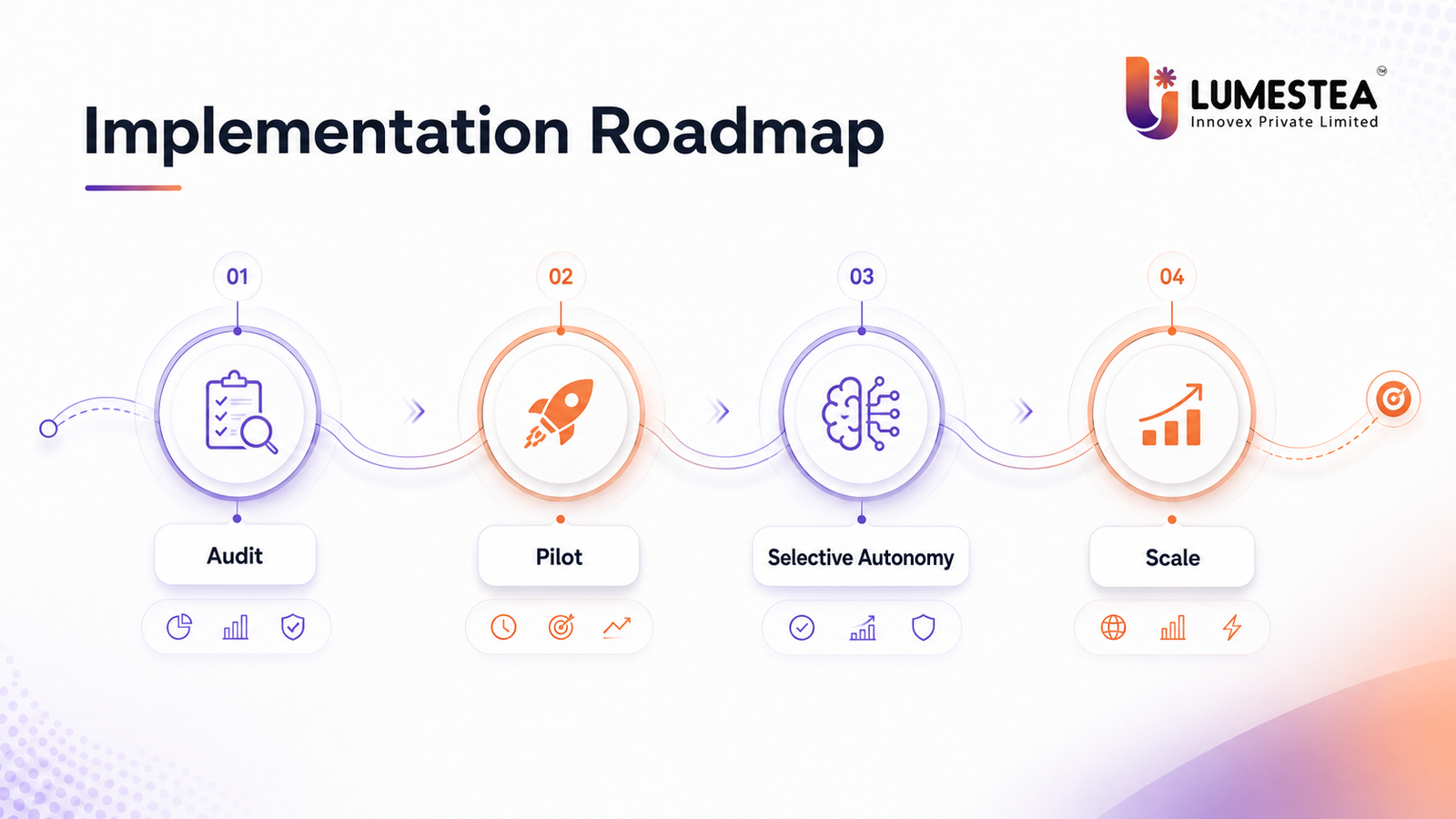
A common — and understandable — hesitation around AI order processing is the fear of a disruptive, all-or-nothing rollout that risks the order pipeline a business depends on every day. In practice, the implementations that succeed follow a deliberately incremental path. Here’s how Lumestea typically structures a rollout, and why each stage exists.
Phase 1: Audit and Baseline (Typically 1–2 Weeks)
Before any AI agent touches a live order, the goal is to understand exactly what’s happening today: what channels orders arrive through, what share of volume is already automated versus manual, where errors currently occur, and what the real cycle time looks like from order receipt to fulfillment. This baseline matters for two reasons — it identifies the highest-impact place to start, and it gives you an honest before-and-after comparison once the system is live, which becomes essential for the ROI tracking covered next.
Phase 2: Pilot on a Contained Slice of Volume (Typically 2–6 Weeks)
Rather than automating every channel at once, the pilot phase targets a specific, well-understood segment — often a single channel (like a shared order inbox) or a single customer segment with predictable order patterns. The AI agent runs in assisted mode during this phase: it processes orders and proposes actions, but a human reviews and confirms before anything is committed to production systems. This builds an accuracy track record without any risk to live operations.
Phase 3: Selective Autonomy (Typically 4–8 Weeks)
Once the pilot demonstrates consistent accuracy on the piloted segment, autonomy is extended incrementally — first for the highest-confidence order types (say, orders under a certain value from established customers), while lower-confidence or higher-risk orders continue to route for approval. This is also when integration work expands to cover the full set of downstream systems (ERP, WMS, TMS) rather than the narrower pilot scope.
Phase 4: Scale Across Channels and Segments
With autonomy proven on the initial segment, the same pattern extends to additional channels, customer segments, and order types — email, EDI, portal submissions, different product lines — each following the same assisted-then-autonomous progression, but typically moving faster than the initial pilot because the underlying integration and governance work is already in place.
Phase 5: Continuous Governance
AI order processing isn’t a “set and forget” deployment. Ongoing governance includes periodically reviewing exception patterns (are the same issues recurring, and can a rule or integration change eliminate them at the source?), auditing a sample of automated decisions for quality, and adjusting confidence thresholds as the business’s risk tolerance or order mix evolves.
A Realistic Timeline
For a mid-sized business with a moderately complex order environment, a path from kickoff to meaningful production autonomy on a first segment typically runs 8–12 weeks — not the 6-plus months sometimes associated with large ERP or automation projects, because AI order processing agents infer patterns from real order data rather than requiring every rule to be manually configured before go-live. Enterprise environments with more complex, bespoke system landscapes — the kind of environment covered in the enterprise use case earlier in this guide — typically run longer, primarily due to integration complexity rather than the AI agent itself.
What This Means for Change Management
Because autonomy is earned incrementally and visibly, teams tend to build trust in the system organically rather than being asked to trust it on faith from day one. This addresses one of the most common reasons automation initiatives stall — not technical failure, but a team that never fully trusted the system enough to stop double-checking its work, a challenge covered in more depth next.
Common Challenges and How to Overcome Them
AI order processing delivers strong, well-documented returns, but implementations do run into predictable friction points. Naming them honestly — and how they’re addressed — matters more than another list of benefits.
Challenge 1: Inconsistent Historical Data Quality
Many businesses discover, once they start measuring order data closely, that their existing systems already contain inconsistencies — duplicate customer records, outdated pricing tables, SKUs that were renamed without updating every reference. An AI order processing agent validates against these systems of record, so it will surface these inconsistencies quickly, sometimes uncomfortably so.
How it’s addressed: Treat this as a valuable side effect, not a blocker. The audit phase of implementation is specifically designed to surface these issues before go-live, and cleaning up the highest-impact data problems (the ones actually affecting order accuracy) tends to have a positive payoff independent of the AI project itself.
Challenge 2: Change Management and Team Trust
Operations teams that have handled order entry manually for years — often building deep, informal expertise about which customers tend to make which kinds of mistakes — can be understandably skeptical of a system taking over that judgment. This isn’t resistance to change for its own sake; it’s a reasonable response to being asked to trust an opaque system with a process they understand intimately.
How it’s addressed: The phased, assisted-then-autonomous rollout described earlier exists largely for this reason. When a team can see the AI agent’s proposed actions before anything is committed, watch its accuracy build over weeks, and retain the ability to override it, trust tends to follow naturally. Involving the team that currently handles order entry in defining the validation rules and reviewing early exceptions also converts them from skeptics into the system’s most effective quality-control layer.
Challenge 3: Integration Complexity With Legacy Systems
Not every ERP or OMS in production today has a modern API. Some older or heavily customized systems require more creative integration approaches — batch file exchanges, database-level integration, or middleware — which adds time and complexity to implementation.
How it’s addressed: This is precisely the kind of problem system and cloud integration work is built to solve, and it’s why an honest vendor conversation about integration depth (covered in the buyer’s checklist) matters more than a feature list. In some cases, legacy system limitations are also a signal that broader modernization is overdue — a topic explored in our piece on why software product engineering projects fail, much of which traces back to underestimating integration and legacy-system complexity early in a project.
Challenge 4: Governance and Oversight at Scale
As covered in industry adoption research, a significant share of organizations deploying AI agents broadly still lack mature governance practices for them — visibility into what agents are doing, clear ownership, and consistent audit trails. Order processing is a lower-risk domain than some agentic AI use cases (it’s bounded, rule-governed, and every action is checkable against a system of record), but governance discipline still matters.
How it’s addressed: Building in the review dashboard, confidence-threshold controls, and audit logging described in the Lumestea OrderIQ architecture from day one — rather than retrofitting oversight after a problem occurs — keeps governance proportional to risk without slowing down the parts of the workflow that don’t need it.
Challenge 5: Unrealistic Expectations About Timeline and Scope
Some organizations expect a “flip the switch” transformation where 100% of order volume is automated within weeks. When that doesn’t happen immediately for the messiest 10% of edge cases, it can feel like the project underdelivered — even when it’s performing exactly as designed.
How it’s addressed: Setting expectations against a realistic straight-through-processing curve from the start — starting around 60–70% automation on well-understood segments and climbing over months as the system learns — avoids the disappointment that comes from comparing reality to an unrealistic “fully automated on day one” benchmark that no serious AI order processing deployment actually achieves, or should aim for.
Measuring ROI: What to Track Before and After
The businesses that get the clearest read on AI order processing ROI are the ones that measure the right baseline before implementation, not just outcomes after. Here’s the metric set worth tracking.
Core Metrics to Baseline Before Go-Live
- Straight-through processing (STP) rate — the percentage of orders that currently move from receipt to fulfillment-ready without any manual touch.
- Average order cycle time — from the moment an order is received to the moment it’s confirmed in your OMS/ERP, broken out by channel if possible.
- Order error rate — tracked specifically, not estimated; pull a sample of orders from the last quarter and count actual discrepancies between what was ordered and what was fulfilled or invoiced.
- Cost per order processed — fully loaded, including the labor time spent on entry, correction, and related customer service contact.
- Peak-period performance — how cycle time and error rate change during your highest-volume periods compared to normal volume; this gap is often where the strongest ROI case lives.
Metrics to Track Post-Implementation
- STP rate over time — this should show a clear upward trend as the system learns, not just a one-time jump.
- Exception volume and resolution time — how many orders are genuinely escalated, and how quickly they’re resolved once flagged.
- Error rate on automated vs. manually-reviewed orders — a useful sanity check that automated processing isn’t quietly trading speed for accuracy.
- Customer-facing metrics — order confirmation speed, delivery accuracy, and any reduction in order-related support tickets.
- Team time reallocation — how the operations team’s time shifts from data entry toward higher-value exception handling and customer service.
A Simple ROI Framework
At the simplest level, the return on an AI order processing investment can be framed as:
ROI (%) = ((Annual Savings from Automation − Total Implementation and Ongoing Cost) ÷ Total Implementation and Ongoing Cost) × 100
Annual savings should combine labor cost reduction, error-related cost avoidance (returns, credits, expedited freight), and — where measurable — revenue impact from faster order-to-cash cycles and improved customer retention. Businesses across sectors adopting comparable automation have reported first-year ROI in the 200%+ range when the rollout is scoped well and measured honestly against a clear baseline (ThinkAutomation, 2026)
The Metric That Matters Most Long-Term
Of everything above, STP rate trend is the single most useful ongoing metric, because it captures the compounding nature of AI order processing that a one-time cost comparison misses. A system climbing from 60% to 85% straight-through processing over six months isn’t just delivering a static return — it’s delivering an accelerating one, which is the clearest signal that the underlying learning loop, not just the initial automation, is doing its job.
Security, Compliance, and Data Governance
Order data sits close to the financial core of a business — pricing, contract terms, customer information, and payment-adjacent details all pass through it. Any AI order processing deployment needs a security and governance posture that matches that sensitivity, not an afterthought bolted on once the system is already live.
Data Handling and Access Control
An AI order processing agent should operate on the principle of least privilege — accessing only the systems and data fields it genuinely needs to validate and process an order, with every access logged. Role-based access controls should govern who on the human side can view exception queues, override decisions, or adjust confidence thresholds, mirroring the access discipline already applied to your ERP and CRM systems.
Encryption and Data Residency
Order data should be encrypted both in transit and at rest, and businesses operating in regulated regions or industries need clarity on where data is actually processed and stored — a question worth asking directly of any vendor, since “cloud-based” alone doesn’t answer it.
Auditability
Every automated decision — what was extracted, what confidence score it carried, what validation checks it passed or failed, and what action was taken — should be logged in a way that can be reconstructed later. This matters for internal quality control, for resolving customer disputes, and for regulatory audits in industries like healthcare and finance where order records may need to be produced on request.
Industry-Specific Compliance
Compliance requirements vary meaningfully by sector:
- Healthcare supply chains need lot-tracking, expiration validation, and controlled-substance handling to meet regulatory standards.
- Financial services and fintech need order and transaction records to satisfy audit and reporting obligations.
- Any business handling EU or similarly regulated customer data needs the underlying platform to support data protection requirements around storage, access, and deletion.
The Governance Gap Worth Watching
Broader research into agentic AI adoption has found that governance maturity often lags deployment speed — with a meaningful share of organizations running AI agents in production without full visibility into what those agents are doing across connected systems (Digital Applied, 2026). Order processing is a comparatively lower-risk agentic use case than open-ended agents with broad system access — its actions are bounded, checkable, and tied to clear business rules — but that’s a reason to maintain discipline, not to skip it. The review dashboard, confidence thresholds, and audit logging described in Lumestea OrderIQ’s architecture exist specifically to keep this system on the right side of that governance gap from day one.
The Future of AI Order Processing
Order processing is a relatively contained, well-bounded problem compared to some of the more ambitious agentic AI use cases being discussed in 2026 — which is exactly why it’s proven to be one of the areas where AI agents are delivering the most consistent, measurable value already. Looking ahead, a few trends are worth watching.
From Reactive to Predictive Ordering
Today, most AI order processing happens after an order is placed — capturing, validating, and fulfilling what a customer has already requested. The next stage of maturity is predictive: systems that recognize a customer’s ordering pattern closely enough to proactively suggest a reorder, flag an unusual gap in an expected order cycle, or pre-validate likely order patterns before they even arrive. This shifts order processing from a purely reactive workflow toward something closer to a demand-sensing layer for the business.
Deeper Multi-Agent Orchestration
The industry-wide trend toward multi-agent systems — specialized agents collaborating under a coordination layer rather than one general-purpose model handling everything — is accelerating broadly across enterprise AI, and order processing is a natural fit for it. Expect order processing agents to increasingly coordinate directly with pricing agents, inventory-forecasting agents, and customer-service agents in real time, rather than operating as an isolated workflow.
Expanding Autonomous Decision Scope, Carefully
As trust and track records build, expect the scope of fully autonomous decisions to expand — not by removing human oversight, but by narrowing where it’s actually needed. Analysts tracking enterprise AI agent adoption broadly project autonomous decision-making to account for a meaningfully growing share of routine business decisions over the next few years (Accelirate, 2026), and order processing — being bounded, rule-governed, and highly measurable — is well positioned to be among the use cases where that expansion happens responsibly and early.
Standardization Around Agent-to-System Integration
As more enterprise software embeds AI agents by default — a trend already well underway, with industry surveys showing a sharp rise in the share of enterprise applications shipping with embedded, task-specific AI agents (Digital Applied, 2026) — the integration surface between an AI order processing agent and the ERP, OMS, and CRM systems it touches is likely to standardize further, reducing the custom integration work that currently makes up a meaningful share of implementation time and cost.
What Won’t Change
Even as the technology matures, the core principle behind a responsible AI order processing deployment isn’t likely to change: autonomy should be proportional to confidence, every decision should be explainable, and a human should always be able to see, question, and override what the system is doing. The businesses getting the most value from AI order processing today aren’t the ones chasing full autonomy for its own sake — they’re the ones using it to remove the tedious, error-prone parts of the job while keeping people firmly in charge of the judgment calls that still need them.
Why Businesses Choose Lumestea for AI Order Processing
Building an AI order processing agent that businesses can actually trust with live orders takes more than a language model wrapped around an API call. It takes an understanding of the operational systems the agent has to sit inside, the industry-specific rules that govern validation, and the integration realities of whatever ERP, OMS, or CRM a business already runs on. That combination — AI capability plus genuine systems-integration depth — is where Lumestea Innovex has focused since day one.
An AI-First Company, Not an AI Add-On
Lumestea was built around practical AI solutions for real business use cases — automation, decision support, and custom AI agents designed to solve specific operational problems, order processing among them. That focus shows up in how OrderIQ is architected: as a multi-agent system built for explainability and incremental autonomy, not a generic chatbot repositioned for a new use case.
Deep Integration Capability
An AI order processing agent is only as useful as its connection to the systems around it. Lumestea’s CRM & ERP solutions and system and cloud integration teams work directly alongside the AI implementation, which means the hardest part of most order processing projects — connecting cleanly to existing inventory, pricing, and fulfillment systems — is handled by the same team building the agent, not handed off to a separate integration vendor after the fact.
Flexible Engagement Models
Businesses come to an AI order processing project at different stages of readiness, and Lumestea’s engagement models reflect that:
- Fixed-scope delivery for businesses with a clearly defined order processing problem and a specific timeline — well suited to the phased pilot approach described in the implementation roadmap.
- Managed services for businesses that want an ongoing partner to maintain, refine, and expand their AI order processing agent as order volume and complexity grow.
- Staff augmentation for businesses with an internal team that needs additional AI, integration, or QA capacity to move faster on their own timeline.
Built for Global Teams
Lumestea works in sync with U.S. business hours and maintains fluent English-speaking project teams specifically to reduce the communication friction that often slows down cross-border technology projects — a practical detail that matters more than it might seem once a project moves from planning into daily implementation work.
Proven Across Adjacent Domains
Beyond order processing specifically, Lumestea’s work spans the operational domains that order processing connects to — logistics and supply chain platforms, e-commerce and retail systems, and enterprise-grade CRM and ERP integration — supported by a track record documented across our case studies and industry blog.
Getting Started
Most engagements begin with a short discovery conversation to understand your current order volume, channel mix, and systems landscape — the same audit described in Phase 1 of the implementation roadmap — before any commitment to a full build. If you’re evaluating AI order processing for your business, you can book a 30-minute call or reach out through our contact page to start that conversation.
The Technology Stack Behind AI Order Processing
For technical decision-makers, it’s worth opening up what actually runs underneath an AI order processing agent — because the specific technologies involved determine both what the system can handle and how it should be evaluated.
Document and Text Understanding Layer
- OCR (optical character recognition) converts scanned images and PDFs into machine-readable text. Modern OCR engines used in order processing are layout-aware, meaning they understand tables, multi-column layouts, and form structures, not just raw text.
- NLP (natural language processing) interprets the meaning of that text — distinguishing a purchase order from a casual email, identifying which sentence describes a quantity change versus a delivery instruction.
- Large language models (LLMs) provide the reasoning layer on top of extraction: resolving ambiguous references (“the usual order,” “item 12”), inferring likely intent from incomplete information, and generating human-readable explanations of what the system found and why.
Data Matching and Validation Layer
- Entity resolution and fuzzy matching connect a customer’s own product names or abbreviations (“the 12mm blue connectors”) to your actual SKU catalog, even when the wording doesn’t exactly match your system’s naming conventions.
- Business rules engines encode the specific, often idiosyncratic logic every business runs on — customer-specific pricing tiers, minimum order quantities, credit hold policies — and sit alongside the AI reasoning layer rather than being replaced by it. AI order processing doesn’t eliminate business rules; it applies them far more consistently and to a much wider range of input formats than a person or a rigid script can.
- Confidence scoring models attach a numeric certainty level to every extracted field and every validation decision, which is what allows the orchestration layer to decide, order by order, whether to proceed automatically or escalate.
Integration and Orchestration Layer
- APIs provide real-time, bidirectional connections to modern ERP, OMS, WMS, TMS, and CRM platforms.
- EDI (Electronic Data Interchange) handles structured transaction sets (850 purchase orders, 855 order acknowledgments, 856 advance ship notices, 810 invoices) still widely used in B2B, distribution, and logistics relationships.
- Middleware and integration platforms bridge older systems that don’t expose modern APIs, translating between legacy formats and the AI agent’s internal data model.
- Orchestration logic — the coordination layer described earlier in Lumestea OrderIQ’s architecture — ties these pieces together, sequencing extraction, validation, and system updates as a single coherent workflow rather than disconnected steps.
Why the Stack Matters to a Buyer, Not Just an Engineer
Understanding this stack helps translate vendor marketing into real capability assessments. A vendor claiming “AI-powered” order processing that turns out to rely purely on OCR with no language-model reasoning layer will struggle with anything beyond clean, templated documents. A system with strong extraction but a thin business-rules and integration layer will read orders accurately but still require significant manual work to actually act on them. The strongest AI order processing platforms invest visibly across all three layers — understanding, validation, and integration — because weakness in any one of them limits what the whole system can safely automate, a point closely tied to the buyer’s checklist covered earlier in this guide.
Build vs. Buy: Custom AI Order Processing Agent or Off-the-Shelf Software?
One of the most consequential early decisions in adopting AI order processing is whether to license an existing platform or commission a custom-built agent tailored to your specific systems and rules. Both paths are viable, and the right answer depends on a handful of concrete factors.
The Case for an Off-the-Shelf Platform
Pre-built AI order processing software makes sense when:
- Your order formats and business rules are relatively standard for your industry, without highly unusual edge cases.
- You need to move quickly and can’t wait for a custom build’s discovery and development timeline.
- Your integration needs are limited to common, well-supported platforms the vendor already connects to out of the box.
- You’d rather pay a predictable subscription than carry ongoing internal ownership of a custom system.
The tradeoff is flexibility: off-the-shelf platforms are built to serve many customers at once, which means their validation logic and integration options are necessarily more generic than what a custom build can offer, and deep customization requests often move at the vendor’s product roadmap pace rather than yours.
The Case for a Custom-Built AI Order Processing Agent
A custom agent tends to make more sense when:
- Your business rules are genuinely unusual — complex contract-based pricing, industry-specific compliance requirements, or order logic that doesn’t map cleanly to a generic platform’s configuration options.
- Your systems landscape includes legacy or heavily customized ERP/OMS platforms that off-the-shelf connectors don’t support well.
- Order processing is a genuine competitive differentiator for your business (common in logistics, distribution, and specialized manufacturing), where owning and controlling the system’s behavior has strategic value beyond the immediate cost savings.
- You want the system’s learning and improvement to compound specifically around your own order patterns and customer base, rather than a generic model trained across many unrelated businesses.
The tradeoff here is upfront investment and timeline: a custom build requires the discovery, architecture, and integration work described in the implementation roadmap, rather than a shorter off-the-shelf onboarding process.
A Middle Path: Configurable Platforms With Custom Integration
In practice, many of the strongest deployments — including how Lumestea typically approaches OrderIQ engagements — land between these two extremes: a configurable core platform (the extraction, reasoning, and orchestration engine) paired with custom-built validation rules and integration work specific to the client’s systems. This captures much of the speed advantage of a pre-built platform while still delivering the tailored accuracy and deep integration of a custom build, particularly for the industry-specific use cases covered earlier — logistics, manufacturing, and enterprise environments especially, where generic, one-size-fits-all configuration tends to underperform.
Questions to Decide Which Path Fits
- How standard versus unusual are our order formats and business rules, honestly?
- How legacy or customized is our current ERP/OMS/CRM environment?
- Is order processing accuracy a genuine competitive differentiator, or purely a cost center to optimize?
- What’s our realistic tolerance for a longer initial build timeline in exchange for deeper long-term fit?
AI Order Processing by Business Size
The right approach to AI order processing looks different depending on the scale and complexity of the business adopting it. It’s worth separating expectations by size rather than assuming a single playbook fits everyone.
Small and Mid-Sized Businesses (SMBs)
For SMBs — typically processing hundreds to a few thousand orders a month — the priority is usually speed to value and low integration overhead. These businesses often run a single ERP or a lightweight OMS, a handful of order channels, and a small team where even one or two people’s time freed from manual entry has an outsized relative impact. The right approach here tends to favor a configurable, faster-to-deploy platform over a lengthy custom build, with a pilot that can realistically go live in a matter of weeks rather than months. The ROI case is often the clearest at this scale, precisely because a small team feels the cost of manual order entry more acutely than a large one that can absorb inefficiency across more headcount.
Mid-Market Businesses
Mid-market companies — often processing thousands to tens of thousands of orders monthly across multiple channels, sometimes with a mix of B2B and B2C order flows — tend to have outgrown simple automation but aren’t yet running the highly bespoke, multi-system environments common at enterprise scale. This is frequently the sweet spot for the “configurable platform plus custom integration” middle path described in the build vs. buy section above: enough complexity to benefit from tailored validation rules and integration work, but not so much bespoke infrastructure that a fully custom build is the only viable option.
Enterprise Organizations
Enterprise environments bring genuine complexity: multiple ERPs across business units or regions, high order volumes with strict SLAs, complex approval hierarchies, and often regulatory requirements layered on top. For these organizations, the system and cloud integration work tends to be the largest share of total implementation effort — not because the AI reasoning itself is harder, but because connecting cleanly and securely to a large, heterogeneous systems landscape takes real engineering time. Enterprise rollouts also tend to place more weight on the governance and audit capabilities covered earlier, since more stakeholders —
The Common Denominator
Regardless of size, the same core principle holds across every tier: start with an honest baseline, pilot on a contained slice of volume, and expand autonomy as accuracy proves itself. What changes with scale is mainly the integration complexity and governance weight — not the fundamental soundness of a phased, evidence-based rollout.
A Sample 90-Day Rollout Timeline
To make the implementation roadmap more concrete, here’s what a representative 90-day rollout for a mid-sized business might look like in practice.
| Timeframe | Focus | Key Activities |
| Weeks 1–2 | Audit and baseline | Map order channels and volume, measure current STP rate, error rate, and cycle time; identify highest-impact starting segment |
| Weeks 3–4 | Environment setup | Connect the AI agent to a sandbox or limited-scope instance of the relevant ERP/OMS; configure initial business rules and validation logic |
| Weeks 5–8 | Assisted-mode pilot | Run the system on live orders from the chosen segment in assisted mode; human reviewers confirm every proposed action; accuracy and confidence patterns are tracked closely |
| Weeks 9–10 | Threshold tuning | Analyze pilot results; set initial confidence thresholds for autonomous processing based on demonstrated accuracy on specific order types |
| Weeks 11–12 | Selective go-live | Grant autonomy for the highest-confidence order types within the pilot segment; continue human review for everything else; begin tracking live STP rate and exception volume |
| Ongoing (Month 4+) | Expansion | Extend the same assisted-then-autonomous pattern to additional channels and segments; begin the continuous governance cadence of periodic review |
This timeline compresses considerably for simpler environments (a single ERP, standardized order formats) and extends for more complex ones (multiple legacy systems, heavy customization, strict regulatory review requirements) — but the sequence of audit, assisted pilot, selective autonomy, and expansion holds regardless of how long each stage takes for a specific business.
The Vendor Landscape: Categories of AI Order Processing Tools
Businesses evaluating AI order processing in 2026 will typically encounter three broad categories of providers, each with a different origin point and set of strengths.
ERP-Native Automation Modules
Many major ERP platforms now offer their own order automation add-ons or modules, often marketed with AI-related branding. These tend to integrate very tightly with that specific ERP’s data model, which is a genuine advantage if a business runs entirely on one platform. The tradeoff is usually flexibility outside that ecosystem — handling channels, formats, or business logic the ERP vendor didn’t anticipate can be more limited than with a purpose-built, ERP-agnostic solution.
Intelligent Document Processing (IDP) Platforms Extended Into Order Workflows
A number of vendors originally built for general document automation — invoices, contracts, forms — have extended their platforms specifically into order processing. These tend to have strong document extraction and OCR capabilities, given their document-processing origins, but the depth of order-specific business logic (pricing validation, inventory checks, order-specific exception handling) varies significantly from vendor to vendor, since it wasn’t necessarily the platform’s original focus.
Purpose-Built AI Order Processing Agents
The category this guide has focused on — agentic AI systems designed specifically around the order lifecycle, combining document understanding, business-rule validation, and system orchestration as a unified workflow rather than a general-purpose tool applied to a new use case. Lumestea’s OrderIQ falls into this category, along with a growing number of agentic AI vendors entering the space through 2026 as multi-agent architectures mature.
How to Choose Between Categories
The right category depends heavily on your existing systems landscape and how standard or unusual your order logic is:
- If you run a single, modern ERP and your order logic is fairly standard for your industry, an ERP-native module may offer the fastest path with the least integration risk.
- If your primary pain point is document variety and volume (scans, PDFs, emails) more than complex business-rule validation, an IDP-based platform extended into order workflows may be sufficient.
- If your order logic is genuinely complex, your systems landscape spans multiple platforms, or order processing accuracy is a real competitive differentiator, a purpose-built AI order processing agent — whether licensed or custom-built, as covered in the build vs. buy section — tends to deliver the deepest, most durable fit.
Whichever category a business leans toward, the evaluation criteria in the buyer’s checklist apply equally — document variety handling, uncertainty management, integration depth, explainability, security, and realistic implementation timelines matter regardless of which category a given vendor falls into.
Signs Your Business Is Ready for AI Order Processing
Not every business needs to act on this immediately, and not every business is equally ready to get value from it on day one. The checklist below is a useful gut-check — the more of these that sound familiar, the stronger the case for moving forward now rather than later.
- Your team regularly re-types the same information from an email or PDF into your OMS or ERP. If this happens daily, it’s a strong candidate for automation.
- Order volume spikes seasonally, and your current process visibly strains during peaks. This is often where the ROI case is easiest to see and quantify.
- You’ve had at least one costly order error in the last quarter — a wrong shipment, a pricing mismatch, a missed delivery commitment — that traced back to manual data entry.
- Your existing rule-based automation has plateaued, handling a consistent chunk of volume but leaving a large, stubborn manual remainder that hasn’t moved in months or years despite configuration effort.
- Your ERP or OMS data quality suffers because different people enter similar orders slightly differently. Inconsistent human judgment is exactly the kind of variability AI order processing is built to standardize.
- You can’t currently answer, with confidence, what your straight-through processing rate actually is. If nobody can answer this question quickly, it’s usually a sign the process hasn’t been measured closely enough to know where the opportunity is — which is itself worth fixing, as covered in the ROI section of this guide
If several of these resonate, the next reasonable step isn’t necessarily a full commitment — it’s the audit and baseline described in Phase 1 of the implementation roadmap, which turns a general sense that “this is a problem” into a specific, measurable business case.
Common Myths About AI Order Processing, Debunked
Misconceptions about AI order processing tend to fall into a few recurring patterns. Addressing them directly helps set realistic expectations before a project begins.
Myth: “AI order processing means no human ever looks at an order again.”
Reality: Even mature deployments keep humans firmly in the loop for genuine exceptions, high-value orders, and periodic quality audits. The goal is removing repetitive manual entry on high-confidence, routine orders — not eliminating human oversight of the process entirely. As covered in the implementation roadmap, autonomy expands gradually and stays proportional to demonstrated accuracy.
Myth: “It only works if all our orders come in through one clean, standard format.”
Reality: This is precisely the opposite of what makes AI order processing valuable. Rule-based automation needs standardized input; AI order processing is specifically built to handle the messy, inconsistent, real-world mix of emails, scans, and free text that most businesses actually receive, as detailed in how AI order processing works.
Myth: “It’s only for large enterprises with big IT budgets.”
Reality: While large enterprises do adopt AI order processing, mid-sized distributors, manufacturers, and e-commerce businesses are frequently where the clearest, fastest ROI shows up — often precisely because they lack the large operations teams that let bigger companies absorb manual inefficiency without feeling it as acutely.
Myth: “AI order processing will make mistakes I can’t see or explain.”
Reality: This describes poorly built systems, not the category as a whole. Well-architected AI order processing agents attach confidence scores and reasoning to every decision and maintain full audit logs — arguably making automated decisions more visible and reviewable than the informal, undocumented judgment calls a busy human team makes under time pressure. This visibility is a core design requirement covered in the security, compliance, and governance section of this guide.
Myth: “Once it’s implemented, it’s done — no further involvement needed.”
Reality: AI order processing benefits from ongoing governance: reviewing exception patterns, adjusting confidence thresholds as risk tolerance evolves, and expanding coverage to new channels or order types as the business changes. Treating it as a one-time project rather than an evolving capability tends to leave real value on the table over time.
Myth: “It’s basically the same as the automation we already have.”
Reality: As covered in detail earlier in this guide, rule-based automation and AI order processing solve genuinely different problems. Existing rule-based automation typically plateaus around 20–50% of order volume; AI order processing is built specifically to extend automation into the unstructured, inconsistent volume that rules can’t reach.
Glossary of Key Terms
- AI order processing agent — An AI-powered system that autonomously captures, extracts, validates, and acts on orders across multiple channels and formats, with minimal human intervention.
- Straight-through processing (STP) — The percentage of orders that move from receipt to fulfillment-ready status without any manual touch.
- OCR (optical character recognition) — Technology that converts scanned images or PDFs into machine-readable text.
- NLP (natural language processing) — A branch of AI focused on understanding and interpreting human language, used in order processing to determine intent and meaning from unstructured text.
- EDI (Electronic Data Interchange) — A standardized format for exchanging structured business documents (like purchase orders and invoices) directly between two companies’ systems.
- OMS (order management system) — The system of record that tracks an order’s lifecycle from creation through fulfillment.
- ERP (enterprise resource planning) — The core business software platform managing finance, inventory, procurement, and related operations
- WMS (warehouse management system) — Software that manages warehouse operations, including picking, packing, and shipping.
- TMS (transportation management system) — Software that manages shipment planning, carrier selection, and freight logistics.
- Confidence score — A numeric estimate of how certain an AI system is about a specific extracted field or decision, used to determine whether an order proceeds automatically or is escalated for review.
- Human-in-the-loop — A workflow design where an AI system proposes or drafts an action, but a human reviews and confirms it before it takes effect.
- Multi-agent system — An AI architecture in which several specialized AI agents, each responsible for a narrow task, coordinate under an orchestration layer to complete a broader workflow.
- Order-to-cash (O2C) cycle — The full business process from an order being placed through to payment being collected.
- Exception handling — The process of identifying orders or fields that fall outside normal, high-confidence processing and routing them for human review.
Frequently Asked Questions
1) What is AI order processing?
AI order processing is the use of AI agents to automatically capture, read, validate, and act on orders arriving through any channel — email, PDF, EDI, web portal, or chat — without requiring a person to manually key in the details. Unlike rule-based automation, it understands context and unstructured formats, and only escalates genuine exceptions to a human reviewer.
2) How is AI order processing different from RPA (robotic process automation)?
RPA automates repetitive clicks and keystrokes by following a fixed script — it works well when the input format never changes, and breaks when it does. AI order processing uses machine learning and language models to understand order content regardless of format, which means it keeps working when a document layout changes, a customer writes an informal email, or an order arrives in a format the system hasn’t seen configured before. RPA automates how a task is done; AI order processing automates the judgment behind deciding what to do.
3) Is AI order processing the same thing as an order management system (OMS)?
No. An OMS is the system of record that tracks an order’s lifecycle once it’s entered — inventory allocation, fulfillment status, shipping. AI order processing is the layer that gets orders into the OMS accurately and automatically in the first place, regardless of what channel or format they arrived in. The two work together: AI order processing feeds clean, validated data into the OMS rather than replacing it.
4) How much does AI order processing cost?
Pricing varies by vendor and typically depends on order volume, integration complexity, and the number of connected systems. Common pricing models include per-order processing fees, seat-based licensing, or flat platform fees, sometimes in combination. Rather than comparing sticker price alone, it’s more useful to evaluate cost against expected ROI — covered in the ROI section of this guide — since a slightly higher-cost platform with deeper integration and fewer exceptions can easily deliver better total value than a cheaper tool that still requires significant manual cleanup.
5) How long does it take to implement AI order processing?
For a mid-sized business, a typical path from kickoff to meaningful production autonomy on an initial order channel or segment runs about 8 to 12 weeks, following the phased approach described in the implementation roadmap — audit, pilot in assisted mode, selective autonomy, then scaling across additional channels. Enterprise environments with more complex or legacy systems typically take longer, primarily due to integration work rather than the AI agent’s core capability.
6) Can AI order processing integrate with my existing ERP and OMS?
Yes, in most cases. Modern AI order processing agents are built to layer on top of existing systems through APIs or EDI connections rather than replacing them — writing validated orders directly into your ERP, OMS, WMS, TMS, or CRM. The depth of that integration varies significantly by vendor, which is why it’s worth evaluating specifically, as covered in the buyer’s checklist above, particularly for older or heavily customized systems.
7) Is AI order processing secure enough for regulated industries like healthcare and finance?
A well-architected AI order processing system can meet the security and compliance requirements of regulated industries, but this depends heavily on the specific platform — encryption standards, data residency, access controls, and audit logging all need to be verified directly with the vendor rather than assumed. See the security, compliance, and data governance section of this guide for the specific questions worth asking.
8) What order formats can AI order processing handle?
A capable AI order processing agent should handle the full range of formats a business actually receives: structured EDI transactions, PDFs (both native and scanned), spreadsheets, web and portal submissions, plain-text emails, and in some implementations, voice orders transcribed in real time. The ability to handle inconsistent and unstructured formats — not just clean, templated ones — is the key differentiator from older rule-based automation, as discussed in how AI order processing works.
9) Will AI order processing replace my order processing team?
In most successful implementations, no — it changes what the team spends its time on rather than eliminating the need for them. Routine, high-confidence orders are handled automatically, while the team’s time shifts toward genuine exceptions, unusual customer situations, and process improvement — work that tends to be both higher-value and more engaging than manual data entry. Businesses that scale order volume without proportionally scaling headcount typically redeploy existing staff rather than reducing the team, since the exception volume and customer-facing work still require people.
10) What ROI can I expect from AI order processing?
Reported outcomes vary by business and implementation quality, but organizations combining AI-driven order automation with proper validation and integration have reported cutting order-related costs by 50–70%, reducing manual data entry errors by up to 88%, and achieving first-year ROI in the range of 200% or more when the rollout is scoped and measured well (Apollo, 2026; ThinkAutomation, 2026). The specific number for your business depends on current order volume, error rates, and cycle times — which is why establishing an accurate baseline before implementation, as described in the ROI section, matters more than benchmarking against any single published figure.
11) What’s the difference between OCR and AI order processing?
OCR (optical character recognition) converts a scanned document or image into machine-readable text — it solves the “can a computer read this” problem. AI order processing goes several steps further: understanding what the extracted text means (which field is a SKU versus a delivery date), validating it against business rules, deciding what action to take, and updating connected systems. OCR is typically one component inside a broader AI order processing pipeline, not a substitute for it.
12) How do I know if my business needs AI order processing?
A useful starting signal is measuring your current straight-through processing rate — the share of orders that move from receipt to fulfillment-ready without anyone manually touching them. If that number is meaningfully below 70–80%, or if order volume during peak periods regularly overwhelms your team, there’s likely a strong, measurable case for AI order processing. The real cost of manual order processing section of this guide walks through the specific costs worth quantifying before making that decision.
Conclusion
Order processing has quietly become one of the clearest, most measurable wins available to businesses adopting AI in 2026 — not because it’s the flashiest use case, but because it’s bounded, rule-governed, and directly tied to costs every operations leader already feels: labor hours, error rates, cycle times, and the ceiling those place on growth. Unlike some of the more speculative agentic AI use cases still working toward production maturity, AI order processing is already delivering documented, repeatable returns across e-commerce, logistics, manufacturing, healthcare, and enterprise procurement alike.
The path there doesn’t require betting the business on full autonomy from day one. It starts with an honest baseline of where manual effort and error currently live, a contained pilot that builds trust through visible, assisted-mode results, and a gradual expansion of autonomy as accuracy proves itself — the same pattern this guide has walked through end to end, from what AI order processing actually is through how to measure whether it’s working.
If your team is still spending hours every week re-typing orders from emails, PDFs, and spreadsheets into your OMS or ERP, that’s not a permanent operational reality — it’s a solvable problem, and one with a clear, well-trodden path to fixing it.
Lumestea builds AI order processing agents — including our own multi-agent platform, OrderIQ — designed around real integration depth, incremental autonomy, and full explainability, for businesses across e-commerce, logistics, distribution, and enterprise operations. If you’d like to talk through what AI order processing could look like for your specific order volume and systems, book a 30-minute call or get in touch with our team — we’re happy to start with an honest look at where the opportunity actually is before recommending anything.