
ERP AI Chatbots in 2026: Features, Use Cases, Benefits, and Deployment Roadmap for Smarter Enterprise Operations
ERP AI Chatbots in 2026: Features, Use Cases, Benefits, and Deployment Roadmap for Smarter Enterprise Operations
 Pushpa

Summarize with AI
Not enough time? Get the key points instantly.


Table of Contents
What Is an ERP AI Chatbot?
Why ERP AI Chatbots Matter Now
What Makes an ERP AI Chatbot Enterprise-Grade?
How ERP AI Chatbots Transform Traditional ERP Systems
Types of ERP AI Chatbots
Must-Have Features of an Enterprise ERP AI Chatbot
ERP AI Chatbot Use Cases Across Business Functions
Key Benefits of ERP AI Chatbots for Enterprises
Practical Roadmap to Deploy an ERP AI Chatbot
ERP AI Chatbot Integration Checklist
Common ERP AI Chatbot Implementation Challenges and How to Fix Them
Build vs Buy: Which ERP AI Chatbot Approach Is Better?
The Future of ERP AI Chatbots
How Lumestea Can Help Build ERP AI Chatbots
FAQs on ERP AI Chatbots
ERP systems are the operational backbone of modern businesses. They hold finance data, purchase orders, inventory records, payroll details, supply chain updates, sales information, vendor data, compliance records, and management reports. But even when an ERP system contains the right information, employees often struggle to access it quickly.
A finance manager may need to check overdue invoices. A warehouse team may need live stock availability. An HR executive may need to answer policy questions. A business leader may need a quick summary of cash flow, procurement delays, or order fulfillment performance. In many organizations, these answers are buried inside menus, reports, permissions, spreadsheets, or support requests.
This is where ERP AI chatbots are becoming valuable. An ERP AI chatbot sits on top of the ERP ecosystem and allows users to interact with business data through natural conversations. Instead of navigating complex dashboards, employees can ask questions in plain language, receive role-specific answers, and in advanced cases, complete ERP actions directly through chat.
For enterprises, the opportunity is not simply adding a chatbot. The real opportunity is turning ERP from a static system of record into a more accessible, intelligent, and action-oriented business assistant.
Planning to make your ERP easier to use? Lumestea can help you assess workflows, identify chatbot opportunities, and design a secure ERP AI assistant roadmap.
What Is an ERP AI Chatbot?
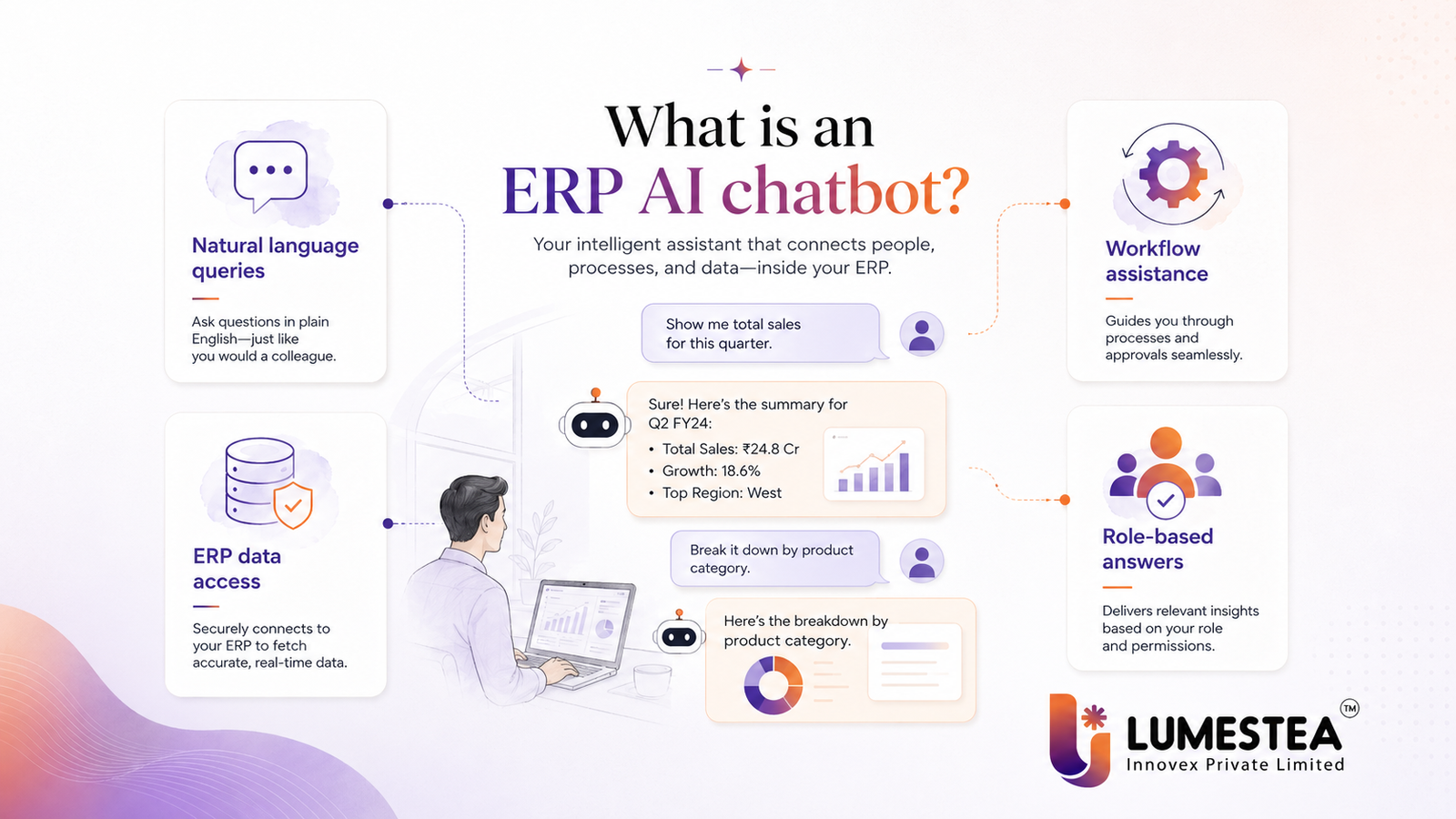
An ERP AI chatbot is an AI-powered conversational assistant that connects with an enterprise resource planning system and helps users retrieve information, understand business data, complete routine tasks, and move through ERP workflows using natural language.
In simple terms, it allows employees to talk to the ERP system instead of manually searching through multiple modules. A basic ERP chatbot may answer questions such as “What is the current stock level for Product A?” or “Show pending invoices for this vendor.” A more advanced ERP AI chatbot can process approval requests, guide multi-step workflows, summarize financial data, raise alerts, or recommend operational actions based on live ERP information.
AI-powered business systems are becoming more useful when they combine clean data, workflow context, and responsible automation.
Why ERP AI Chatbots Matter Now
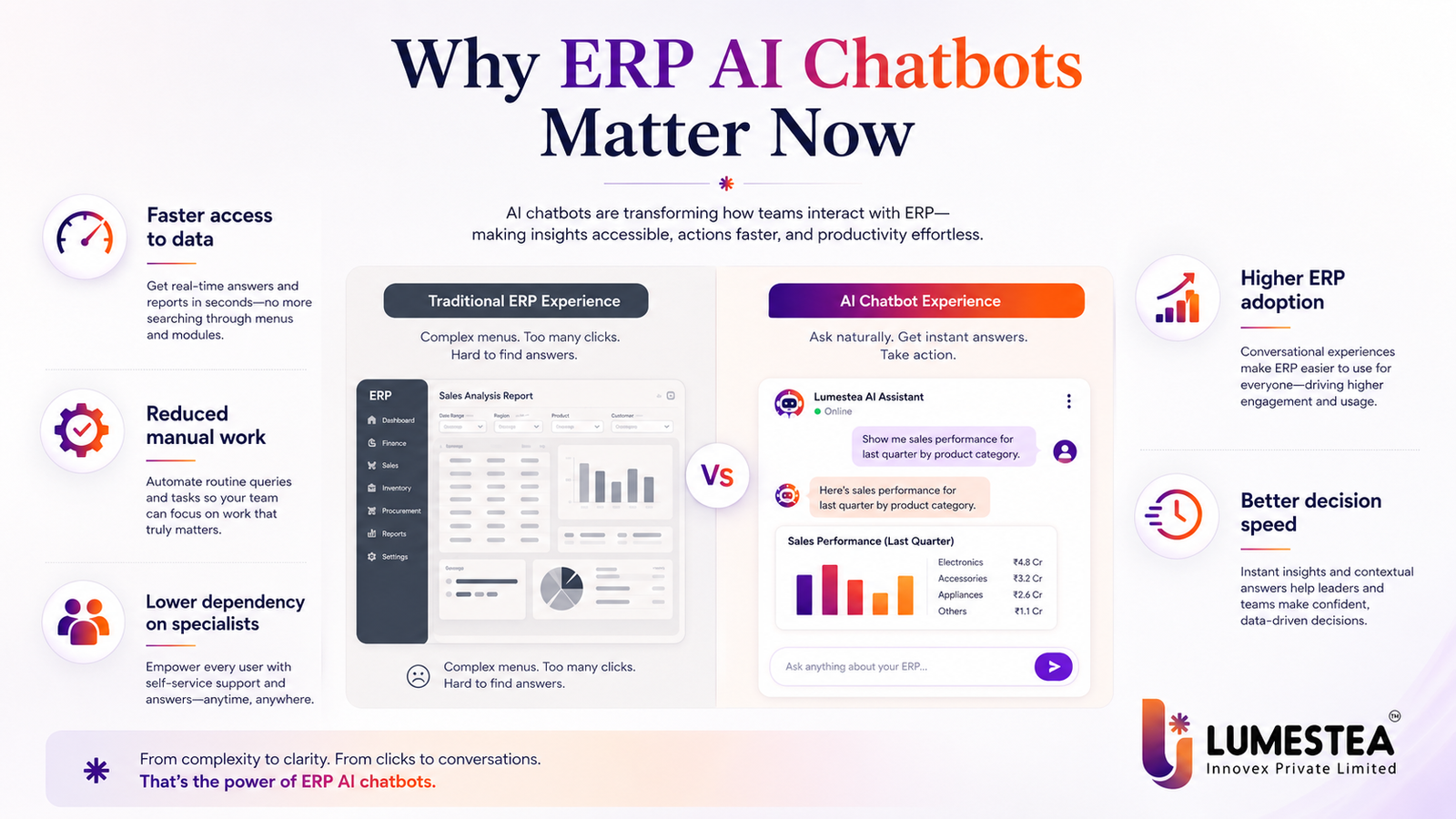
Traditional ERP systems were designed to manage business processes. They are powerful, but they are not always easy to use. Many employees rely on analysts, admin teams, ERP specialists, or manual reports to get the information they need.
That creates delays. It also increases dependency on a small group of ERP users who understand the system deeply. As businesses grow, this dependency becomes expensive and inefficient.
ERP AI chatbots solve this problem by giving employees a simpler interaction layer. Users can ask questions naturally, get answers faster, and complete repetitive tasks without moving through several screens. This improves ERP adoption because people are more likely to use systems that feel simple, helpful, and fast.
The rise of AI-enabled ERP also connects with a broader enterprise trend. Businesses are no longer satisfied with software that only stores data. They want platforms that can explain data, surface insights, support decisions, and help teams act faster.
What Makes an ERP AI Chatbot Enterprise-Grade?
Not every chatbot connected to an ERP system is enterprise-grade. A simple FAQ bot or generic AI assistant cannot safely handle procurement approvals, finance queries, payroll details, vendor data, or inventory decisions.
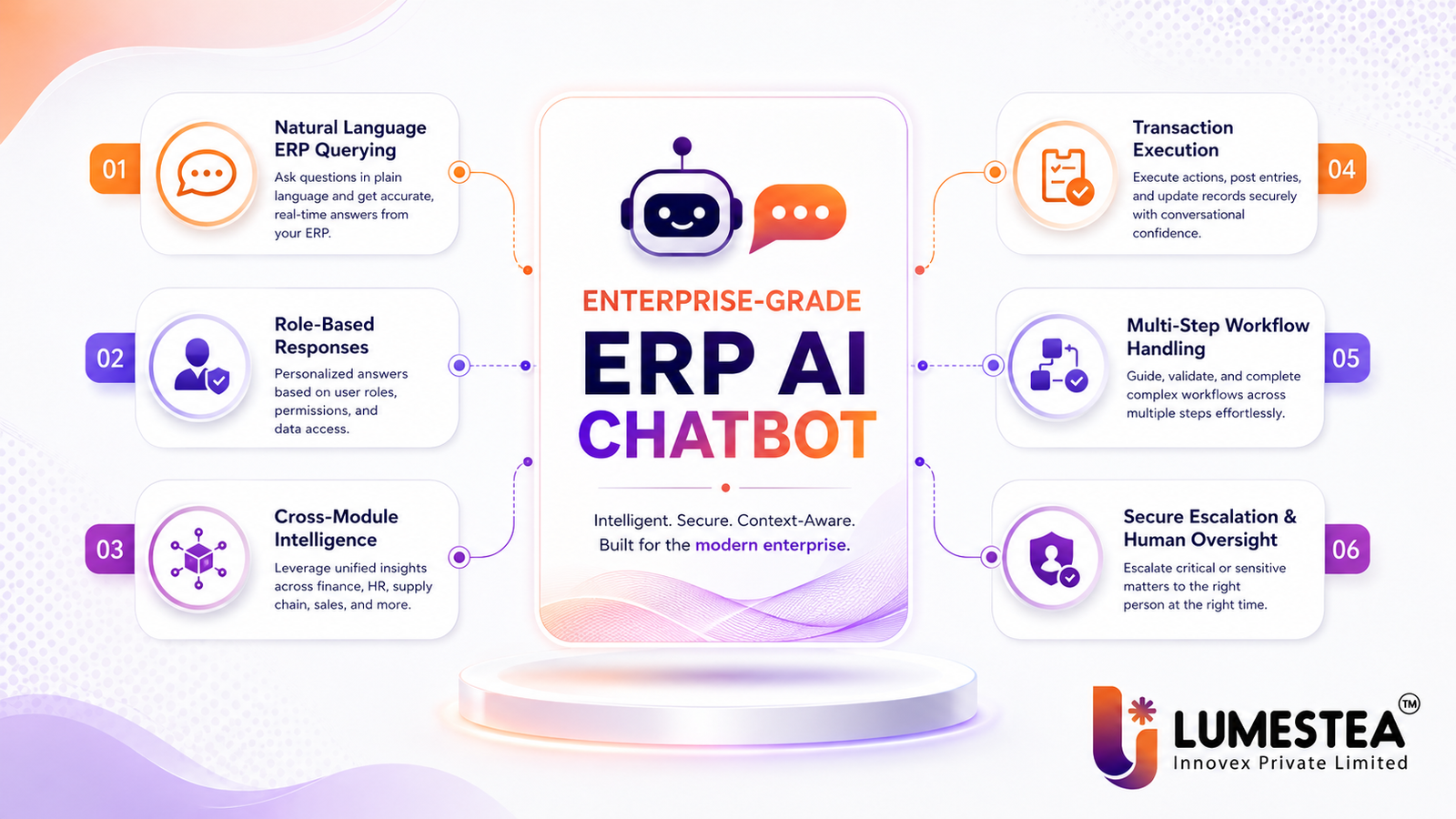
An enterprise-grade ERP AI chatbot needs business context, permission awareness, workflow understanding, data grounding, and auditability. It must understand the difference between asking for a simple stock count and requesting a business-critical transaction.
The chatbot should support natural language ERP querying, role-based responses, cross-module intelligence, transaction execution, multi-step workflow handling, and secure escalation when a query is unclear, sensitive, or outside policy.
For AI governance context, use NIST AI Risk Management Framework.
How ERP AI Chatbots Transform Traditional ERP Systems
Traditional ERP systems require users to navigate menus, remember module names, export reports, and request help from internal experts. ERP AI chatbots make the same data more accessible through a conversational interface.
The shift matters because ERP value depends on adoption. If employees avoid the ERP system because it feels complex, the business loses the benefit of centralized data. A chatbot can reduce that friction by acting as a simple front door to ERP information.
Instead of opening multiple modules, a procurement manager can ask which purchase orders are pending approval this week. Instead of waiting for finance to generate a report, a department head can ask why expenses increased last month. Instead of checking multiple screens, a support team can ask for the delivery status of an order.
Internal link sentence: A successful ERP AI chatbot is not only about AI accuracy; it is also about cleaner, more intentional UX that reduces friction for employees.
Types of ERP AI Chatbots
ERP AI chatbots can be built at different maturity levels. The right type depends on business complexity, ERP readiness, security requirements, and the level of automation the company wants.
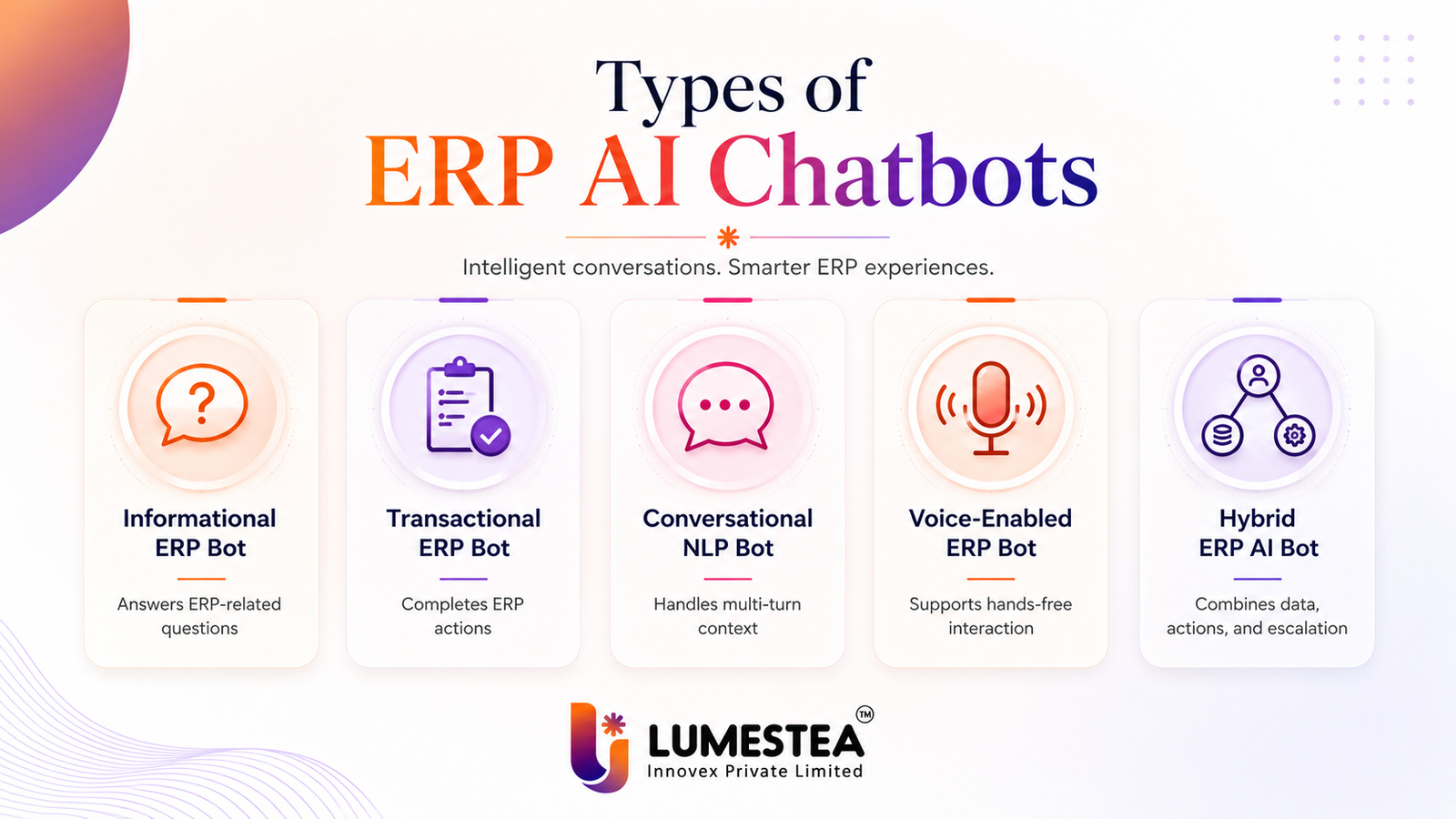
| Type | What It Does | Best For |
|---|---|---|
| Informational ERP Bot | Answers ERP-related questions by retrieving live or approved data. | Inventory checks, invoice status, order tracking, HR policy queries. |
| Transactional ERP Bot | Completes actions through ERP workflows. | PO approvals, leave requests, expense submissions, stock updates. |
| Conversational NLP Bot | Handles multi-turn conversations and understands context. | Complex reports, variance analysis, filtered queries, guided workflows. |
| Voice-Enabled ERP Bot | Allows hands-free ERP interaction through voice. | Warehouses, manufacturing floors, logistics teams, field operations. |
| Hybrid ERP AI Bot | Combines information retrieval, transactions, voice, escalation, and workflow automation. | Enterprises with multi-department ERP needs. |
Must-Have Features of an Enterprise ERP AI Chatbot
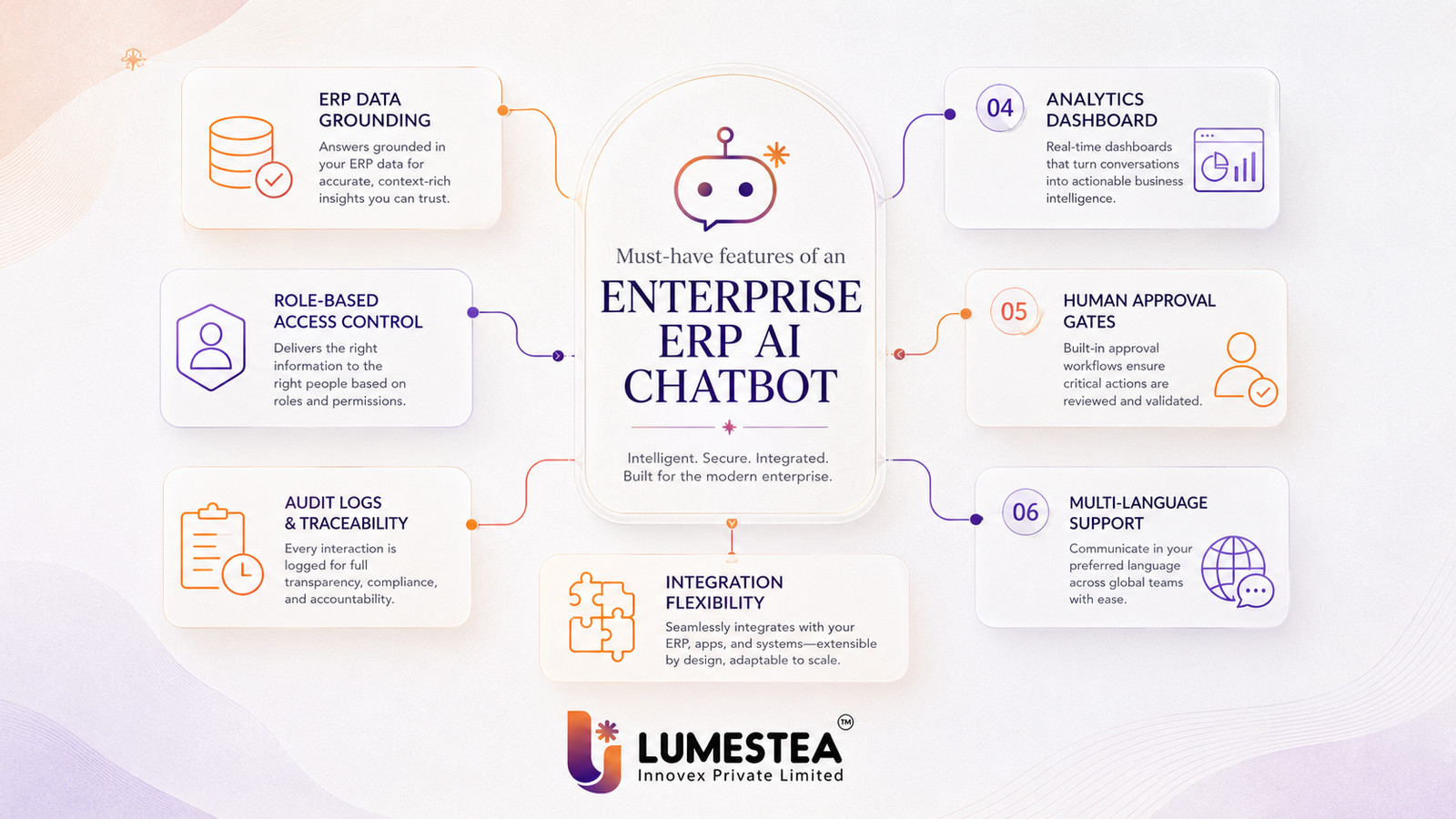
A production-ready ERP AI chatbot needs more than a chat interface. It must be designed like an enterprise software component with security, reliability, accuracy, and governance from the beginning.
The chatbot should answer based on approved ERP data, knowledge bases, policies, and connected systems. Retrieval-Augmented Generation, also known as RAG, can help ground chatbot responses in verified company data. Every answer and action should match the user’s ERP permissions. If a user cannot access a report inside the ERP, they should not access it through the chatbot.
Audit logs, human approval gates, multi-language support, integration flexibility, and analytics dashboards are also important. These features make the chatbot usable, accountable, and ready for real enterprise operations.
External support link: For LLM security controls, use OWASP Top 10 for Large Language Model Applications
Internal link sentence: ERP AI chatbot success depends heavily on architecture decisions that support security, scalability, integration, and long-term flexibility.
ERP AI Chatbot Use Cases Across Business Functions
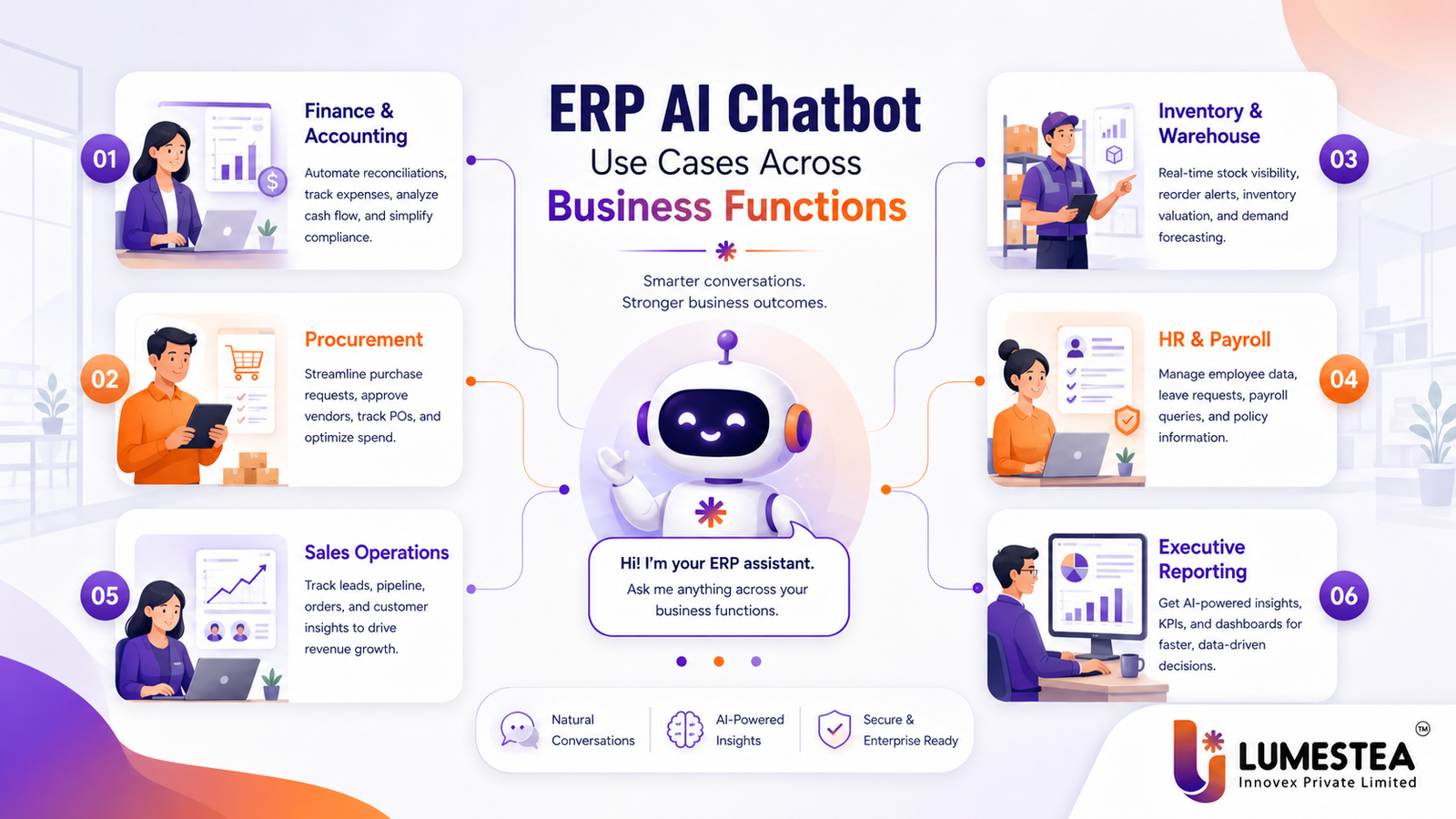
ERP AI chatbots can support nearly every business function because ERP systems already touch finance, HR, sales, procurement, inventory, operations, logistics, and management reporting.
Finance and accounting
Finance teams can check invoice status, identify overdue receivables, summarize cash flow, review expense trends, track payment approvals, and generate variance explanations without waiting for manual reports.
Procurement
Procurement teams can track purchase orders, compare supplier performance, check pending approvals, review delivery timelines, and identify procurement delays before they affect production or customer delivery.
Inventory and warehouse
Inventory teams can check stock levels, identify shortages, reconcile items, review warehouse movement, and update counts. Voice-enabled bots are especially useful in warehouse environments.
HR and payroll
HR teams can automate repetitive employee questions around leave balance, payslips, onboarding tasks, policy documents, attendance, and approval status.
Sales and customer operations
Sales teams can check order status, credit limits, product availability, pending quotes, delivery timelines, and customer account summaries through chat.
Executive management
Executives can request KPI summaries, business performance updates, margin analysis, procurement risk, and board-ready summaries in simple language.
ERP AI chatbots become more powerful when connected with real-time logistics software and delivery visibility systems.
Key Benefits of ERP AI Chatbots for Enterprises
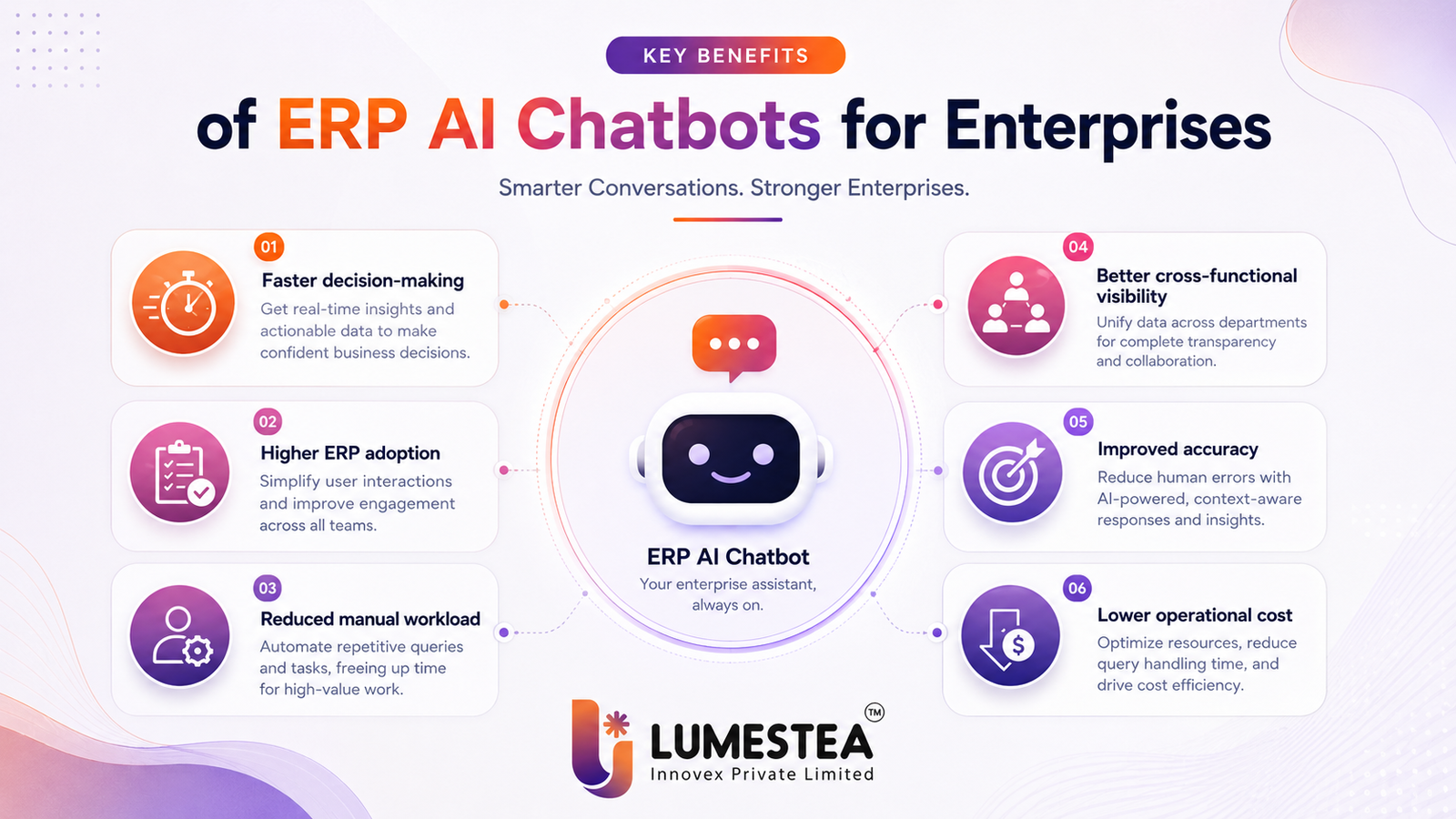
ERP AI chatbots create value because they reduce the gap between business data and business action. The ERP already contains critical information, but the chatbot makes that information easier to access, understand, and use.
The biggest benefits include faster decision-making, higher ERP adoption, reduced manual workload, better cross-functional visibility, improved accuracy, and lower operational cost. The business impact becomes stronger when the chatbot is tied to real workflows rather than treated as a generic FAQ tool.
External support link: Use IBM AI in ERP as an authority reference for AI in ERP benefits.
Practical Roadmap to Deploy an ERP AI Chatbot
ERP AI chatbot implementation should be phased. A rushed enterprise rollout can create security, adoption, and accuracy problems. A structured roadmap helps teams start small and expand based on real business value.
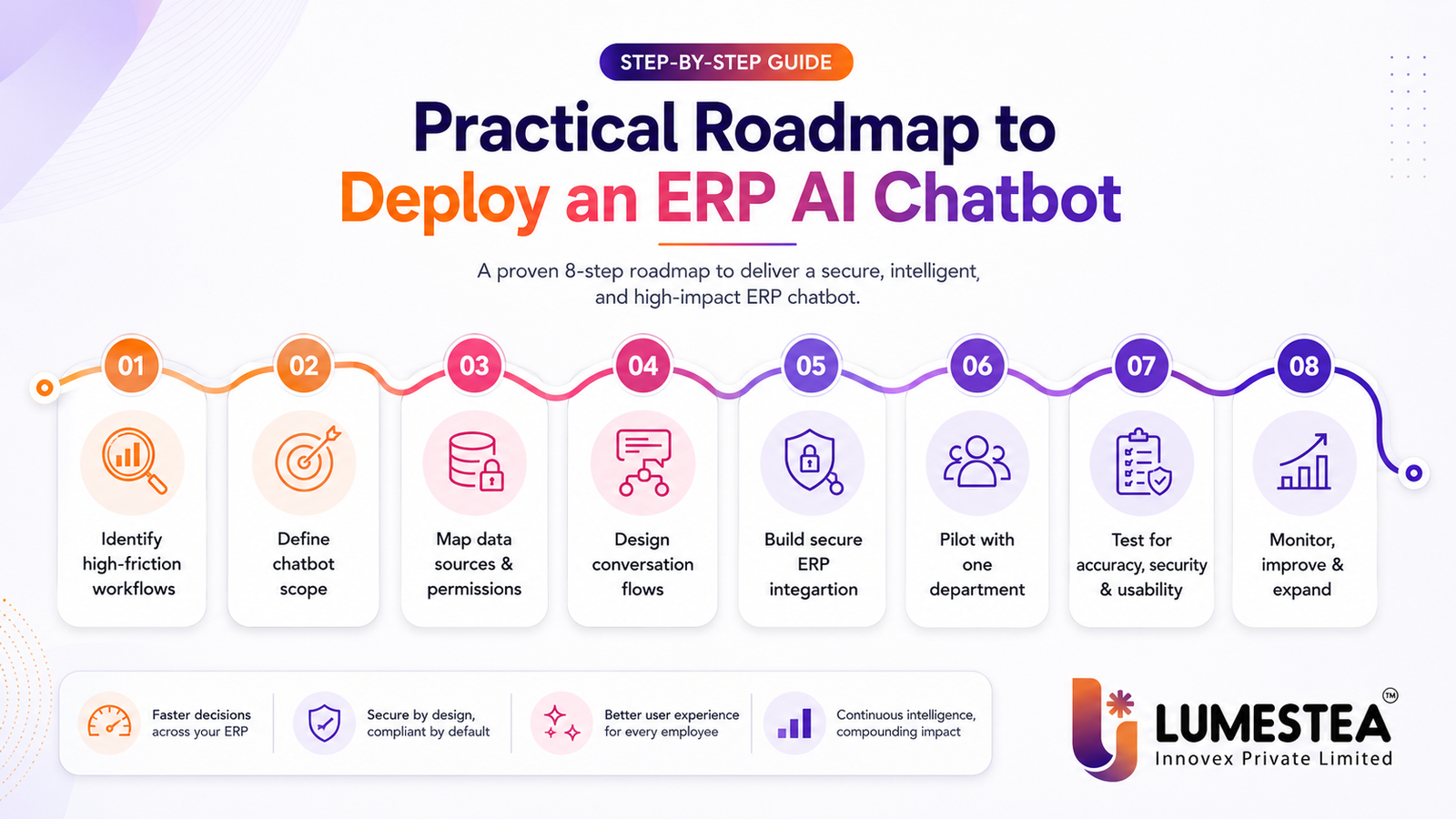
1. Identify high-friction ERP workflows
Start by finding where employees spend too much time inside ERP systems, such as invoice status checks, PO approvals, inventory queries, HR self-service, expense claims, order tracking, and executive reporting.
2. Define chatbot scope
Decide whether the first version should be informational, transactional, or workflow-based. A safe starting point is usually an informational bot grounded in approved ERP data.
3. Map data sources and permissions
Define which data the chatbot can access, which users can access it, and what actions the chatbot can perform.
4. Design conversation flows in employee language
Conversation design should be based on how employees actually ask questions, not how developers describe database fields.
5. Build secure ERP integration
The chatbot should connect with ERP APIs, middleware, databases, document repositories, and workflow systems securely.
6. Pilot with one department
Start with one department that has a clear business problem and motivated users.
7. Test for accuracy, security, and usability
Testing should cover functional accuracy, role-based access, data freshness, hallucination risk, edge cases, transaction validation, error handling, and user experience.
8. Monitor, improve, and expand
After launch, track usage, response accuracy, escalation rate, user satisfaction, process time saved, and business impact.
ERP AI Chatbot Integration Checklist
Before building or buying an ERP AI chatbot, the development team should evaluate the ERP environment carefully. This helps avoid integration surprises later.
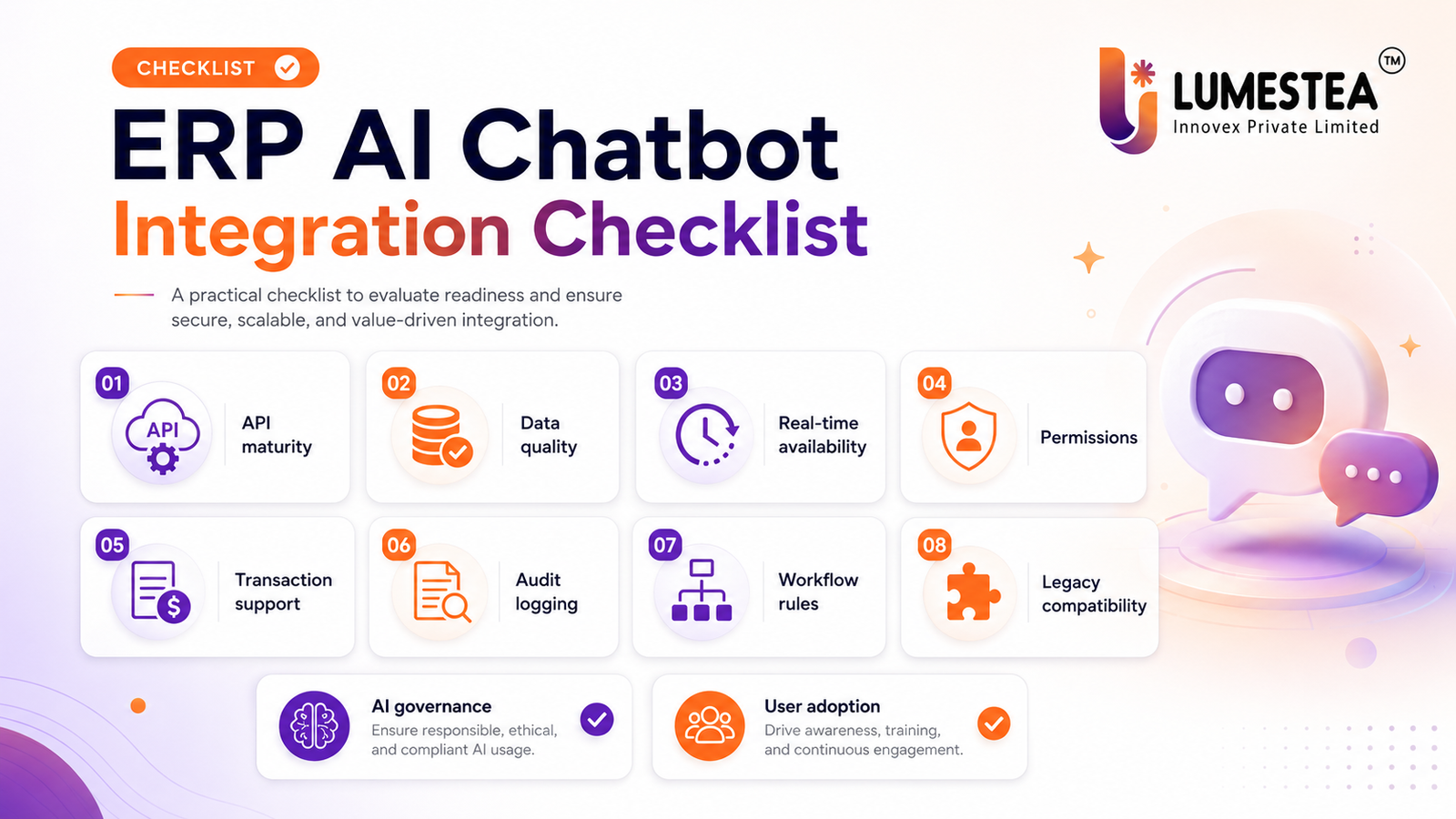
| Evaluation Area | What to Check |
|---|---|
| API maturity | Are ERP APIs stable, documented, and secure? |
| Data quality | Is ERP data accurate, complete, and structured? |
| Real-time availability | Does the chatbot need live data or scheduled sync? |
| Permissions | Can role-based access be enforced at chatbot level? |
| Transaction support | Will the bot only read data or also execute actions? |
| Audit logging | Can every query and action be tracked? |
| Workflow rules | Are approvals, validations, and exceptions clearly defined? |
| Legacy compatibility | Does the ERP need middleware or an integration layer? |
| AI governance | Are hallucination controls, human escalation, and policy boundaries defined? |
| User adoption | Are employees involved in conversation design and testing? |
Common ERP AI Chatbot Implementation Challenges and How to Fix Them
ERP AI chatbot projects can fail when companies focus only on the AI interface and ignore the system underneath. The chatbot is only as useful as the data, integrations, permissions, and workflows behind it.
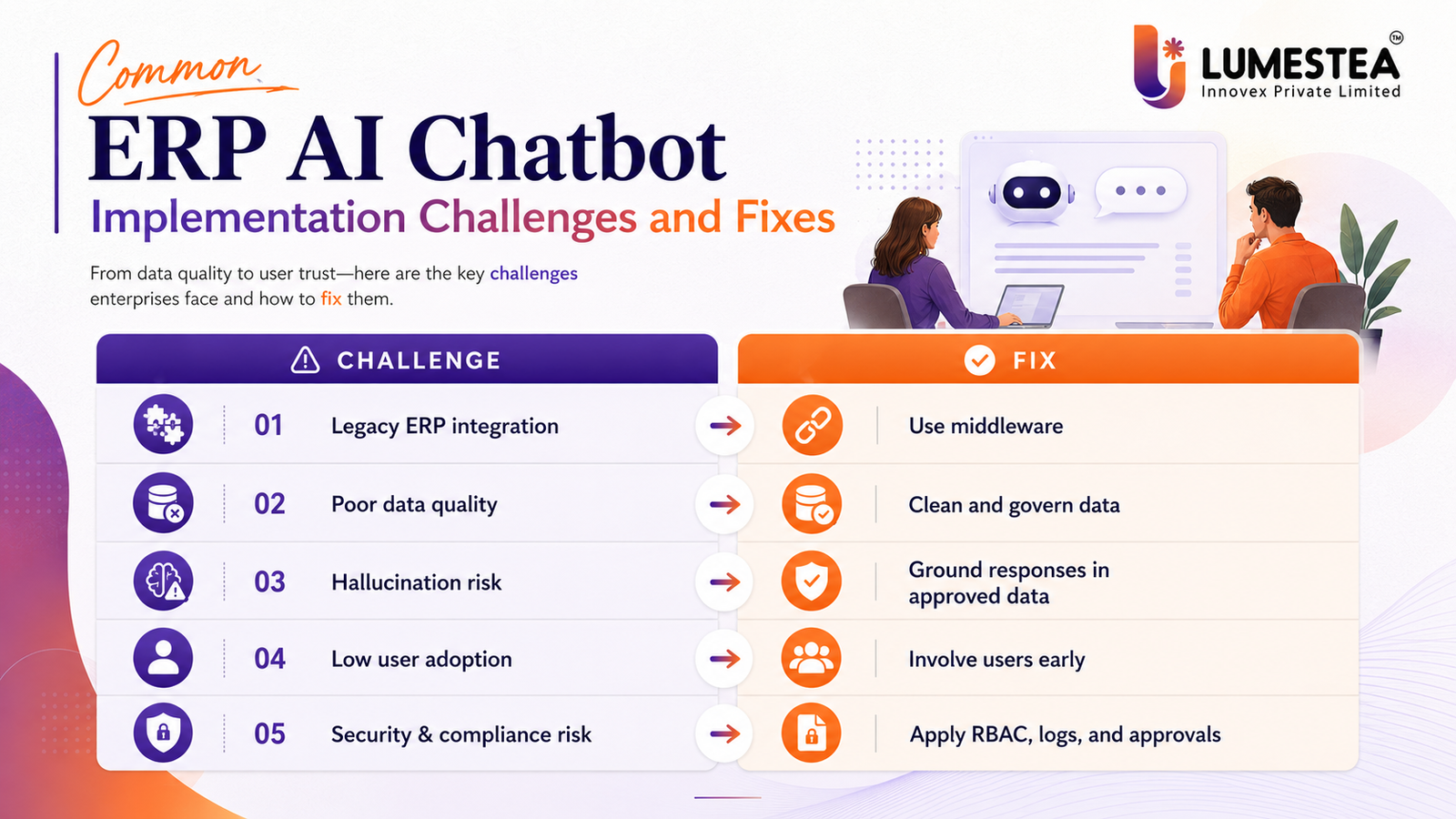
Legacy ERP integration:
Older ERP systems may not have modern APIs. The fix is to use middleware, API gateways, secure database connectors, or controlled integration services that expose only approved data and actions.
Poor data quality:
If ERP data is incomplete, outdated, duplicated, or inconsistent, the chatbot will return weak answers. Data cleansing, validation rules, and master data governance should happen before enterprise rollout.
Hallucination risk:
ERP AI chatbots should use approved data sources, RAG pipelines, confidence thresholds, fallback responses, and human escalation.
Low user adoption:
Involve users early, test real query patterns, and start with high-value use cases.
Security and compliance risk:
Chatbot access must follow role-based permissions, encryption, audit logs, approval gates, and compliance controls.
Build vs Buy: Which ERP AI Chatbot Approach Is Better?
Businesses usually have three options: use a native AI assistant from their ERP vendor, configure a third-party chatbot platform, or build a custom ERP AI chatbot.
A native ERP assistant may be faster to start with if the organization already uses SAP, Microsoft Dynamics, Oracle, or another cloud ERP platform. A third-party chatbot platform can work when speed matters and the use cases are not deeply custom A custom ERP AI chatbot is better when the business has complex workflows, multiple systems, legacy ERP dependencies, unique approval rules, or industry-specific operations.
Microsoft Dynamics 365 ERP and AI capabilities as an official reference for these technologies.
The Future of ERP AI Chatbots
ERP AI chatbots are moving beyond basic Q&A. The next generation will be more proactive, multimodal, personalized, and deeply embedded into daily work.
Employees will interact with ERP systems through text, voice, images, scanned documents, and possibly IoT
signals. A warehouse worker may confirm stock by scanning a shelf image. A supervisor may update
production status through voice. A finance user may upload an invoice and ask the chatbot to validate it
against purchase orders.
ERP AI assistants may also become proactive, flagging budget overruns, supply chain delays, vendor risk,
late payments, or inventory shortages before teams manually discover them. This requires careful
governance so enterprises can define what AI can do independently, what needs human approval, and what
must always stay under manual control
Use Gartner ERP insights for ERP strategy and AI context..
How Lumestea Can Help Build ERP AI Chatbots
ERP AI chatbot development is not just chatbot development. It requires understanding enterprise
workflows, ERP integration, AI architecture, data security, user experience, and long-term scalability
Lumestea Innovex Private Limited helps businesses plan, design, and build AI-powered enterprise systems that are practical, secure, and aligned with real operations. Our approach starts with workflow discovery and data readiness assessment, then moves into architecture, integration, conversation design, development, testing, and continuous improvement.
Final CTA
Ready to make your ERP easier to use and smarter to operate? Let Lumestea help you plan and build an ERP AI chatbot that connects data, people, and workflows securely. Button: Talk to Our ERP AI Experts.
Frequently Asked Questions
1) What is an ERP AI chatbot?
An ERP AI chatbot is an AI-powered conversational assistant that connects with an ERP system and helps employees retrieve business data, answer operational questions, complete routine tasks, and move through ERP workflows using natural language.
2) How does an ERP AI chatbot work?
An ERP AI chatbot works by connecting to ERP data, APIs, knowledge bases, and workflow systems. It understands user questions through natural language processing, checks user permissions, retrieves relevant data, and returns role-appropriate answers or actions.
3) What are the benefits of ERP AI chatbots?
ERP AI chatbots improve decision-making, reduce manual workload, increase ERP adoption, simplify access to business data, automate repetitive workflows, and improve cross-functional visibility across finance, HR, procurement, sales, inventory, and operations.
4) Can ERP AI chatbots work with legacy ERP systems?
Yes, ERP AI chatbots can work with legacy ERP systems, but the integration approach is usually more complex. Older ERP systems may require middleware, API gateways, secure connectors, or controlled database access to expose approved data safely.
5) Are ERP AI chatbots secure?
ERP AI chatbots can be secure when implemented with role-based access control, encryption, audit logs, human approval gates, secure APIs, data grounding, and compliance-aware governance. Security must be designed from the beginning, not added later.
6) What are the best use cases for ERP AI chatbots?
The best use cases include invoice status checks, purchase order approvals, inventory queries, HR self-service, expense management, sales order tracking, executive KPI summaries, production updates, and supplier performance analysis.