
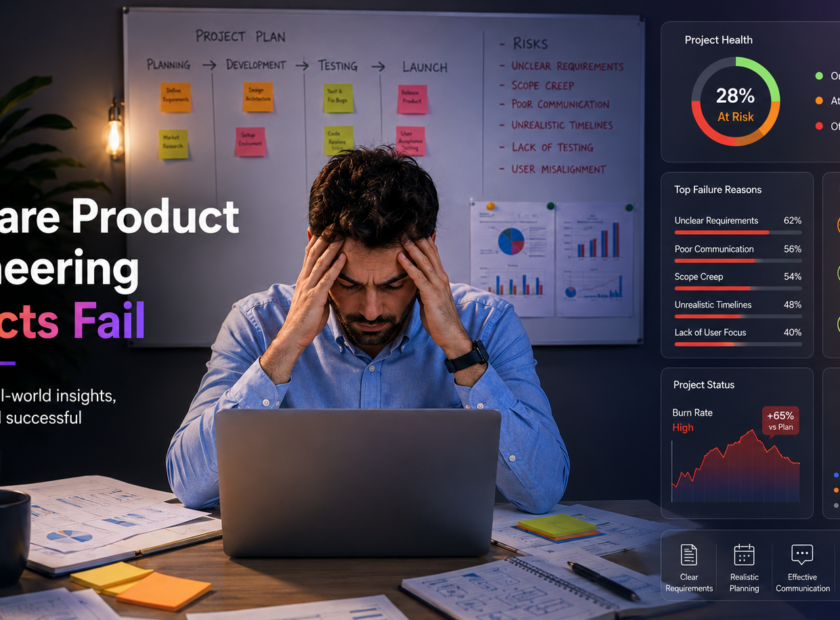
Why Software Product Engineering Projects Fail – and How to Build Products That Actually Scale
Why Software Product Engineering Projects Fail – and How to Build Products That Actually Scale
 Pushpa

Summarize with AI
Not enough time? Get the key points instantly.


Software products rarely fail because of one bad decision. Most failures build slowly. A rushed architecture choice becomes technical debt. A vague requirement becomes scope creep. A skipped test becomes a production defect. A team without ownership becomes a delivery bottleneck. By the time the problem becomes visible to customers, the real damage has already happened inside the engineering process.
For startups, growing companies, and enterprises, software product engineering is not just about writing code. It is about building a product that can handle change, scale with users, support business goals, and remain reliable under pressure. When engineering decisions are treated as short-term delivery tasks instead of long-term product investments, projects start moving in the wrong direction.
At Lumestea Innovex Private Limited, we help businesses build scalable web platforms, SaaS products, mobile apps, AIpowered systems, and custom software solutions. What we see repeatedly is simple: successful products are not only shipped fast. They are planned carefully, engineered responsibly, tested deeply, and improved continuously.
Quick takeaway
Software product failure is usually not sudden. It is the result of weak planning, poor architecture, unclear ownership, uncontrolled scope, quality gaps, and lack of long-term product thinking.
What Does a Failing Software Product Look Like?
A failing software product does not always fail suddenly. In many cases, the warning signs appear early, but teams ignore them because the product still appears to work. The team keeps shipping features, but every release becomes slower. Bugs become more frequent. Customers complain about performance. Developers hesitate to touch old modules because one change breaks another part of the system.
A failing project often looks busy from the outside. Meetings are happening, tickets are moving, and releases are going out. But underneath that activity, the product is losing stability. The roadmap becomes reactive. The team spends more time fixing problems than improving the product. Business leaders lose visibility into timelines, cost, and risk.
| Red Flag | What It Usually Means |
|---|---|
| Missed deadlines | Planning, dependencies, or estimation are not under control. |
| Frequent bugs | QA coverage, architecture, or release discipline is weak. |
| Scope keeps changing | Requirements and change control are not mature. |
| Slow performance | Scalability and data design were not planned early. |
| Team confusion | Ownership, documentation, or communication is unclear. |
| High maintenance cost | Technical debt is increasing faster than it is being reduced. |
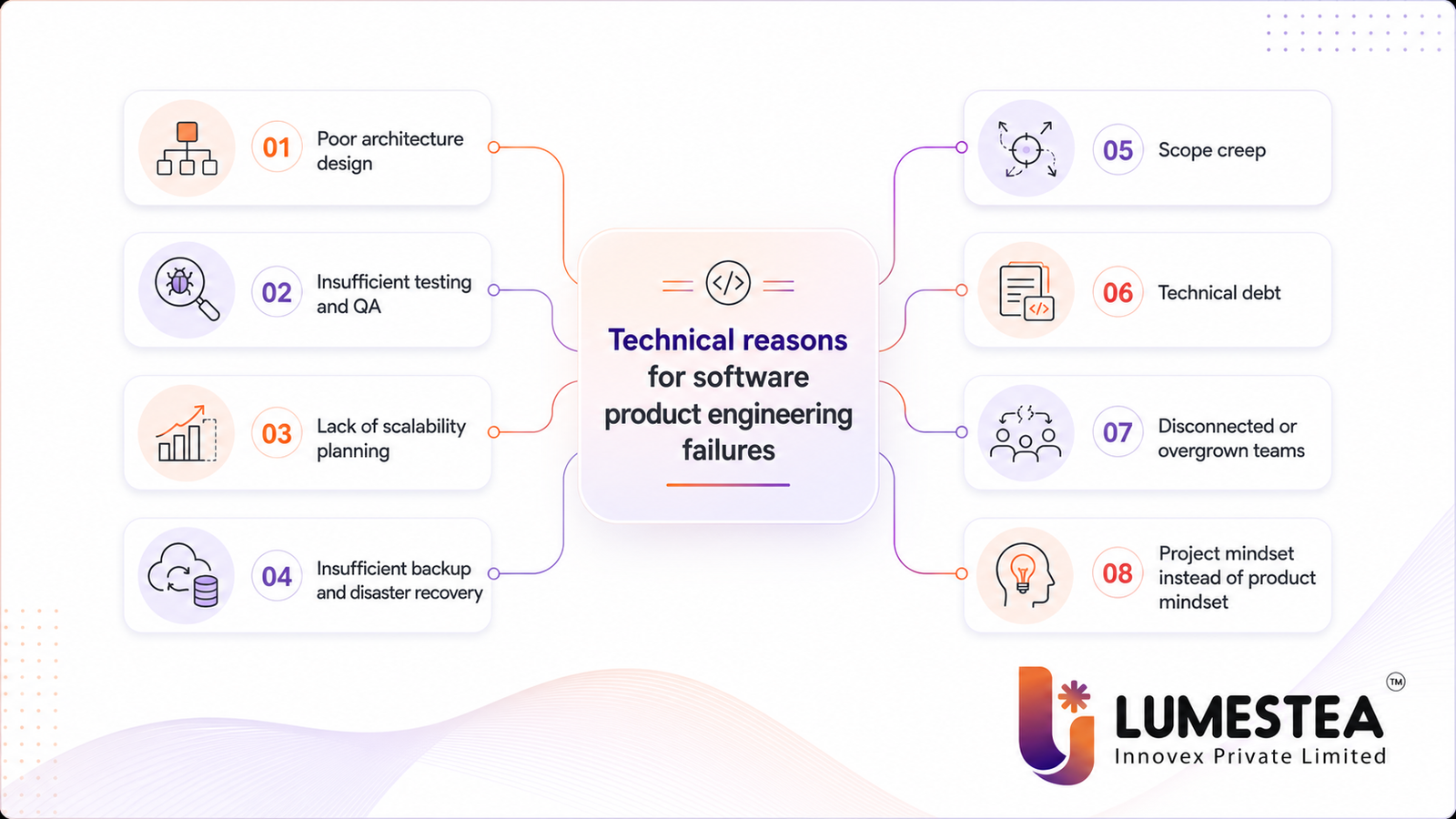
1. Weak Architecture Decisions
Architecture is one of the earliest product decisions, but it creates some of the longest-lasting consequences. A weak architecture may not hurt during the first release, especially when the product has fewer users and limited features. The problem appears later, when the business needs integrations, new modules, higher traffic, faster releases, stronger security, or multiregion scalability.
Poor architecture usually creates a product that is difficult to change. A small update in one feature affects unrelated parts of the system. Developers become afraid to refactor. Database queries slow down. APIs become inconsistent. Business logic gets duplicated in multiple places. Over time, every new feature takes longer because the foundation cannot support clean growth.
The right architecture is not always the most complex one. The real goal is to make architecture decisions that fit the product’s current stage while leaving enough room for future growth.
To avoid architecture failure, define core workflows, data structures, integration needs, user growth expectations, and security requirements before development becomes too deep. Architecture reviews should happen at important milestones so structural risks are caught before they become expensive rework.
2. Poor Testing and Quality Assurance
A product can have good design and clean code, but still fail if quality assurance is weak. Testing is often treated as a final step before release, when it should be part of the entire product engineering lifecycle. When teams test late, defects are discovered after the cost of fixing them has already increased.
Poor QA does not only create bugs; it creates business risk because software quality issues directly affect cost, customer trust, and long-term maintainability.
Testing should prove that features work reliably, securely, and consistently under realistic usage. This includes functional testing, regression testing, integration testing, performance testing, accessibility checks, security validation, and user acceptance testing.
A strong QA process begins with clear acceptance criteria. Every feature should have defined expected behavior, edge cases, failure states, and user scenarios. Automated tests should support repeated validation, while manual testing should focus on real experience, usability, and business-critical flows.
3. No Scalability Planning
Many products are built for launch, not for growth. This works temporarily, but it becomes risky once users, data, transactions, integrations, or internal teams grow. A product that performs well with 500 users may struggle with 50,000 users if scalability was never considered.
Scalability failure can appear in different ways. Pages load slowly. Database queries become expensive. Background jobs pile up. Notifications are delayed. Third-party API limits are reached. Infrastructure cost increases without clear control. The product becomes unstable during traffic spikes or marketing campaigns.
Scalability is not only an infrastructure issue. It also depends on database design, API structure, caching strategy, asynchronous processing, queue management, cloud architecture, and code quality. If these areas are ignored early, scaling becomes expensive later.
The same engineering discipline applies to logistics platforms, where real-time visibility, performance, integrations, and operational reliability directly affect business outcomes.
4. Weak Backup and Disaster Recovery Planning
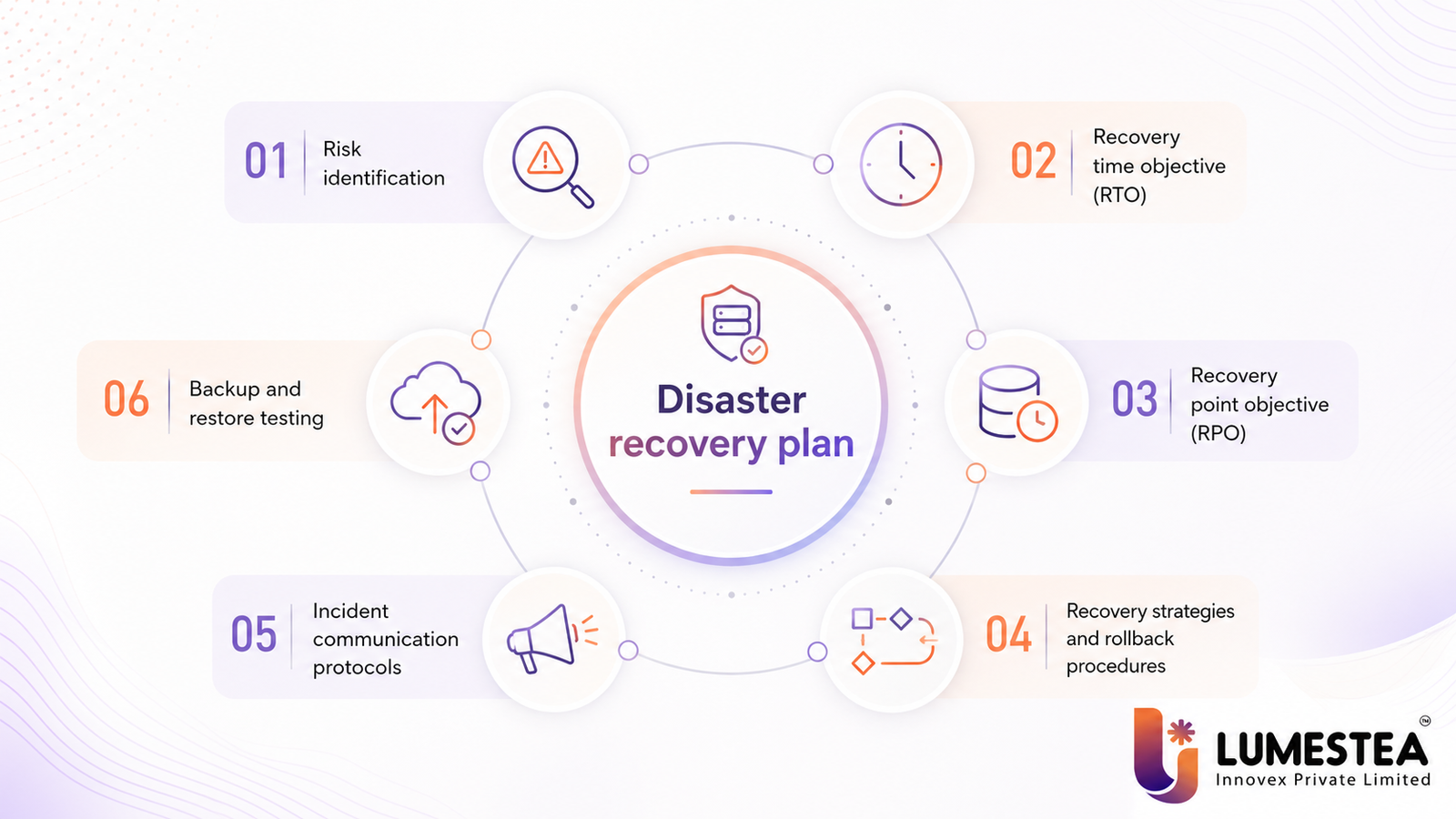
Backup and disaster recovery are often ignored until something goes wrong. Teams assume cloud hosting, managed databases, or server snapshots are enough. In reality, recovery only works when backups are reliable, independent, tested, and connected to a clear restoration process.
A product without a recovery plan is exposed to serious risk. Data corruption, accidental deletion, infrastructure failure, cyber incidents, failed deployments, and human error can all create downtime or permanent data loss. For customer-facing products, even a short outage can affect revenue, reputation, and trust.
Define recovery objectives clearly. Recovery Time Objective tells you how quickly the system must be restored. Recovery Point Objective tells you how much data loss is acceptable. These two numbers should guide backup frequency, storage strategy, monitoring, and restoration planning.
5. Scope Creep Without Change Control
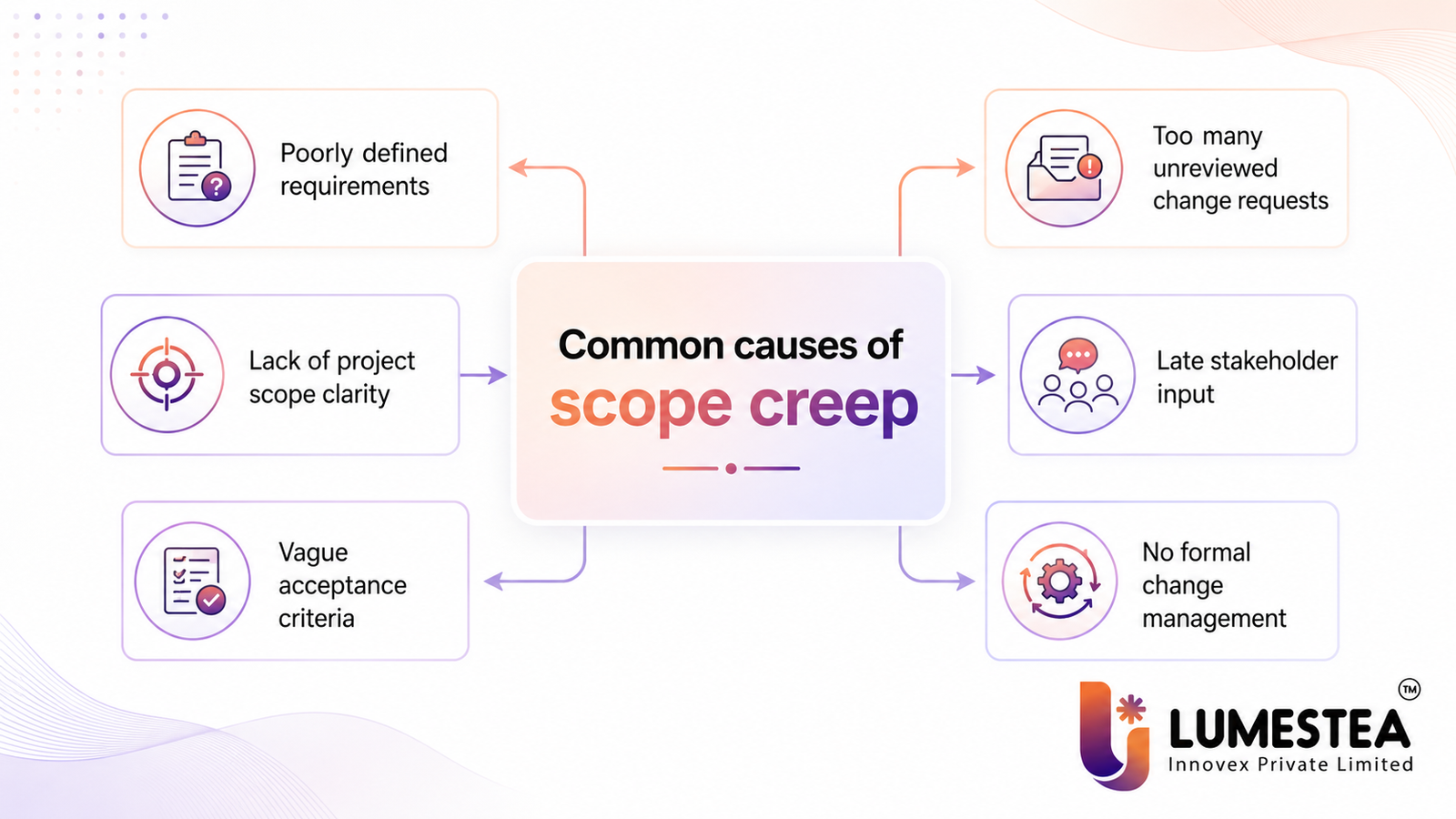
Scope creep is one of the most common reasons software product engineering projects fail. It happens when new features, changes, and assumptions enter the project without proper evaluation. At first, these additions may look small. Over time, they stretch the timeline, increase cost, confuse priorities, and create technical shortcuts.
Poor requirements management is one of the biggest reasons scope expands, timelines slip, and software teams lose delivery control.
Scope should be defined around product outcomes, not only features. Every major feature should connect to a user need, business goal, or measurable value. When new requests appear, they should be reviewed for impact on timeline, budget, technical complexity, testing, and user experience.
A good change process does not block innovation. It protects the product from uncontrolled expansion. Teams should keep a backlog for future improvements while maintaining focus on the current milestone.
6. Growing Technical Debt
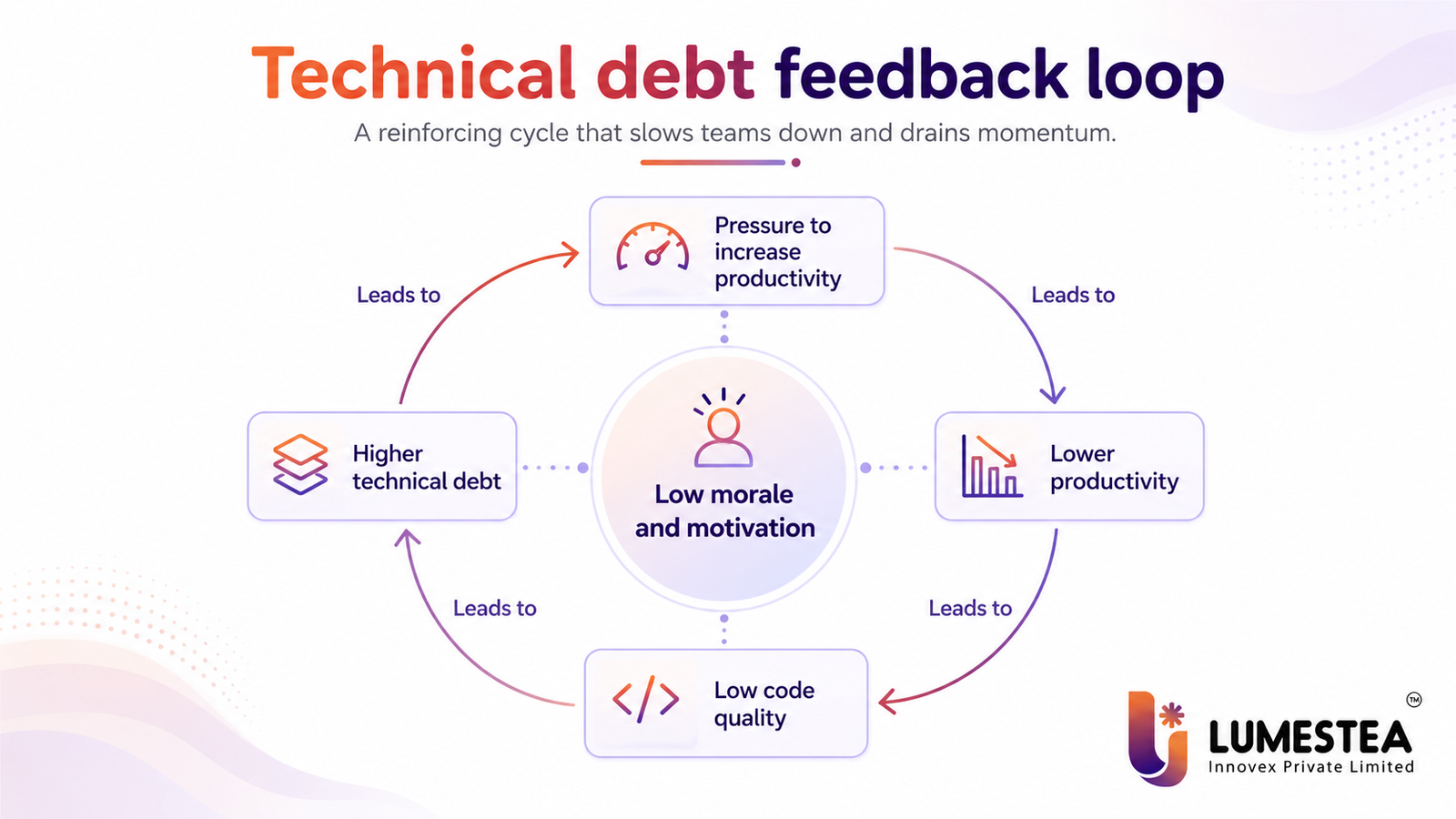
Technical debt is the cost of shortcuts. Some technical debt is normal, especially in fast-moving products. The real problem begins when debt is ignored, undocumented, or allowed to grow without a plan.
Technical debt makes products slower to improve. Developers spend more time understanding old code. Bugs become harder to trace. Refactoring feels risky. New features require workarounds. The product becomes expensive to maintain because the team is paying for yesterday’s rushed decisions.
Technical debt should be visible. Teams should document it, estimate its impact, and prioritize it based on business risk. Not every debt item needs immediate cleanup, but high-risk areas should be addressed before they affect reliability, security, or product growth.
Refactoring should be part of the roadmap, not an afterthought. Code reviews, automated testing, dependency updates, documentation, and CI/CD pipelines help prevent debt from becoming unmanageable.
7. Security Gaps and Weak Release Controls
Security issues often appear when product teams move quickly without secure engineering practices. A feature may work functionally, but still expose user data, permissions, API endpoints, or sensitive workflows if security testing is not included in the delivery process.
Security testing should not be treated as optional, especially for web applications that handle user data, payments, business operations, or sensitive workflows. The OWASP Top 10 is a useful reference for understanding common web application security risks.
Security should be part of requirements, architecture, code review, testing, deployment, and monitoring. It is easier to prevent security gaps during engineering than to fix them after a public incident.
8. Disconnected or Overgrown Teams
As teams grow, communication becomes harder. A larger team does not automatically mean faster delivery. In many software projects, adding more people without clear ownership creates confusion, duplicate work, inconsistent decisions, and slower execution.
Disconnected teams often show the same symptoms. Designers, developers, QA, DevOps, and product managers work in separate silos. Requirements are discussed in one place, but implementation happens somewhere else. Decisions are not documented. Developers build features without enough product context. QA receives features too late. Stakeholders see progress only near the end.
For larger products, smaller cross-functional teams often work better because ownership, communication, and decision-making stay closer to the feature area.
Strong teams need clear ownership, not just more people. Every feature should have defined responsibility across product, design, engineering, QA, and deployment. Smaller cross-functional teams usually move faster because communication is direct and decisions are easier to track.
9. Project Mindset Instead of Product Mindset
A project mindset focuses on finishing tasks. A product mindset focuses on creating long-term value. This difference is one of the biggest reasons software engineering efforts succeed or fail.
When teams work with only a project mindset, success is measured by delivery completion. The question becomes, “Did we finish the scope?” But strong products require a deeper question: “Did we solve the right problem, and can this product keep improving?”
A product mindset treats launch as the beginning of learning. It connects engineering with user behavior, business goals, performance data, and continuous improvement. Teams should measure adoption, retention, performance, support issues, conversion, customer satisfaction, and operational efficiency instead of only tracking completed tickets.
10. Poor User Experience and Low Adoption
Even technically strong products can fail if users do not want to use them. Poor UX increases friction, support tickets, onboarding time, and abandonment. In business software, weak UX can also reduce internal adoption because teams return to spreadsheets, manual workarounds, or older tools.
Good UX is not decoration. It is product efficiency. It helps users complete tasks faster, understand workflows clearly, avoid mistakes, and trust the system. This is why cleaner, more intentional UX should be part of product engineering, not a final design polish step.
UX should be included early in product planning. Teams should map user journeys, identify friction points, test workflows, and design for real usage conditions. Every major feature should be reviewed from the user’s perspective, not only the engineering perspective.
11. Lack of Monitoring After Launch
Many teams treat deployment as the finish line. In reality, launch is when the product starts facing real users, real traffic, real data, and real edge cases. Without monitoring, teams cannot see problems until customers complain.
Post-launch monitoring should track the signals that actually reveal system health: latency, traffic, errors, and saturation.
A mature engineering team should also measure delivery performance through deployment frequency, lead time for changes, change failure rate, and recovery time.
Post-launch support should be planned before launch. This includes release monitoring, rollback planning, bug triage, support ownership, and continuous improvement cycles.
12. AI and Automation Without Engineering Discipline
AI can improve software products, but it can also expose weak engineering systems. If requirements are unclear, data quality is poor, testing is shallow, or governance is missing, AI features can create more risk than value.
As products become more data-driven, teams need to think about AI-powered workflows, automation readiness, responsible data handling, and measurable business outcomes.
AI works best when it is built into a strong product system: clear use cases, tested workflows, secure data pipelines, monitoring, human review, and continuous improvement. AI should amplify good engineering practices, not cover up poor ones.
How to Avoid Software Product Engineering Failure
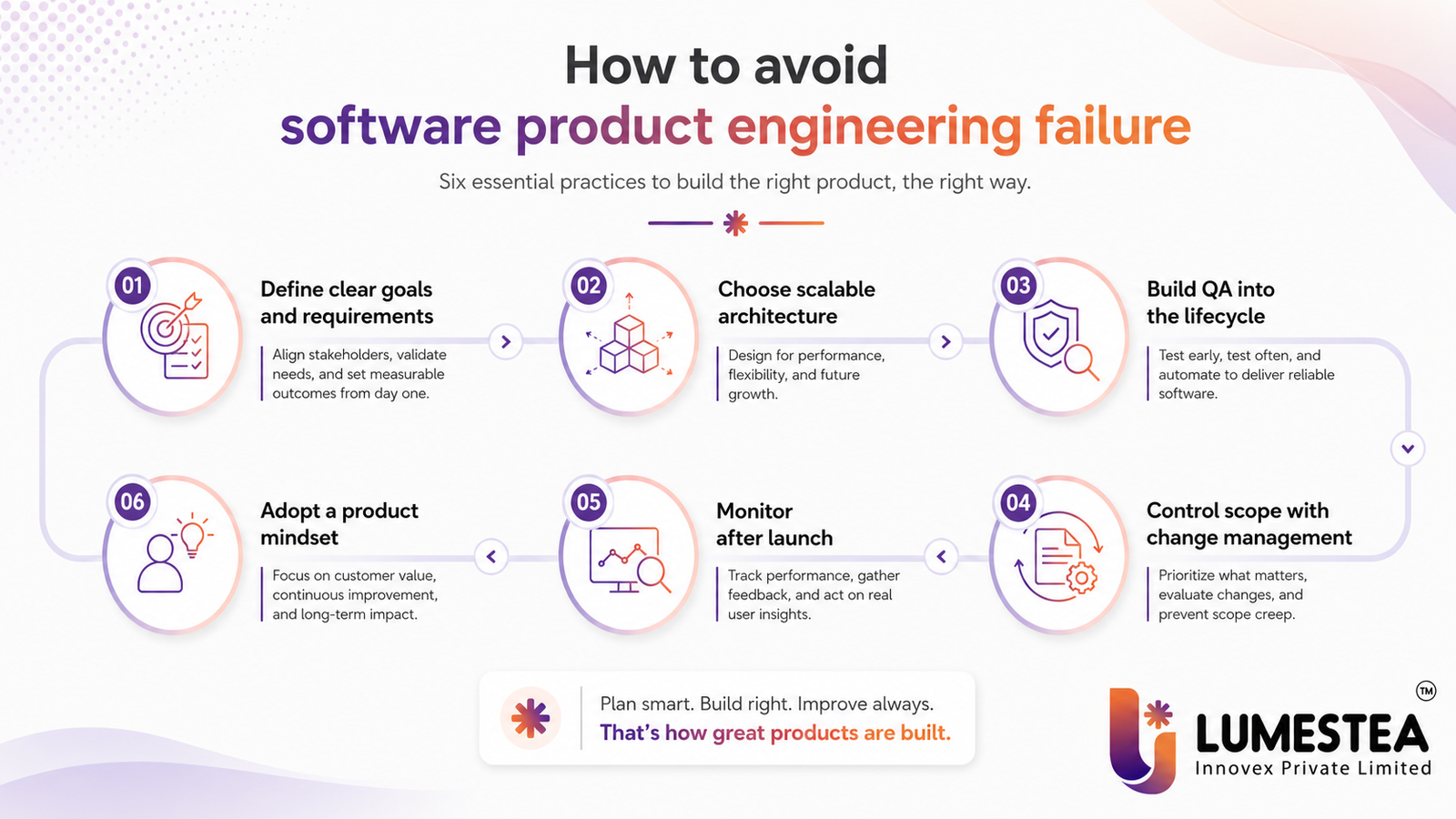
Avoiding failure requires discipline across strategy, design, engineering, testing, deployment, and support. The most successful products are built with clear goals, strong architecture, controlled scope, continuous QA, scalable infrastructure, and a team that understands both technology and business value.
The first step is clarity. Teams need to understand what problem the product solves, who will use it, what workflows matter most, and how success will be measured. Without this foundation, development becomes activity without direction.
The second step is engineering discipline. Architecture, code quality, testing, security, documentation, and deployment practices must support the product’s future, not only its first release. Fast delivery matters, but speed without structure creates long-term cost.
The third step is continuous improvement. Great products evolve. Teams should monitor usage, learn from feedback, reduce technical debt, improve UX, and keep the product aligned with changing business needs
Final CTA
Talk to Lumestea and get a practical roadmap for architecture, QA, scalability, UX, and long-term product growth.
Frequently Asked Questions
1) What are the most common reasons software product engineering projects fail?
Software product engineering projects usually fail because of weak architecture, poor testing, lack of scalability planning, uncontrolled scope creep, technical debt, unclear team ownership, weak disaster recovery planning, poor UX, and a project mindset instead of a product mindset.
2) How can businesses avoid software product failure?
Businesses can avoid software product failure by defining clear goals, validating requirements early, building scalable architecture, testing continuously, controlling scope, monitoring after launch, and treating the product as a long-term business asset.
3) Why does technical debt cause product failure?
Technical debt slows development because developers spend more time fixing old shortcuts, understanding messy code, and working around structural issues. Over time, this increases maintenance cost and reduces the team’s ability to release new features safely.
4) Why is software architecture important in product engineering?
Architecture defines how a product scales, integrates, performs, and adapts over time. Poor architecture may work during early development but creates serious problems when the product grows, adds users, or needs new integrations.
5) What is the difference between a project mindset and a product mindset?
A project mindset focuses on finishing tasks within a fixed scope. A product mindset focuses on solving user problems, improving outcomes, and building long-term value through continuous learning and iteration.
6) How does QA reduce product engineering risk?
QA reduces risk by catching bugs, usability issues, performance problems, security gaps, and workflow failures before they reach users. Strong QA protects customer trust and improves release confidence.