
Modernizing Legacy Systems in Healthcare: A Complete Guide for Digital Transformation
Modernizing Legacy Systems in Healthcare: A Complete Guide for Digital Transformation
 Pushpa

Summarize with AI
Not enough time? Get the key points instantly.


Table of Contents
What Is a Legacy System in Healthcare?
Common Types of Legacy Healthcare Systems
Maintaining vs. Modernizing Healthcare Systems
Why Healthcare Legacy System Modernization Matters
Signs Your Healthcare System Needs Modernization
Risks of Delaying Legacy System Modernization
Main Approaches to Healthcare Legacy System Modernization
Step-by-Step Process to Modernize Healthcare IT Systems
Best Integration Methods for Healthcare Modernization
How Cloud Supports Healthcare Legacy Modernization
Role of AI and Automation in Healthcare Modernization
Challenges in Modernizing Legacy Healthcare Systems
Best Practices for Successful Healthcare Modernization
KPIs to Measure Modernization Success
FAQ
Healthcare organizations now depend on digital systems for almost every critical workflow, from patient registration and clinical documentation to billing, claims, lab reporting, imaging, telehealth, and patient engagement. Yet many hospitals, clinics, payers, and healthcare networks still run important operations on systems that were built for a very different technology environment.
These legacy platforms may still function, but they often create hidden friction across the organization. They slow down clinical teams, make integrations harder, increase security exposure, complicate compliance reporting, and prevent healthcare providers from delivering the connected digital experience patients now expect.
Modernizing legacy systems in healthcare is no longer just an IT upgrade. It is a strategic decision that affects patient safety, operational efficiency, staff productivity, cybersecurity, interoperability, and long-term digital transformation.
Quick takeaway
Legacy modernization should not be treated as a one-time technical replacement. It should be planned as a phased, compliance-aware transformation that improves workflows, data access, user experience, and scalability together.
What Is a Legacy System in Healthcare?
A legacy system in healthcare is an outdated software application, database, platform, or infrastructure layer that continues to support important clinical, administrative, or operational workflows even though it no longer meets modern expectations for security, interoperability, performance, usability, or scalability.
These systems often remain in place because they are deeply connected to daily operations. A hospital may depend on an old EHR module for patient records, a lab may use a dated reporting system, or a payer may run claims workflows through software that is difficult to replace without disruption. The system may still work, but it can quietly limit how fast the organization can improve.
In healthcare, the risk is higher than in many other industries because legacy systems frequently manage sensitive patient data and mission-critical care workflows. When these platforms become hard to maintain or integrate, the impact is not limited to IT. It can affect staff efficiency, patient communication, readiness, and care coordination
Common Types of Legacy Healthcare Systems
Healthcare organizations usually do not have a single legacy system. They often operate a connected network of older tools across clinical, operational, and administrative departments. The modernization roadmap should begin by identifying which systems are business-critical, which are security-sensitive, and which are creating workflow bottlenecks
-
Electronic Health Record Systems
Older EHR platforms may support basic documentation but fail to provide modern interoperability, mobile access, real-time data exchange, or user-friendly clinical workflows.
-
Hospital Information Systems
Legacy HIS platforms often manage admissions, discharge workflows, billing, and internal coordination, but may struggle with reporting, scalability, and system connectivity.
-
Laboratory Information Systems
Outdated LIS platforms can delay lab reporting, create manual handoffs, and make integration with modern diagnostic tools more difficult.
-
Radiology and Imaging Systems
Legacy RIS or PACS environments may face storage limitations, slow image retrieval, and compatibility issues with newer imaging workflows.
-
Claims Processing Systems
Older claims systems may not keep pace with changing payer requirements, billing rules, compliance needs, and automation opportunities.
-
Patient Portals and Telehealth Platforms
Outdated engagement tools often lack secure messaging, mobile-friendly access, digital forms, and smooth integration with EHR or scheduling systems.
Maintaining vs. Modernizing Healthcare Systems
Not every old system needs to be replaced immediately. In some situations, maintaining an existing platform for a short period may be practical, especially when it is stable, supported, low-risk, and not blocking important business or clinical goals.
However, healthcare leaders should compare the short-term comfort of maintaining legacy systems with the long-term cost of slow workflows, fragile integrations, security gaps, and missed innovation opportunities. The right decision depends on system condition, vendor roadmap, available budget, compliance exposure, and the organization’s future digital strategy.
| Area | Maintaining Legacy System | Modernizing System |
|---|---|---|
| Cost | May appear cheaper in the short term if the system is stable. | Can reduce long-term maintenance, manual work, and infrastructure burden. |
| Risk | Avoids immediate change but keeps existing security and scalability concerns. | Requires planning, but reduces long-term operational and compliance risk. |
| Integration | Often depends on custom connectors, manual exports, or outdated protocols. | Supports API-first, cloud-ready, and interoperability-focused architecture. |
| User Experience | Staff may be familiar with the system, but workflows can remain slow. | Improves usability for clinical, administrative, and patient-facing users. |
| Future Readiness | Limits adoption of analytics, automation, AI, remote care, and modern reporting. | Creates a stronger foundation for digital healthcare transformation. |
Why Healthcare Legacy System Modernization Matters
Healthcare modernization matters because outdated technology rarely stays isolated. A slow or disconnected system can create delays across registration, care coordination, claims, reporting, and patient communication. Over time, these small workflow gaps become measurable operational problems.
Modernization helps healthcare organizations improve interoperability, strengthen data security, reduce manual effort, and create better digital experiences for both staff and patients. It also prepares the organization for cloud adoption, automation, analytics, and AI-enabled healthcare workflows.
Healthcare modernization also creates the data foundation required for AI-powered clinical support, predictive analytics, administrative automation, and smarter patient engagement. Without clean, connected, and accessible data, even advanced AI tools struggle to deliver reliable value inside real healthcare workflows.
The goal is not simply to make old software look new. The goal is to improve how information moves, how users complete work, how securely data is handled, and how easily the platform can support future healthcare needs.
Signs Your Healthcare System Needs Modernization
Modernization becomes urgent when technology begins to slow down business operations or increase clinical, financial, or compliance risk. Healthcare leaders should watch for patterns across performance, usability, integration, security, and vendor support.
| Sign | What It Means | Business Impact |
|---|---|---|
| Slow performance | Users experience delays, crashes, or unstable access during daily workflows. | Staff productivity drops and patient-facing processes become slower. |
| Poor interoperability | Systems cannot easily share data with EHR, billing, labs, imaging, or portals. | Data silos increase and care coordination becomes harder. |
| Security gaps | The system lacks modern access control, encryption, logging, or patching. | Cybersecurity and compliance risk increases. |
| High maintenance cost | The organization spends too much keeping old technology alive. | IT budget is consumed without improving business value. |
| Vendor support ending | The vendor has limited updates, no roadmap, or end-of-life notices. | Operational continuity and security patching become risky. |
| Manual workarounds | Staff rely on spreadsheets, duplicate entry, phone calls, or paper-based steps. | Errors increase and workflows become harder to scale. |
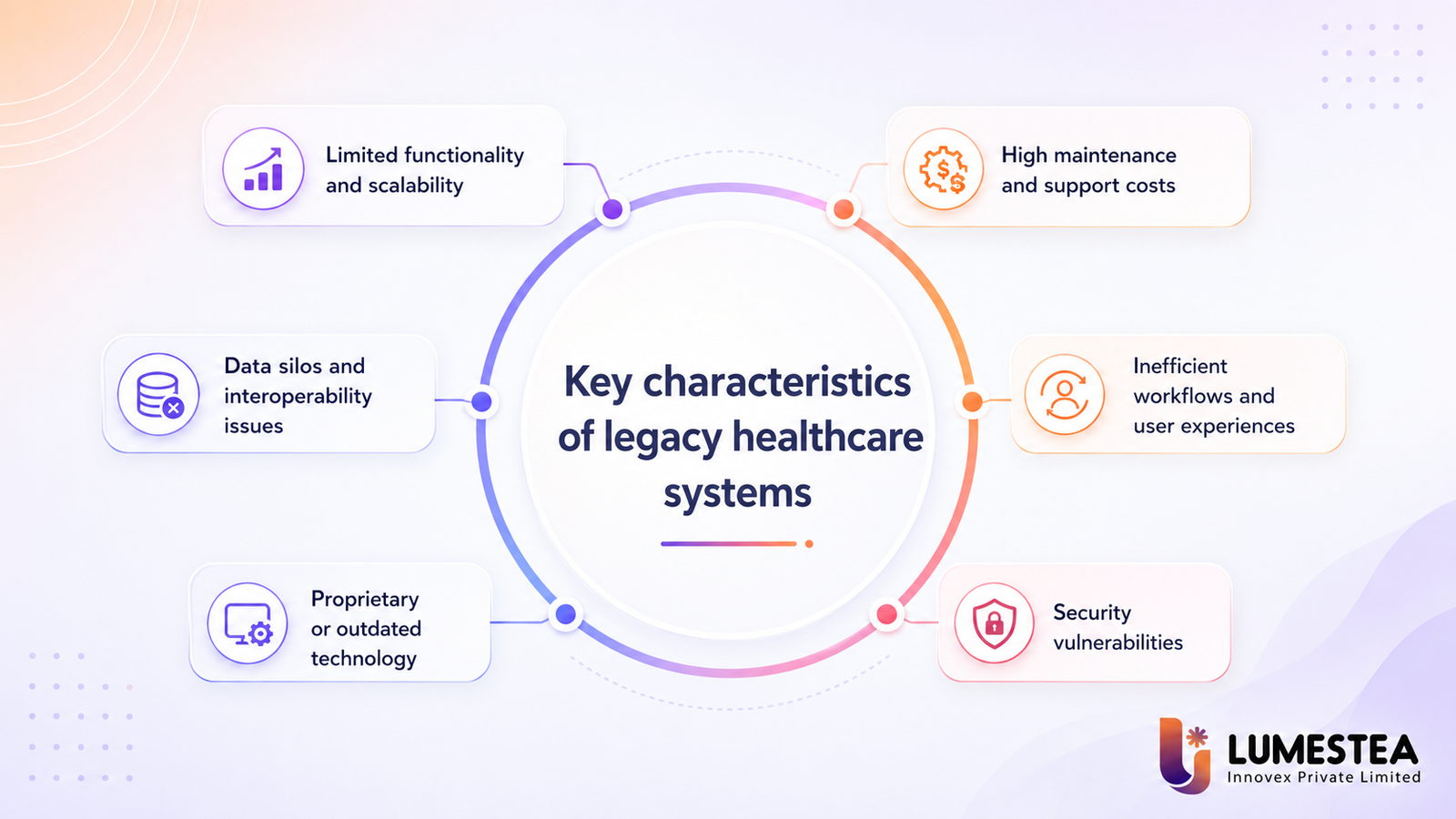
If several of these signs appear together, modernization should not remain a future wishlist. It should become a structured roadmap with clear ownership, phased delivery, and measurable outcomes.
Risks of Delaying Legacy System Modernization
Delaying modernization can feel safer than changing critical systems, but the risk usually grows over time. The older the platform becomes, the harder it is to maintain, secure, integrate, and support. In healthcare, that delay can affect more than IT performance.
Patient safety may be affected when teams cannot access accurate or complete information at the right time. Operational efficiency suffers when employees move between disconnected tools or repeat the same data entry across multiple systems. Security exposure increases when outdated systems lack modern controls or vendor patches.
There is also a competitive risk. Patients increasingly expect digital access, online scheduling, secure communication, telehealth, and easy access to records. Healthcare providers that cannot support these experiences may lose trust to more digitally mature competitors.
Main Approaches to Healthcare Legacy System Modernization
The right modernization approach depends on the condition of the system, its role in healthcare operations, the level of technical debt, and the organization’s risk tolerance. Many healthcare organizations use more than one approach because different systems require different levels of change.
The most important point is to avoid short-term fixes that create long-term constraints. The architecture decisions made during modernization can define how easily the platform scales, integrates, and adapts over the next several years.
| Approach | Best For | What It Does |
|---|---|---|
| Encapsulation | Systems that still work but need modern connectivity. | Adds APIs or modern interfaces around the legacy system without changing the core immediately. |
| Rehosting | Applications that need infrastructure modernization quickly. | Moves the system to modern infrastructure or cloud with minimal code change. |
| Refactoring | Systems with useful business logic but poor internal code quality. | Improves maintainability, performance, and technical structure without changing external behavior. |
| Rearchitecting | Platforms that need scalability, modularity, and faster feature delivery. | Redesigns the architecture for cloud-native, microservices, or event-driven patterns. |
| Rebuilding | Systems that are too outdated to improve safely. | Creates a new platform while preserving required workflows and business logic. |
| Replacing | Systems beyond repair or no longer aligned with future needs. | Retires the old system and adopts a better custom or commercial solution. |
Step-by-Step Process to Modernize Healthcare IT Systems
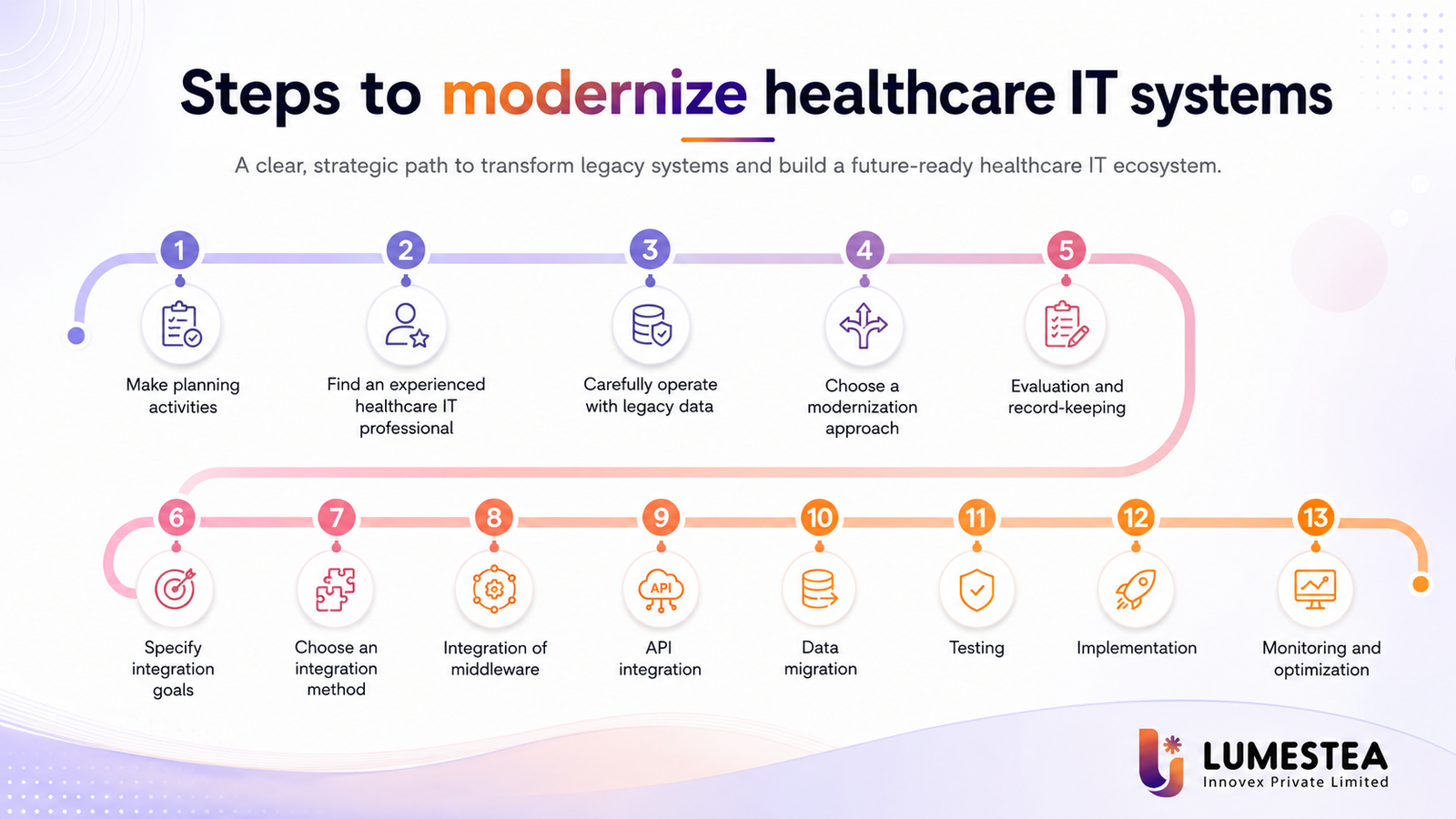
Modernizing healthcare systems requires a careful phased approach. These systems often support sensitive data and critical workflows, so the process must reduce disruption while improving security, usability, and interoperability.
-
01 Audit the Current IT Environment
Begin with a complete review of applications, databases, infrastructure, integrations, vendor dependencies, user roles, security controls, maintenance costs, and data flows. This gives the modernization team a clear view of risk and priority.
-
02 Define Business and Clinical Priorities
Modernization should connect to practical outcomes such as faster registration, improved care coordination, better reporting, reduced manual work, secure patient access, or lower claims processing time.
-
03 Choose the Right Modernization Strategy
Decide whether the system should be encapsulated, rehosted, refactored, rearchitected, rebuilt, or replaced. The decision should consider complexity, cost, timeline, compliance, and operational disruption.
-
04 Design a Compliance-First Architecture
Security, privacy, auditability, access control, encryption, backup, and disaster recovery should be included from the beginning. Healthcare modernization cannot treat compliance as a final stage checklist.
-
05 Plan Interoperability and Data Exchange
Define how the system will connect with EHR, billing, lab, imaging, telehealth, patient portal, analytics, and external partner systems. API-first and standards-based integration should be prioritized where possible.
-
06 Select the Right Technology Stack
Choose technologies that support scalability, maintainability, secure access, cloud readiness, analytics, and future AI or automation needs. The stack should match the organization’s long-term roadmap, not only immediate delivery speed.
-
07 Create a Data Migration Plan
Profile, clean, map, migrate, validate, and reconcile data carefully. Patient and operational data must be accurate, complete, and secure before the modernized system becomes the source of truth.
-
08 Develop and Test in Phases
Use phased development, integration testing, security testing, performance testing, usability testing, and user acceptance testing. This reduces risk and allows teams to validate real workflows before full rollout
-
09 Train Users and Manage Change
Doctors, nurses, administrators, billing teams, and support staff need clear training and communication. A modern system succeeds only when users understand how it improves their daily work.
-
10 Monitor and Optimize After Launch
Track uptime, performance, API reliability, security events, data quality, user adoption, and workflow efficiency after deployment. Modernization should continue through optimization and support.
Best Integration Methods for Healthcare Modernization
Integration is often the difference between a successful modernization effort and another disconnected system. Healthcare platforms must exchange accurate data across departments, systems, devices, and external partners while maintaining security and auditability.
Modern teams commonly use APIs, middleware, HL7/FHIR integration, iPaaS platforms, and automation layers to connect legacy systems with modern applications. The chosen integration method should depend on data sensitivity, workflow complexity, transaction volume, and long-term maintainability.
| Integration Method | Best Use Case |
|---|---|
| API Integration | Connecting patient portals, mobile apps, telehealth platforms, analytics tools, and third-party services. |
| HL7/FHIR Integration | Standardized healthcare data exchange across EHR, lab, imaging, and external systems. |
| Middleware | Connecting legacy platforms with newer applications without immediately replacing the core system. |
| RPA | Automating repetitive tasks where legacy systems do not provide reliable APIs. |
| iPaaS | Connecting cloud and on-premise healthcare applications with reduced infrastructure overhead. |
A modernized healthcare platform should not only be technically stronger; it should also reduce friction for doctors, staff, and patients through cleaner, more intentional UX. When usability is ignored, even technically strong systems can fail to gain adoption
How Cloud Supports Healthcare Legacy Modernization
Cloud adoption is often a major part of healthcare modernization because it can improve scalability, disaster recovery, data storage, monitoring, remote access, and analytics readiness. However, cloud migration should not be treated as a simple hosting change.
A secure healthcare cloud strategy should include access control, encryption, network segmentation, audit logging, backup planning, disaster recovery, and continuous monitoring. The organization should also define which workloads are ready for cloud migration and which require refactoring or rearchitecture first.
For many organizations, rehosting is a useful first step, but it should not be mistaken for complete transformation. The strongest modernization outcomes happen when cloud infrastructure, application architecture, integration design, and data strategy are planned together.
Role of AI and Automation in Healthcare Modernization
AI and automation can deliver meaningful value in healthcare, but only when the underlying systems and data foundation are ready. Legacy environments often hold data in disconnected formats, making it difficult to build reliable analytics, predictive models, or workflow automation.
Once systems are modernized, healthcare organizations can support use cases such as clinical documentation assistance, predictive risk scoring, patient communication automation, claims workflow support, remote monitoring alerts, and operational forecasting.
The priority should be practical AI, not novelty. Healthcare teams should focus on high-impact workflows where automation can reduce administrative burden, improve response time, support better decisions, and maintain human oversight.
Challenges in Modernizing Legacy Healthcare Systems
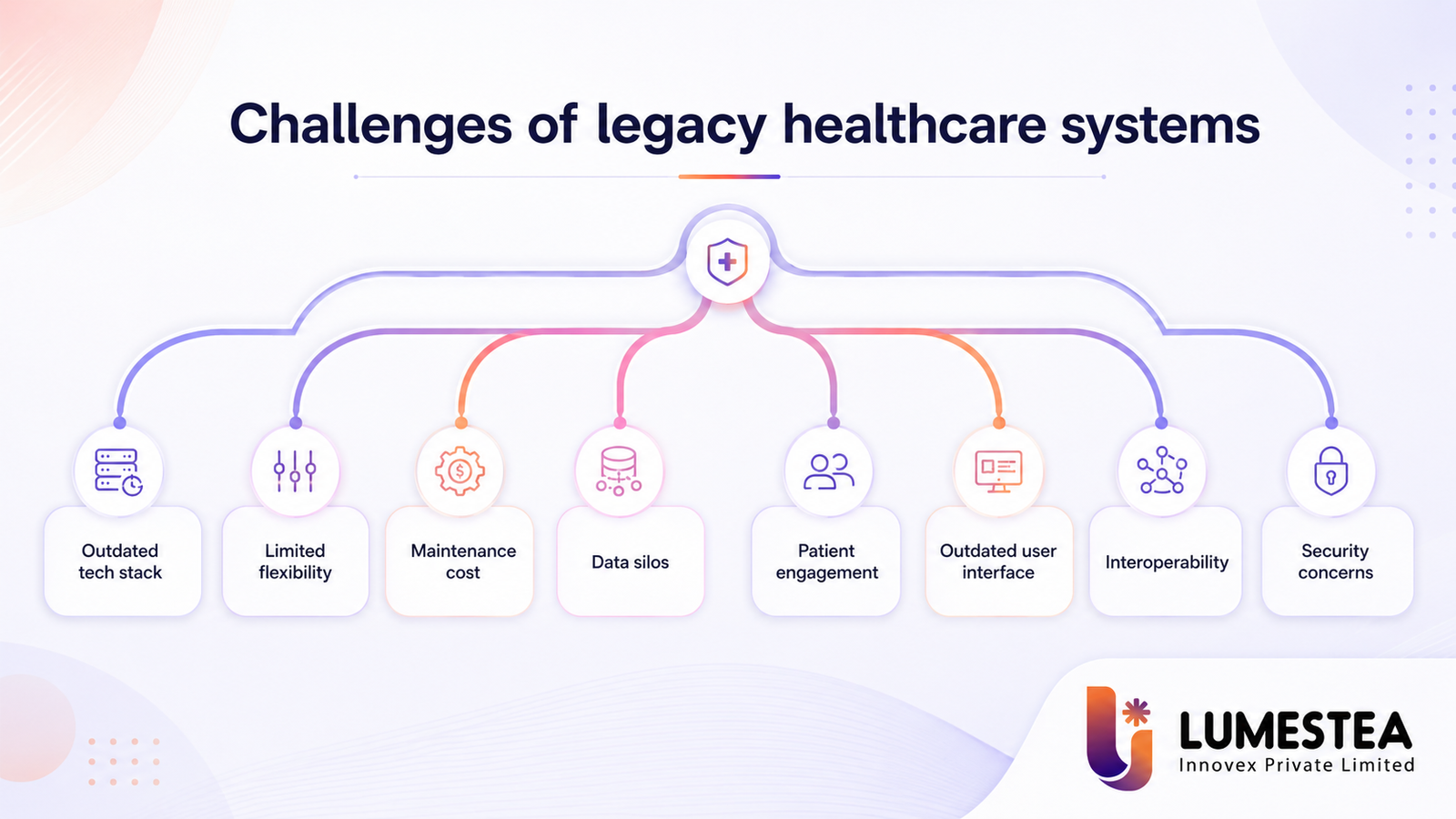
Healthcare modernization can produce strong long-term results, but it requires careful planning. The challenge is not only replacing technology. It is managing dependencies, protecting patient data, maintaining continuity, and helping users adapt to new workflows.
-
System Dependencies
Legacy platforms are often connected to billing, reporting, scheduling, labs, imaging, and EHR workflows. A change in one area can affect many others.
-
Data Migration Risk
Patient and operational data must be cleansed, mapped, validated, and reconciled carefully to avoid errors or incomplete records.
-
Compliance and Security
Modernization must protect sensitive health data through secure architecture, access control, audit logs, encryption, and monitoring.
-
User Adoption
Clinicians and staff may resist new systems if they feel the change adds steps or slows them down. Training and workflow design are essential.
-
Budget and Resource Limits
Modernization requires investment in planning, development, migration, testing, training, and long-term support.
-
Downtime Management
Healthcare operations are time-sensitive. Deployment must be phased and supported by rollback, backup, and continuity planning.
Best Practices for Successful Healthcare Modernization
Successful healthcare modernization starts with business clarity. The organization should know which workflows are most affected, which systems carry the highest risk, and which outcomes matter most. This prevents modernization from becoming a purely technical exercise.
A phased roadmap is usually safer than a big-bang replacement. Teams can modernize one workflow, integration, or module at a time while validating performance, data quality, compliance controls, and user feedback. This approach reduces disruption and allows the organization to show progress earlier.
Security and compliance should be built into the architecture from day one. Data migration should be tested repeatedly. Users should be involved before launch, not only after deployment. Post-launch monitoring should track performance, adoption, data quality, and operational improvements.
KPIs to Measure Modernization Success
Healthcare leaders should measure modernization success with operational, technical, compliance, and user-experience indicators. The goal is to prove that the new system improves real outcomes, not just technology appearance.
| KPI Area | Example Metrics |
|---|---|
| Performance | System uptime, response time, API success rate, error rate. |
| Operational Efficiency | Reduction in manual entry, faster registration, shorter claims processing time. |
| User Adoption | Active user rate, task completion time, staff satisfaction, training completion. |
| Data Quality | Migration accuracy, duplicate reduction, reconciliation success, report reliability. |
| Security and Compliance | Audit readiness, access review completion, incident reduction, backup success rate. |
| Patient Experience | Portal adoption, appointment completion rate, communication response time, satisfaction score. |
Final Thoughts
Modernizing legacy systems in healthcare is not just about replacing outdated software. It is about creating a secure, connected, scalable, and user-friendly digital foundation for better healthcare delivery.
The strongest modernization strategies align technology decisions with clinical workflows, operational priorities, compliance expectations, and patient experience goals. When done well, modernization reduces friction, improves data access, strengthens security, and prepares healthcare organizations for future innovation.
Healthcare organizations that modernize early will be better positioned to support digital care delivery, AI-enabled workflows, secure data exchange, remote access, and more responsive patient engagement.
Final CTA
Lumestea can help you assess current risks, plan a secure modernization roadmap, and build scalable healthcare technology that supports real-world workflows.
Frequently Asked Questions
1) What is legacy system modernization in healthcare?
Legacy system modernization in healthcare is the process of upgrading, integrating, rearchitecting, rebuilding, or replacing outdated healthcare technology so it can support modern security, interoperability, compliance, cloud, analytics, and user experience requirements.
2) Why do healthcare organizations need to modernize legacy systems?
Healthcare organizations need modernization because legacy systems often create security risks, slow workflows, data silos, high maintenance costs, poor user experience, and limited interoperability with modern healthcare platforms.
3) What are examples of legacy healthcare systems?
Common examples include outdated EHR systems, hospital information systems, laboratory information systems, radiology platforms, PACS, claims processing systems, patient portals, billing platforms, and telehealth systems.
4) What is the best approach to modernizing healthcare legacy systems?
The best approach depends on the system’s condition, risk, complexity, and business value. Common options include encapsulation, rehosting, refactoring, rearchitecting, rebuilding, and replacing. Many healthcare organizations use a phased hybrid approach.
5) How does modernization improve healthcare interoperability?
Modernization improves interoperability by introducing APIs, standards-based data exchange, middleware, HL7/FHIR integration, and cloud-ready architecture. This allows EHR, billing, lab, imaging, telehealth, and patient engagement systems to exchange data more effectively.
6) Is cloud migration safe for healthcare systems?
Cloud migration can be safe for healthcare when implemented with encryption, access controls, audit logging, backup planning, disaster recovery, security monitoring, and compliance-aware architecture.
7) What are the biggest challenges in healthcare legacy modernization?
The biggest challenges include complex system dependencies, data migration risk, regulatory compliance, cybersecurity, user adoption, downtime management, budget limitations, and limited legacy documentation