

How Machine Learning Is Revolutionizing E-Commerce — A Complete Guide by Lumestea Innovex Private Limited
How Machine Learning Is Revolutionizing E-Commerce — A Complete Guide by Lumestea Innovex Private Limited
 Deepanshu

Summarize with AI
Not enough time? Get the key points instantly.


Introduction
What truly separates a physical retail store from an online one? Walk into a brick-and-mortar shop, and a salesperson can greet you, understand your preferences, and guide you to exactly what you need. In the digital world, that personal connection has traditionally been missing — until now.
Machine learning in e-commerce is closing that gap, enabling online businesses to understand their customers at an individual level, predict their behavior, and deliver personalized experiences at scale — all without a single face-to-face interaction.
At Lumestea Innovex Private Limited, we help businesses harness the full potential of machine learning to transform their digital commerce operations. In this in-depth guide, we cover the most impactful ML use cases in e-commerce, walk you through the process of implementing ML solutions, and outline the key considerations for deploying ML in a live business environment.
How Machine Learning Is Used in E-Commerce
Machine learning is no longer a novelty for e-commerce businesses — it has become a strategic necessity. Forward-thinking retailers are using ML not just to experiment with new tools, but to uncover revenue opportunities, improve customer lifetime value, and build competitive advantages that are difficult to replicate.
The question for most businesses today is not whether to adopt machine learning, but where to start and how to implement it effectively. The sections below outline the most powerful and proven applications of ML in the e-commerce space.
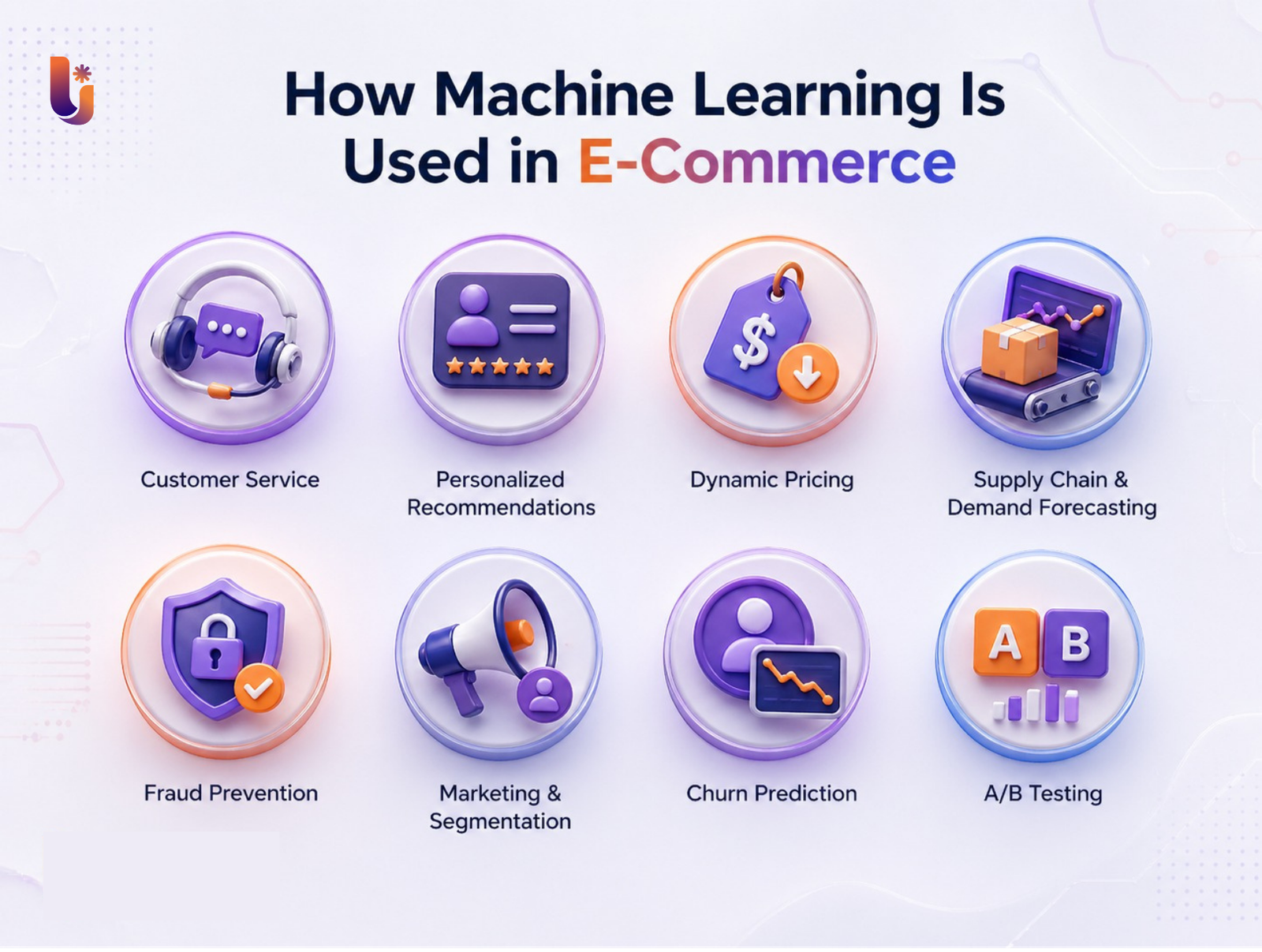
Top ML Use Cases Transforming Online Retail
1. Smarter Customer Service with AI-Powered Chatbots
Delivering exceptional customer service in a high-volume online environment is one of the biggest operational challenges for e-commerce businesses. Customers expect instant, accurate, and helpful responses around the clock — expectations that are virtually impossible to meet with human agents alone.
Machine learning makes this achievable through AI-powered conversational chatbots. These systems analyze customer queries in real time, simulate natural dialogue, and provide relevant answers based on a continuously expanding knowledge base. The more interactions a chatbot processes, the more refined and accurate its responses become.
Beyond reactive customer support, ML-driven chatbots are increasingly being deployed as proactive virtual shopping assistants. By asking customers a few targeted questions, these assistants can identify preferences, recommend suitable products, and even detect upselling opportunities — delivering a customized shopping experience that mirrors what customers would receive in a premium physical store.
Key Benefits:
- Round-the-clock customer support without added staffing costs
- Consistent and accurate responses to high-frequency queries
- Real-time upselling and cross-selling suggestions
- Personalized shopping guidance that increases average order value
2. Hyper-Personalized Product Recommendations
One of the most commercially impactful applications of machine learning in e-commerce is personalized product recommendation. When done well, recommendations feel less like advertising and more like genuine, helpful suggestions — and that distinction drives conversions.
ML algorithms analyze rich datasets including a customer’s browsing history, past purchase behavior, wishlist activity, session duration on specific product pages, and even interactions on external platforms like social media. By finding meaningful patterns within this data, the algorithm can predict which products a particular shopper is most likely to buy next and surface those products at precisely the right moment.
Personalization can take many forms: recommending items similar to previous purchases, highlighting trending products within a customer’s preferred categories, or showing special offers to shoppers who consistently seek out discounts. Each approach is tailored to the individual’s behavioral profile, significantly increasing the probability of conversion and repeat purchases.
3. Dynamic Pricing for Maximum Competitiveness
In today’s highly competitive online retail landscape, static pricing strategies are no longer sufficient. Consumers compare prices across multiple platforms before making a purchase, and even small price differences can determine whether a sale is won or lost.
Machine learning enables dynamic pricing — a strategy in which product prices are automatically adjusted in real time based on a combination of market signals. There are three primary dynamic pricing methodologies:
- Cost-Based Pricing: Prices are calibrated to cover operational expenses while protecting profit margins, automatically adjusting as cost inputs change.
- Competitor-Based Pricing: Pricing algorithms continuously monitor rival retailers and adjust prices to maintain a competitive position without sacrificing profitability.
- Demand-Based Pricing: Prices respond to fluctuations in consumer demand, rising during periods of peak interest and falling when demand softens to stimulate sales.
By implementing ML-powered dynamic pricing, e-commerce businesses can optimize revenue across their entire product catalog in real time — a level of pricing precision that would be impossible to achieve manually.
4. Supply Chain Optimization and Demand Forecasting
Inventory management is a persistent challenge in e-commerce. Overstock situations tie up capital and increase storage costs, while stockouts lead to lost sales and frustrated customers. Traditional manual inventory management is slow, error-prone, and incapable of responding quickly to sudden shifts in consumer demand.
Machine learning addresses this challenge by combining historical sales data with real-time market signals to generate highly accurate demand forecasts. ML models can detect early indicators of demand shifts — such as seasonal trends, viral product mentions on social media, or competitor stockouts — and trigger automatic inventory adjustments before problems arise.
The result is leaner, more responsive supply chain management that reduces waste, prevents revenue loss, and supports more targeted marketing and pricing decisions.
5. Fraud Detection and Transaction Security
E-commerce fraud is a growing threat that costs businesses billions of dollars each year. As fraudsters develop increasingly sophisticated techniques, traditional rule-based detection systems struggle to keep pace.
Machine learning offers a fundamentally more adaptive approach to fraud prevention. ML models are trained on historical transaction data to recognize the behavioral fingerprints of fraudulent activity — unusual purchasing patterns, atypical login locations, mismatched device identities, and more. Each new transaction is evaluated against this learned risk profile and assigned a dynamic risk score in milliseconds.
Crucially, ML fraud detection systems improve over time. Every transaction processed — whether legitimate or fraudulent — adds to the model’s understanding, making it progressively more accurate. And because the entire process operates invisibly in the background, it creates no friction for legitimate customers.
6. Precision Marketing and Customer Segmentation
The data generated by e-commerce platforms is an enormously valuable asset — but only when it is properly analyzed and applied. Machine learning enables businesses to extract deep insights from this data, transforming raw behavioral information into actionable marketing intelligence.
ML algorithms can segment a customer base into highly granular groups based on purchase history, browsing habits, content preferences, price sensitivity, geographic location, and more. These segments can then be targeted with precisely tailored marketing communications that are far more likely to resonate and convert.
In email marketing specifically, ML can help businesses optimize subject lines for higher open rates, determine the optimal send time for each individual recipient, and dynamically populate email content based on personal preferences — turning generic batch communications into one-to-one conversations at scale.
7. Customer Churn Prediction and Retention
Losing a customer is far more costly than retaining one. Research consistently shows that acquiring a new customer costs several times more than keeping an existing one — yet historically, most marketing investment has been directed toward acquisition rather than retention.
Machine learning is changing this dynamic by making it possible to predict customer churn with remarkable accuracy. An ML-based churn prediction model analyzes behavioral signals — declining purchase frequency, reduced session times, lower engagement with marketing communications, increasing cart abandonment — to identify customers who are at risk of disengaging before they actually leave.
Armed with this intelligence, businesses can proactively intervene with personalized retention campaigns, exclusive offers, loyalty rewards, or targeted outreach — all timed to occur at the moment when intervention is most likely to be effective.
8. Intelligent A/B Testing and Conversion Optimization
A/B testing has long been a cornerstone of e-commerce optimization, but traditional approaches are slow, often imprecise, and heavily reliant on human judgment. Machine learning makes A/B testing faster, smarter, and more actionable.
ML enhances the A/B testing process in three important ways:
- Automated Customer Segmentation: Before any test is run, ML algorithms segment the audience into behaviorally coherent groups, ensuring that each variant is tested against the most relevant customer cohort. This produces more statistically meaningful results.
- Automated Decision-Making: Rather than waiting for human analysts to review test results and draw conclusions, ML algorithms can evaluate outcomes in real time and automatically implement the higher-performing variant — compressing the optimization cycle from weeks to days.
- Optimal Product Display Optimization: ML models determine which products, promotions, or page elements should be displayed to specific customer segments based on predicted engagement and conversion probability — continuously refining the customer-facing experience.

How to Implement ML Models for Churn Prediction
Implementing an ML solution is a structured process that requires careful planning, data preparation, and ongoing management. Below is a practical step-by-step framework for deploying an ML model specifically designed to predict and reduce customer churn — one of the most common and high-impact ML applications in e-commerce.
Step 1: Define the Business Problem
Every successful ML project begins with a clearly articulated business problem. In the case of churn prediction, the challenge is straightforward: too many customers are disengaging, and the business lacks the tools to identify who is at risk or to intervene before they leave.
The goal of the ML solution is to detect early warning signs of disengagement by analyzing the behavioral patterns of customers who have previously churned, and to use those patterns to flag current customers who exhibit similar trajectories.
Step 2: Identify Data Sources
Once the problem is defined, the next step is identifying where the relevant data lives. For a churn prediction model, useful data sources typically include CRM systems, website analytics platforms, purchase transaction databases, email engagement records, customer support logs, and feedback submissions.
The principle here is simple: the more relevant data the model has access to, the more accurate its predictions will be.
Step 3: Data Collection, Cleaning, and Preparation
Raw data from multiple sources is rarely ready for immediate use in an ML model. Data scientists must clean, standardize, and transform this data into a consistent format. This includes removing duplicates, handling missing values, resolving formatting inconsistencies, and ensuring that data points are logically coherent across all sources.
This preparatory stage is one of the most time-intensive aspects of any ML project, but also one of the most consequential — the quality of input data directly determines the reliability of model outputs.
Step 4: Feature Engineering
Feature engineering is the process of identifying and constructing the most informative input variables— or “features” — for the model to learn from. For a churn prediction model, relevant features might include the number of purchases in the last 30 days, average time between orders, email open rate trend, recent product return rate, and session frequency over time.
Good feature engineering significantly improves model accuracy. The goal is to distill the most predictive signals from the available data while eliminating noise and redundancy.
Step 5: Customer Segmentation
Grouping customers into segments with similar behavioral profiles before training the model can substantially improve prediction accuracy. Because behavior within a segment tends to be more homogeneous, the model can learn more precise patterns for each group, leading to more targeted and effective retention strategies.
Step 6: Model Selection, Training, and Testing
With features selected and data prepared, the team can begin building and evaluating ML models. Multiple algorithms are typically tested — starting with a simple baseline model and progressively moving to more sophisticated approaches. Models are evaluated against held-out test data to measure accuracy, precision, recall, and other relevant performance metrics.
Step 7: Deployment and Continuous Monitoring
Once the best-performing model is identified, it is deployed into the live production environment. This can be done by integrating the model directly into existing business systems or by deploying it as a standalone analytics service.
Critically, ML models require ongoing monitoring and periodic retraining. As customer behavior evolves and new data accumulates, models can drift — meaning their predictions become less accurate over time. Establishing robust monitoring processes ensures that model performance is maintained and that interventions remain timely and relevant.
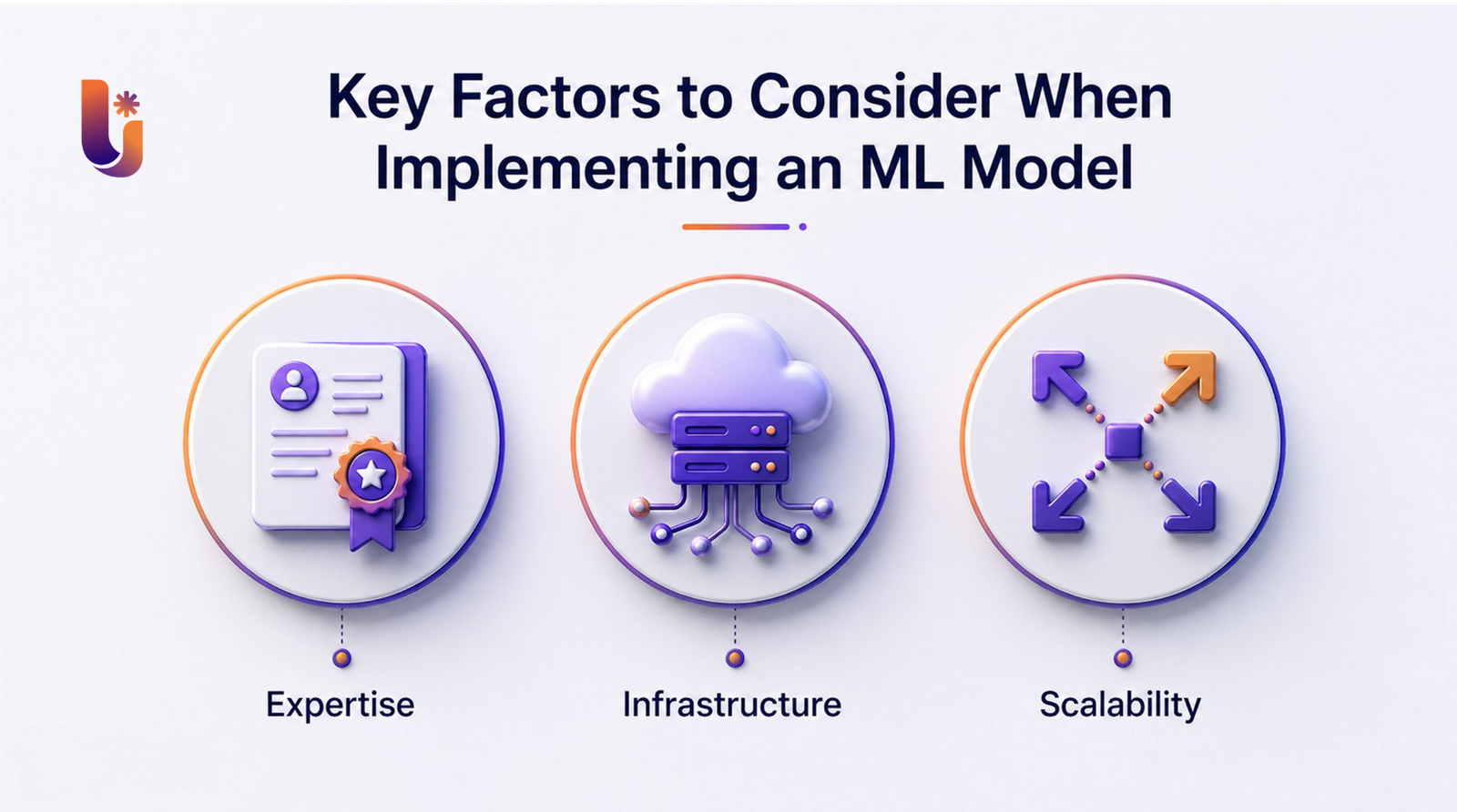
Key Factors to Consider When Deploying an ML Model
Moving from model development to live deployment introduces a new set of challenges and risks. Here are the most important considerations to address:
Technical Expertise
Building and deploying ML models requires a diverse mix of skills — data science, software engineering, MLOps, and domain knowledge. At Lumestea Innovex Private Limited, our multidisciplinary team covers the full spectrum of capabilities needed to take an ML project from concept to production.
Infrastructure Readiness
A robust, scalable technology infrastructure is a prerequisite for ML deployment. Cloud platforms such as Google Cloud Platform, Microsoft Azure, and Amazon Web Services (AWS) are particularly well-suited for ML workloads, offering elastic computing resources that can scale up or down based on model demands — without requiring major upfront capital investment.
Scalability Planning
ML models grow in complexity and data volume over time. It is essential to design the architecture with scalability in mind from the outset, ensuring that the system can handle increasing data throughput and computational requirements without performance degradation.
Best Practices for ML Development and Deployment
To ensure that ML initiatives deliver consistent, reliable results in production environments, Lumestea Innovex Private Limited recommends the following engineering practices:
CI/CD Pipeline Integration
Integrating Continuous Integration and Continuous Deployment (CI/CD) pipelines into the ML development lifecycle automates testing, validation, and deployment workflows. This reduces the risk of human error, accelerates the pace of model iteration, and ensures that only thoroughly validated models reach production.
Observability and Monitoring
Observability refers to the ongoing practice of monitoring system performance, model behavior, and output quality in real time. A robust observability framework enables teams to quickly detect anomalies, diagnose issues, and implement corrections before they affect business outcomes or customer experience.
Site Reliability Engineering (SRE)
Adopting Site Reliability Engineering principles ensures that ML systems are designed and managed to meet high standards of availability, performance, and resilience. SRE practices such as load testing, failover planning, and disaster recovery preparation are essential for e-commerce environments where system downtime translates directly into revenue loss.
Conclusion
Machine learning is fundamentally reshaping the e-commerce landscape — and the gap between businesses that leverage it and those that do not is widening every year. From personalized product recommendations and intelligent chatbots to dynamic pricing engines and churn prediction models, ML is enabling online retailers to operate with a level of intelligence, agility, and customer-centricity that was simply not possible a decade ago.
At Lumestea Innovex Private Limited, we specialize in building practical, scalable machine learning solutions tailored to the unique needs of e-commerce businesses. Whether you are exploring ML for the first time or looking to scale an existing initiative, our team of experts is ready to guide you through every stage of the journey — from strategy and data preparation to deployment and ongoing optimization.
The businesses that invest in machine learning today are the ones that will define the future of digital retail. Don’t let your competitors get there first — reach out to Lumestea Innovex Private Limited today and take the first step toward a smarter, more profitable e-commerce operation.
Transform Your E-Commerce with Machine Learning
Reach out to Lumestea Innovex Private Limited today and take the first step toward a smarter digital business.