

Top 20 Voice AI Agent Development Companies Building Smarter Conversations in 2026
Top 20 Voice AI Agent Development Companies Building Smarter Conversations in 2026
 Deepanshu

Summarize with AI
Not enough time? Get the key points instantly.


Table of Contents
What Is a Voice AI Agent?
How Voice AI Agents Work
Which industries use voice AI agents
Why Voice AI Agent Development Is Different From Basic Chatbot Development
Top 20 Voice AI Agent Development Companies in 2026
How to Choose the Right Voice AI Agent Development Company
Voice AI Agent Development Checklist
Compliance and Transparency for Voice AI Agents
Build vs Buy: Platform or Custom Voice AI Agent?
How Lumestea Can Help Build Voice AI Agents
FAQs
Conclusion
Voice AI agents are changing how businesses handle conversations. A few years ago, most automated voice systems felt slow, robotic, and frustrating. They followed fixed scripts, failed when users interrupted, and quickly pushed people back to human support.
That has changed.
Modern voice AI agents can listen, understand intent, respond naturally, access business systems, qualify leads, schedule appointments, route support requests, update CRM records, and hand off to humans when needed. For many businesses, the voice agent is no longer just a call automation tool. It is becoming a front-line digital worker.
The global voice AI agents market is projected to grow from USD 2.4 billion in 2024 to around USD 47.5 billion by 2034, according to Market.us. Juniper Research also projected that voice assistant devices in use would reach 8.4 billion by 2024, showing how familiar users have become with speaking to digital systems.
For companies, this creates a major opportunity. Voice AI can reduce support load, capture leads after hours, improve scheduling workflows, support multilingual customer journeys, and make enterprise data easier to access through natural conversation.
But the real challenge is not whether voice AI is useful. The real challenge is choosing the right development partner.
Some businesses need a no-code calling platform. Some need a custom voice agent connected to CRM, ERP, payments, booking tools, or healthcare systems. Others need an enterprise-grade AI architecture with audit logs, privacy controls, escalation workflows, and compliance-ready data handling.
This guide explains how voice AI agents work, where they are used, which companies are active in this space, and how to choose the right partner for your use case. If your team is already evaluating AI automation ROI research. AI chatbot market and ROI research.
What Is a Voice AI Agent?
A voice AI agent is an artificial intelligence system that can hold spoken conversations with users in real time. It listens to speech, converts it into text, understands the request, decides what to do, creates a response, converts that response back into speech, and speaks to the user naturally.
A simple voice bot may only answer basic questions. A more advanced voice AI agent can complete workflows, pull data from connected systems, schedule appointments, update records, qualify prospects, verify information, and escalate complex conversations to a human team.
The best voice AI agents are not just voice interfaces. They combine speech recognition, natural language understanding, large language models, text-to-speech, conversation design, backend integrations, analytics, and safety controls.
That is why choosing a development partner matters. A voice AI agent that sounds impressive in a demo can still fail in production if it cannot handle accents, interruptions, background noise, security, CRM updates, compliance, or human handoff.
How Voice AI Agents Work
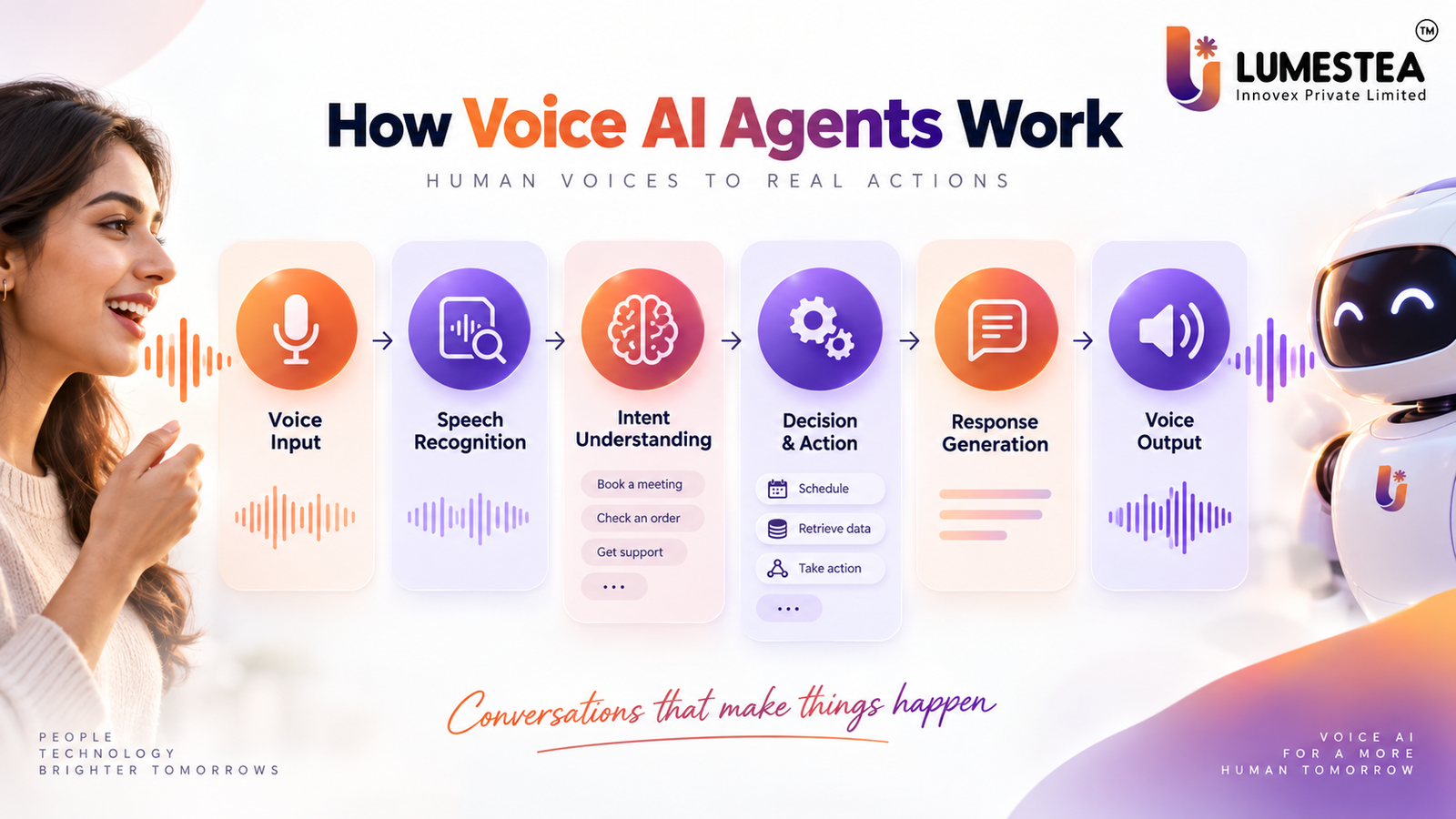
A voice AI agent works through a real-time conversation pipeline. Each part of the pipeline must perform well for the full experience to feel natural.
First, the user speaks through a phone call, web app, mobile app, smart device, or microphone. The system captures the audio and sends it to an automatic speech recognition layer. This layer converts speech into text while handling accents, background noise, silence, and overlapping speech.
Next, the natural language understanding layer identifies what the user wants. It may detect whether the user is booking an appointment, checking an order, asking for support, requesting a refund, or confirming account details.
After that, the agent decides what to do. It may search a knowledge base, query a CRM, check an ERP record, verify availability, trigger a workflow, or use retrieval-augmented generation to ground the answer in approved business data.
Then the system generates a response and converts it into natural-sounding speech using a text-to-speech engine. In strong systems, this all happens quickly enough that the user feels like they are having a real conversation, not waiting for a machine.
The OpenAI Realtime API is one example of modern speech-to-speech infrastructure used for low-latency voice experiences.
The architecture behind a voice AI agent should be planned carefully, because early architecture decisions around model orchestration, integrations, vendor lock-in, and data access can become expensive to change later.
Where Voice AI Agents Are Used
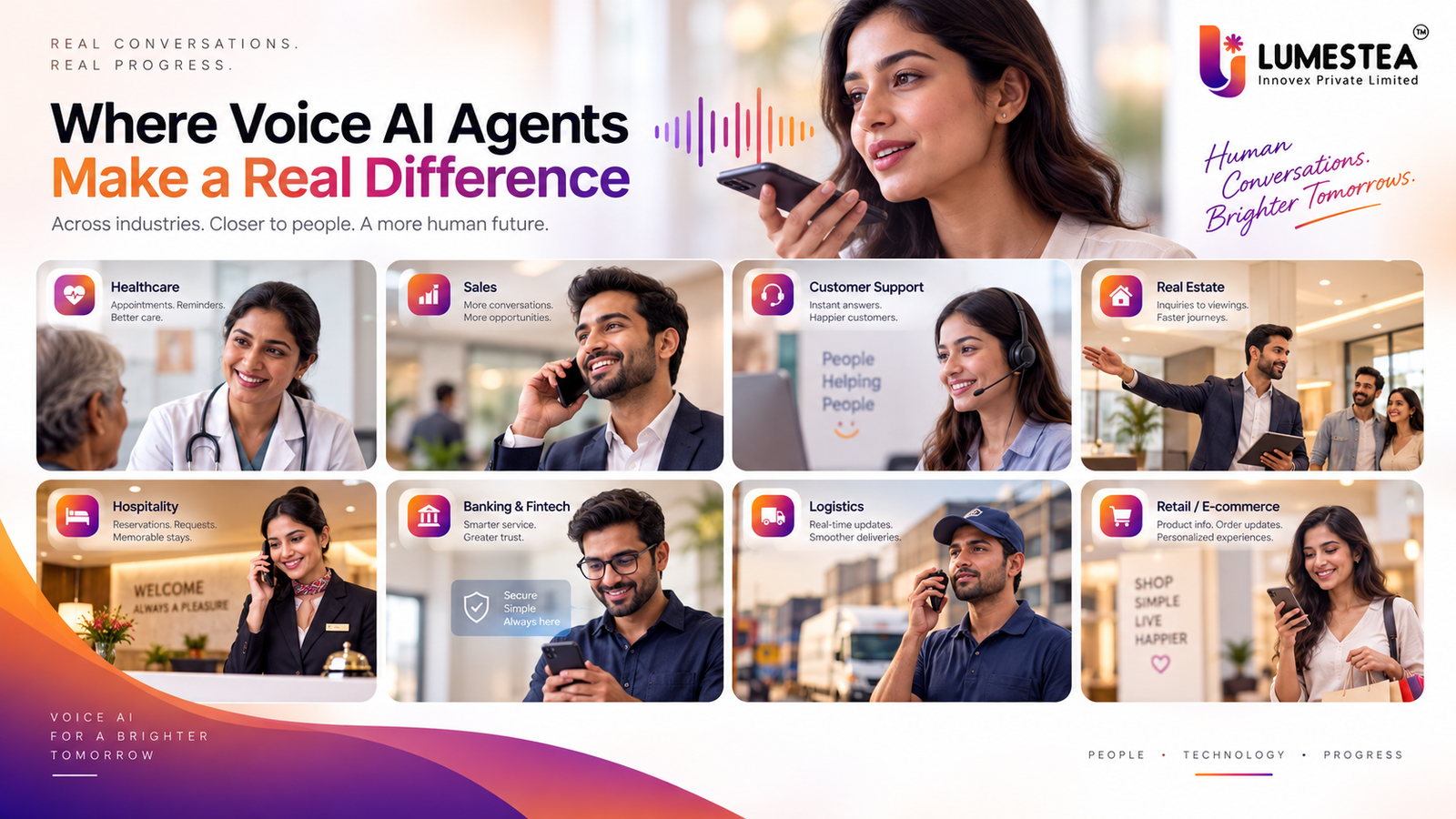
Voice AI agents are useful wherever a business handles repeated conversations, time-sensitive requests, or high-volume customer interactions.
- Healthcare — appointment scheduling, prescription refill requests, intake questions, insurance verification, follow-up reminders, and telehealth check-ins.
- Sales — qualifying leads, scheduling demos, capturing objections, and updating CRM notes after calls.
- Customer support — answering common questions, routing calls, summarizing interactions, and reducing wait times.
- Real estate — booking property tours and capturing buyer details.
- Restaurants and hospitality — reservations, menu questions, and takeout orders.
- Banking and fintech — balance inquiries, transaction checks, fraud alerts, and secure customer verification.
- Logistics — delivery updates, dispatch coordination, and driver support.
For logistics-heavy businesses, voice AI becomes stronger when connected with dispatch, tracking, and operational software. Our logistics software guide covers this in more detail.
Why Voice AI Agent Development Is Different From Basic Chatbot Development
Text chatbots and voice agents share some AI concepts, but voice creates a different level of complexity.
A text chatbot can wait for the user to type. A voice agent must respond while managing silence, interruptions, emotion, tone, latency, background noise, and real-time turn-taking. If the system pauses too long, users lose trust. If it speaks too quickly, users feel interrupted. If it misunderstands an accent or does not handle correction gracefully, the conversation breaks.
Voice AI also needs stronger conversation design. People do not speak the same way they type. They change their mind mid-sentence, ask vague questions, use filler words, and expect the agent to understand context.
Production voice agents also need telephony integration, call recording rules, consent handling, transcript retention policy, analytics, and live-agent transfer logic. In regulated industries, they may need stricter data protection, audit trails, and disclosure controls.
This is where product engineering discipline matters, because AI projects fail when teams skip architecture, QA, scope control, and real-world testing. Read more on why software product engineering projects fail.
Top 20 Voice AI Agent Development Companies in 2026
The companies below represent different delivery models. Some are custom software engineering partners. Some are conversational AI specialists. Some focus on no-code or platform-led voice automation. The right choice depends on your industry, budget, data sensitivity, integration needs, and how much control you want over the final product.
This list is not a one-size-fits-all ranking. It is a buyer-focused shortlist to help teams compare options.
1. Lumestea Innovex Private Limited
Lumestea Innovex Private Limited helps businesses build AI-powered software, automation systems, CRM/ERP solutions, healthcare platforms, SaaS products, and custom digital workflows. For voice AI agent projects, Lumestea is a strong fit when the voice layer needs to connect with real business systems rather than remain a standalone demo.
A practical voice AI implementation may require backend APIs, role-based access, CRM or ERP integration, workflow automation, reporting dashboards, human handoff, and post-launch monitoring. Lumestea’s AI-first product engineering approach is useful for companies that want to move from idea to production while keeping architecture, UX, compliance, and scalability in scope. Learn more about our AI & Emerging Tech services.
Best for: businesses that need custom voice AI agents connected to web apps, mobile apps, CRM, ERP, healthcare systems, logistics workflows, or internal automation tools.
2. Inoxoft
Inoxoft is a software development company that works across AI, machine learning, custom software, and product engineering. It is relevant for buyers looking for full-cycle development around voice AI, especially where the agent must connect with a larger platform.
The company is a good consideration when voice AI is one part of a bigger digital product such as patient intake, fintech workflows, logistics dashboards, or customer support automation.
Best for: regulated or workflow-heavy software products where voice needs to integrate with backend systems.
3. Impekable
Impekable focuses on enterprise digital product design and engineering. It can be relevant for organizations building voice AI experiences around contact centers, customer journeys, and enterprise service workflows.
Its strength is useful when the business needs careful UX, journey mapping, and polished customer-facing interaction design, especially in environments where brand experience matters.
Best for: enterprise teams that need voice AI with strong customer experience and contact-center design.
4. Greenice
Greenice is a custom software development company that works with startups and growing businesses. It is relevant for teams that want focused call automation, booking systems, verification workflows, and practical voice agent MVPs.
This type of partner is useful when the first goal is not a complex enterprise voice ecosystem but a working product that solves a specific operational problem.
Best for: startups and SMBs building booking, call handling, or lead automation agents.
5. Plavno
Plavno develops software products and AI-powered systems for industries such as healthcare, finance, e-commerce, HR, logistics, and travel. It is relevant for voice AI use cases where the agent needs to follow approved playbooks, retrieve knowledge, and support workflow automation.
A buyer may consider Plavno when the use case involves scheduling, pre-screening, employee support, order fulfillment, or industry-specific conversational workflows.
Best for: businesses needing custom AI assistants with workflow and knowledge-base grounding.
6. Azumo
Azumo provides AI development, data engineering, software engineering, and nearshore product teams. It can be a good fit for North American companies that want voice AI capability inside a broader web, mobile, or SaaS platform.
Azumo’s model can be useful when teams need ongoing engineering capacity, not just a one-time voice bot build.
Best for: companies looking for nearshore AI engineering and long-term product development support.
7. Intuz
Intuz works across AI, cloud, IoT, mobile, web, and enterprise software. For voice AI projects, it is relevant where the voice agent needs to interact with connected systems, operational platforms, or enterprise applications.
This can include manufacturing, healthcare, automotive, logistics, e-commerce, and business automation workflows.
Best for: enterprises that need voice AI connected with cloud, IoT, or operational systems.
8. Deviniti
Deviniti is relevant for businesses that require secure, private, or self-hosted AI systems. This matters for industries where sensitive customer, financial, healthcare, or government data cannot be freely sent into public AI services.
For voice AI, Deviniti can be considered when data sovereignty, auditability, and private infrastructure are important buying criteria.
Best for: finance, healthcare, public sector, and organizations needing self-hosted or private AI deployment.
9. BotsCrew
BotsCrew specializes in conversational AI and chatbot development. Its experience in conversation design, knowledge-base structuring, CRM integration, and human escalation can be useful for voice AI programs as well.
Businesses that want consistent automation across web chat, messaging, and phone channels may consider a conversational AI specialist like BotsCrew.
Best for: multi-channel conversational AI programs that combine text and voice.
10. Master of Code Global
Master of Code Global works on conversational AI, CRM integrations, customer engagement, and enterprise digital experiences. It is relevant for brands that need polished AI interactions connected with systems like Salesforce, HubSpot, or other customer platforms.
For voice AI, this matters when the agent must retrieve customer context, update records, and trigger follow-ups during or after calls.
Best for: retail, travel, hospitality, banking, and customer experience teams.
11. Markovate
Markovate works across AI, generative AI, mobile apps, backend platforms, and agentic workflows. It is relevant for businesses that want custom AI voice workflows, especially where multiple agents or automation layers need to coordinate.
It can be a consideration for restaurant, hospitality, insurance, finance, healthcare, and consumer-service use cases.
Best for: companies exploring voice AI agents with multi-step automation workflows.
12. Neoteric
Neoteric combines AI consulting, product design, and custom software development. It is relevant for companies that have a business problem but need help defining whether voice AI is the right solution and how it should be designed.
This type of discovery-led partner can help validate the use case before heavy development begins.
Best for: midmarket and enterprise teams that need AI discovery, product strategy, and engineering together.
13. Konstant Infosolutions
Konstant Infosolutions is a software development company with capabilities across web, mobile, cloud, AI, and enterprise applications. It can be relevant for companies that want to add voice capability into an existing customer app, marketplace, support portal, or service platform.
The key is to ensure the assigned team has real-time voice AI expertise, not only general software development capability.
Best for: cost-conscious businesses adding voice AI into web or mobile products.
14. RebelDot
RebelDot is a product development company with AI consulting and software engineering capabilities. It is relevant for larger product initiatives where voice AI is part of a broader digital product roadmap.
Because complex AI products require discovery, design, engineering, testing, and iteration, RebelDot can be considered when the use case is bigger than a simple phone automation project.
Best for: European businesses building larger AI-enabled products.
15. Qubika
Qubika works across AI, cloud, data engineering, product design, mobile, and enterprise software. It can be useful when a voice AI agent depends on cloud modernization, secure customer data access, event streams, and analytics.
For enterprise buyers, the surrounding data environment can matter as much as the conversation layer itself.
Best for: enterprises combining voice AI with cloud, data, and product modernization.
16. Cheesecake Labs
Cheesecake Labs provides AI consulting, product engineering, mobile development, and modernization services. It is relevant when the voice AI experience must fit inside a polished mobile or web product.
This can be especially useful for product companies that want voice as a feature rather than a standalone call center system.
Best for: product teams adding AI voice features to mobile and web applications.
17. GLOBALDEV
GLOBALDEV provides AI consulting, product development, web, mobile, and staff augmentation. It can support businesses that already have internal product ownership but need engineering capacity to build integrations, backend systems, dashboards, or AI features.
For voice AI, this model works when the client already has a clear roadmap and needs delivery support.
Best for: companies needing distributed AI and software engineering teams.
18. DataRoot Labs
DataRoot Labs is an AI-focused engineering and R&D company. It is relevant for teams that need deeper AI, data, experimentation, and MLOps expertise behind a voice agent.
This type of partner is useful when the voice product requires custom intelligence, retrieval pipelines, model evaluation, monitoring, or a strong data foundation.
Best for: AI-first startups and technical teams building advanced voice AI systems.
19. HatchWorks AI
HatchWorks AI combines AI consulting, data engineering, software development, and nearshore delivery. It is relevant for U.S. companies that want a structured path from discovery to production.
For voice AI, this approach can help companies validate the use case, prepare data sources, design the architecture, and build the surrounding software product.
Best for: U.S. enterprises needing AI discovery, data readiness, and nearshore delivery.
20. Waverley Software
Waverley Software is an established software engineering company with experience across AI, cloud, mobile, web, and enterprise applications. It can be relevant when voice AI is part of a larger engineering roadmap that also includes applications, infrastructure, and long-term maintenance.
Best for: established companies looking for a long-term engineering partner around AI-enabled products.
21. Neyox.ai
Neyox.ai is a specialized no-code voice AI platform for inbound and outbound calls. It is useful for smaller businesses that want to test appointment booking, lead qualification, reminders, or support automation without building a custom platform first.
The tradeoff is control. A no-code platform can move faster, but a custom build gives more flexibility over integrations, data ownership, compliance, and product roadmap.
Best for: small businesses testing voice automation quickly before investing in custom development.
How to Choose the Right Voice AI Agent Development Company
Choosing a voice AI partner should not start with a demo. It should start with your business workflow.
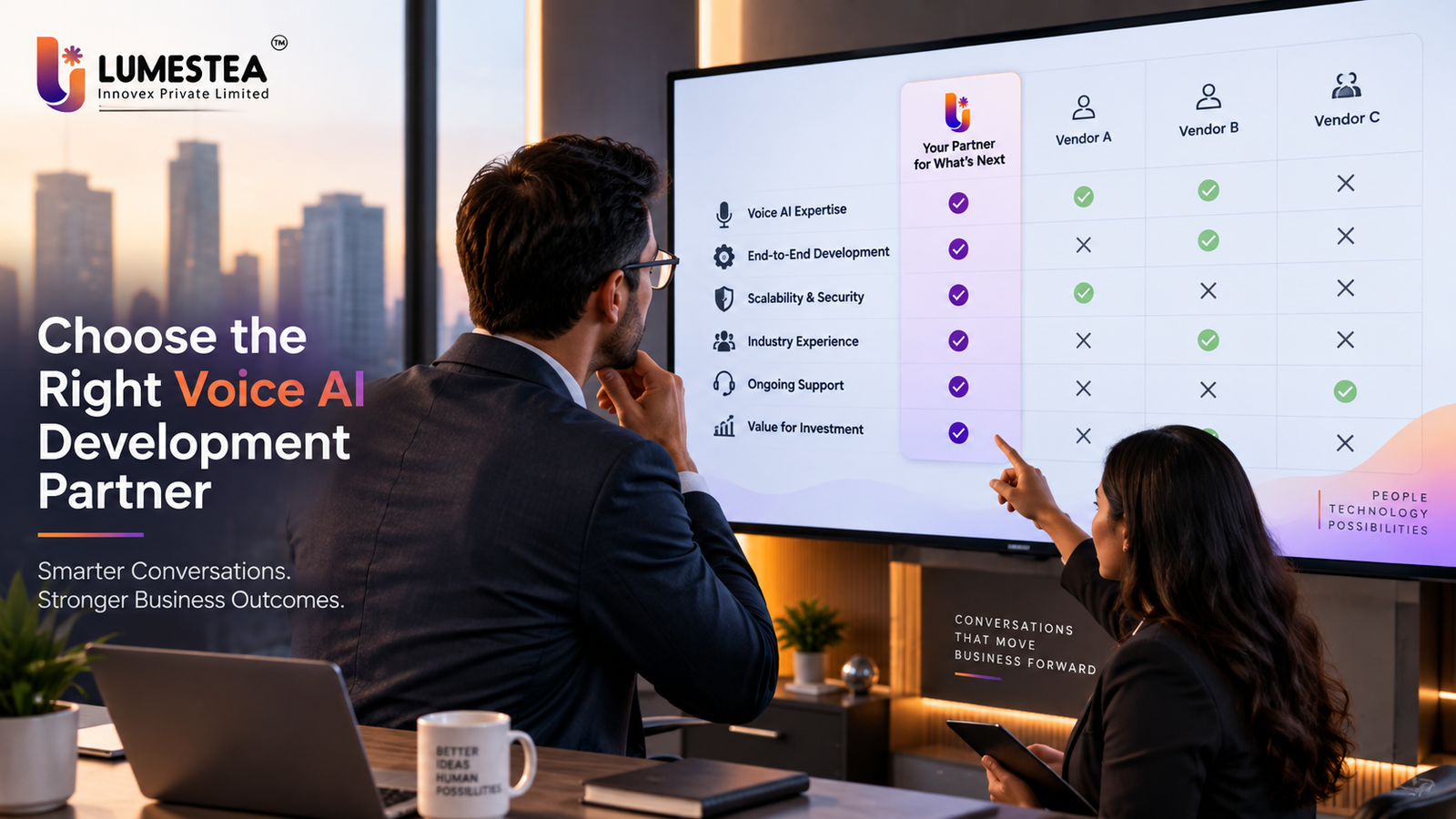
Ask what the agent needs to do. Is it only answering questions, or does it need to take action? Does it need to schedule appointments, update a CRM, verify identity, process payments, route calls, or summarize conversations? The more actions it performs, the more important architecture and security become.
A strong partner should ask about your users, call volume, data sources, escalation rules, compliance needs, languages, accents, and success metrics before proposing a solution.
Important evaluation areas include:
- Latency and speech accuracy
- Interruption handling and fallback behavior
- Human handoff
- Integration capability
- Data privacy and transcript retention
- Analytics
- QA process and model evaluation
- Post-launch optimization
If your voice AI agent will handle sensitive business or customer data, the partner must also understand security, access control, logging, compliance, and disaster recovery.
For businesses building voice AI inside CRM or ERP workflows, our guide on ERP AI chatbots is a helpful next read.
Voice AI Agent Development Checklist
Before hiring a vendor, define these requirements clearly:
| Area | What to Confirm |
| Use case | Support, sales, scheduling, intake, reminders, routing, or internal workflow |
| Channels | Phone, web, mobile, smart device, IVR, WhatsApp, or contact center |
| Speech stack | ASR, TTS, real-time model, telephony provider, and fallback system |
| Integrations | CRM, ERP, EHR, calendar, ticketing, payments, database, or knowledge base |
| Compliance | GDPR, HIPAA, SOC 2, ISO, EU AI Act, or industry-specific rules |
| Data policy | Transcript retention, call recording, consent, encryption, and deletion |
| Human handoff | When and how the agent transfers to a human |
| Evaluation | Test calls, accents, noise, edge cases, latency, and accuracy thresholds |
| Analytics | Call summaries, intent success rate, escalation rate, and ROI tracking |
| Ownership | Source code, prompts, workflows, recordings, logs, and deployment access |
Compliance and Transparency for Voice AI Agents
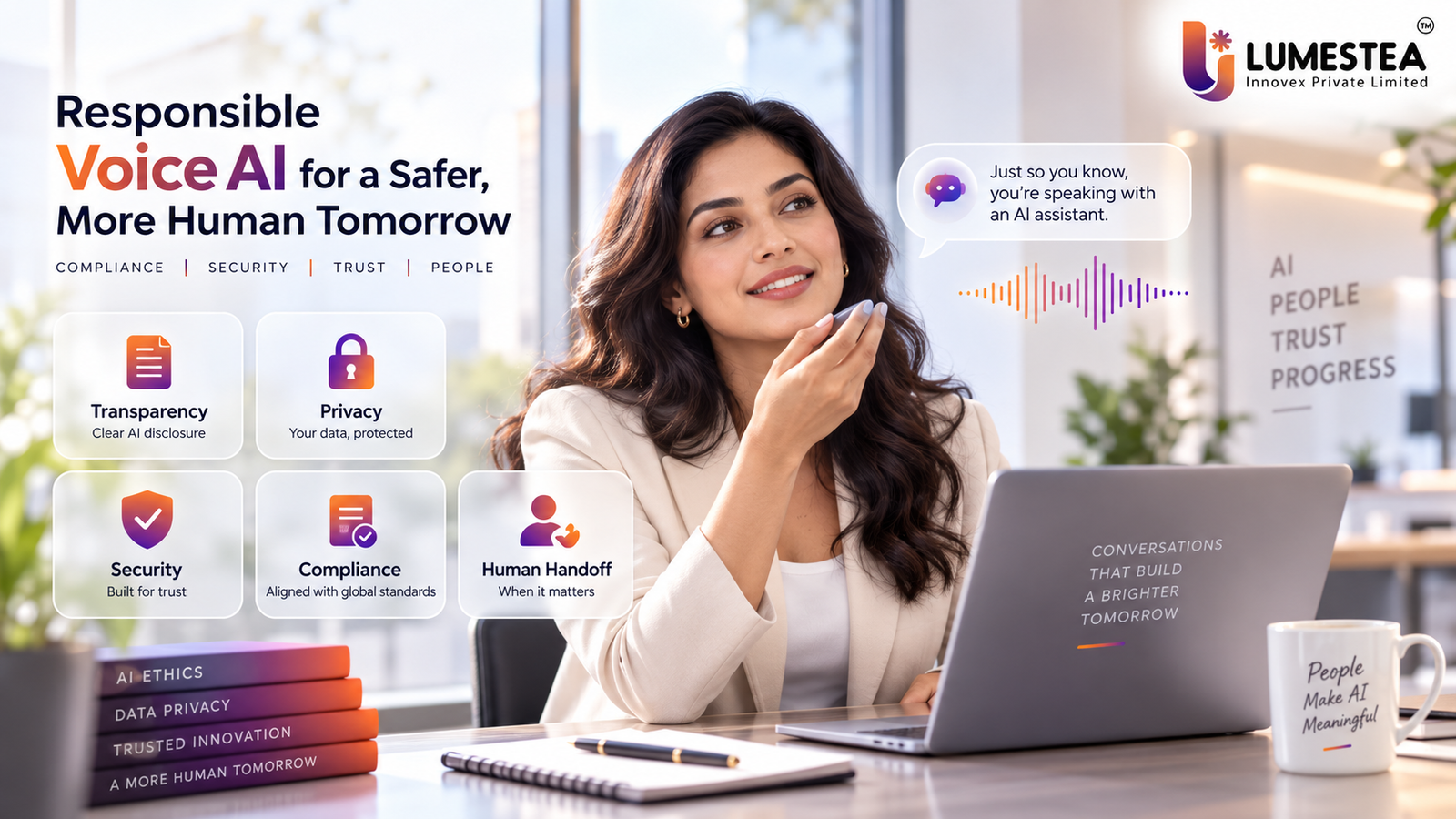
Voice AI agents can create legal and trust issues if users do not know they are speaking with AI. This is especially important for businesses serving EU users.
Under the EU AI Act transparency obligations, people must be informed when they are interacting with an AI system unless it is obvious from the context. This makes disclosure, consent, and call recording policies important parts of voice AI design.
A safe implementation should make disclosure clear at the beginning of the interaction, avoid pretending to be human, follow accessibility requirements, and provide human escalation when the conversation becomes sensitive or complex.
Build vs Buy: Should You Use a Platform or Build a Custom Voice AI Agent?
There are three common approaches.
- No-code or low-code voice AI platform — fastest when the use case is simple. It can work for appointment booking, lead capture, reminders, and basic FAQ automation. The downside is limited customization, platform dependency, and less control over infrastructure.
- Custom voice AI agent — better when the business needs deep integrations, strict security, custom logic, multilingual support, workflow automation, or ownership of the product roadmap. It takes more planning but gives more long-term control.
- Hybrid approach — often the best option. The business starts with proven speech, telephony, or model providers, then builds custom workflow logic, integrations, dashboards, and governance around them.
For businesses worried about vendor lock-in and long-term architecture, see our guide on SaaS architecture decisions.
How Lumestea Can Help Build Voice AI Agents
Lumestea Innovex Private Limited helps businesses design and build AI-powered digital systems that are practical, secure, and connected to real operations.
For voice AI agent development, Lumestea can support:
- Voice AI strategy and workflow discovery
- Conversation design
- AI agent architecture
- Real-time voice interface planning
- CRM, ERP, EHR, calendar, payment, and database integrations
- RAG and knowledge-base grounding
- Role-based access and permissions
- Human handoff workflows
- Dashboard and analytics development
- QA, testing, deployment, and post-launch optimization
A strong voice AI agent is not just an impressive voice. It is a business system that listens, understands, acts, and improves over time.
Planning to build a voice AI agent for support, sales, healthcare, logistics, or internal operations? Lumestea can help you move from concept to a production-ready AI workflow.
Frequently Asked Questions
1) What is a voice AI agent?
A voice AI agent is an AI-powered system that can speak with users in real time, understand spoken requests, access business data, complete tasks, and respond naturally through voice.
2) How do voice AI agents work?
Voice AI agents capture speech, convert audio to text, understand intent, retrieve or process relevant data, generate a response, convert the response into speech, and speak back to the user through a phone, app, web interface, or device.
3) Which industries use voice AI agents the most?
Voice AI agents are commonly used in healthcare, customer support, sales, real estate, hospitality, banking, fintech, logistics, e-commerce, and personal productivity workflows.
4) Can voice AI agents integrate with CRM or call center software?
Yes. Voice AI agents can integrate with CRM systems, call center software, calendars, ticketing tools, ERP systems, EHR systems, databases, and knowledge bases, depending on the architecture and access permissions.
5) How secure are voice AI systems?
Voice AI systems can be secure when designed with encryption, access controls, audit logs, consent handling, transcript retention policies, secure APIs, human escalation, and compliance-aware infrastructure.
6) Do EU AI Act requirements apply to voice AI agents?
Yes, voice AI agents serving EU users may fall under AI transparency obligations. Users generally need to be informed when they are interacting with an AI system unless it is obvious from the context.
7) How much does a voice AI agent cost to build?
Cost depends on scope, channels, integrations, languages, compliance requirements, data sources, and whether the business uses a platform, a custom build, or a hybrid approach.
8) What should I check before hiring a voice AI development company?
Check real-time voice experience, speech accuracy, latency targets, supported languages, integration capability, security controls, data policy, human handoff logic, testing process, post-launch support, and ownership of code and conversation assets.
Conclusion
Voice AI agents are moving from simple call automation to real front-line digital workers. The technology is ready, but results depend on choosing a partner who understands real-time conversation, system integrations, security, and compliance, not just an impressive demo.
Start with your workflow, define your requirements using the checklist above, and pilot on a contained use case before scaling. Whether you choose a no-code platform, a custom build, or a hybrid approach, make sure you keep control of your data, prompts, workflows, and human handoff logic.
If you’re planning a voice AI agent for your business, talk to Lumestea’s voice AI experts and we’ll help you move from concept to production.