
The Freezer Is Now a Boardroom Problem: What Europe’s Supermarket Cyberattacks Teach Every Business
The Freezer Is Now a Boardroom Problem: What Europe’s Supermarket Cyberattacks Teach Every Business
 Deepanshu

Summarize with AI
Not enough time? Get the key points instantly.


Table of Contents
What Happened
Connected Is Not the Same as Exposed
Where Operational Risk Hides
Who Should Pay Attention
The Real Cost Goes Beyond Spoiled Stock
Myths and Realities
The Executive Resilience Checklist
A Practical 90-Day Roadmap
Questions to Put to Your Vendors
How Lumestea Helps
FAQs
Conclusion
This was not a stolen database or a locked email system. It was a cyberattack that spoiled real stock on real shelves, and it carries a message for every leader who runs a business on connected systems: some of your biggest operational risks sit inside equipment that nobody thinks of as “IT”.
This article explains what happened in the supermarket cyberattacks across Europe, why it matters well beyond grocery retail, and how a leadership team can find and close the same kind of gap in its own operations, without disrupting the business while doing so.
Key takeaways
- Attackers reached refrigeration controls that were open to the internet, and the damage was physical: spoiled stock, empty shelves and emergency clean-ups.
- Connectivity is not the flaw. Unprotected, unowned and unmonitored connectivity is.
- Aging hardware, vendor access and single control dashboards quietly multiply the risk.
- A phased 90-day approach can close the most urgent gaps without stopping day-to-day operations.
What Happened
The first wave struck in October, when refrigeration units in hundreds of French supermarkets overheated overnight, spoiling stock and, in some cases, causing fires. A second wave followed overnight into November 2. Stores in Belgium, Luxembourg, Sweden, Ireland, Estonia and the Netherlands, among other countries, reported refrigeration problems, with temperatures in some units reportedly pushed as high as 50°C (122°F).
The impact varied sharply from one retailer to the next, which is itself instructive:
| Where | What was reported |
| Belgium (Carrefour) | 15 of more than 700 stores affected. All stores stayed open, because only some units, mainly freezers, were hit. |
| Ireland (Musgrave / SuperValu) | 13 of 223 stores affected, limited to one refrigeration model. Monitoring caught the issue early, and some chilled and frozen lines were pulled as a precaution. |
| Sweden (Coop and ICA) | 7 of 800 Coop stores reported tampering with refrigeration systems, and ICA stores reported similar overnight problems. |
| Netherlands | Danfoss reported that 17 facilities using its refrigeration systems were affected. |
The exposure behind these incidents is far wider than the stores that made the headlines. After the French attacks, security researchers at Forescout scanned for publicly visible refrigeration equipment and found roughly 13,000 vulnerable services across more than 6,000 public IP addresses in 99 countries.
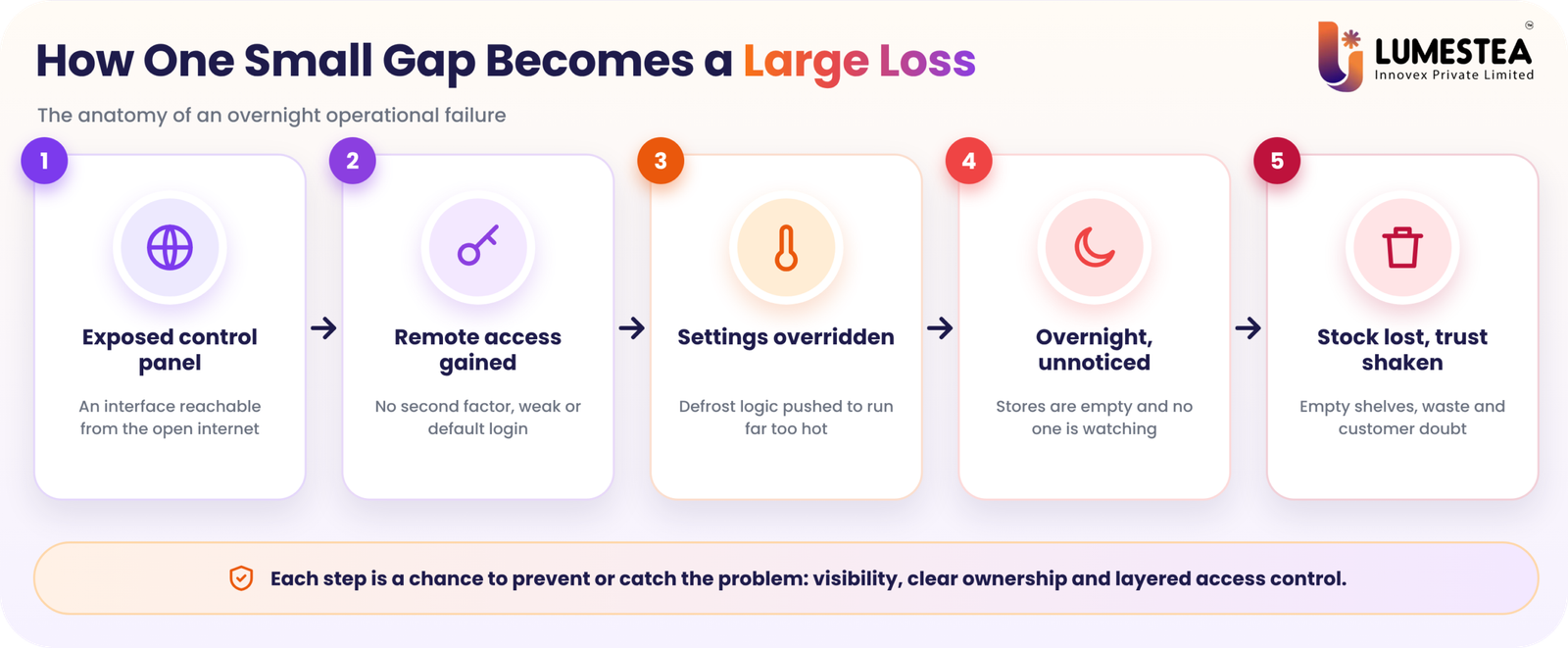
Reporting indicates that the attackers reached remote management interfaces and pushed units into defrost mode, and that many of the affected devices were older models no longer supported by their manufacturers. As for who is behind it, attribution remains unclear, and experts note that this type of intrusion leaves very little evidence behind. For a business leader, that is a secondary question. You do not need to know who did it before deciding to fix the way in.
Connected Is Not the Same as Exposed
When leaders hear “connected equipment”, they often picture risk. That reading is understandable but incomplete. Remote monitoring, predictive maintenance and automatic alerts are genuinely valuable, and most modern operations depend on them.
The real difference lies in how a device is connected. A controller that reports to a properly secured monitoring platform is a very different thing from a controller whose management panel anyone on the internet can reach. The first is an asset. The second is an open door.
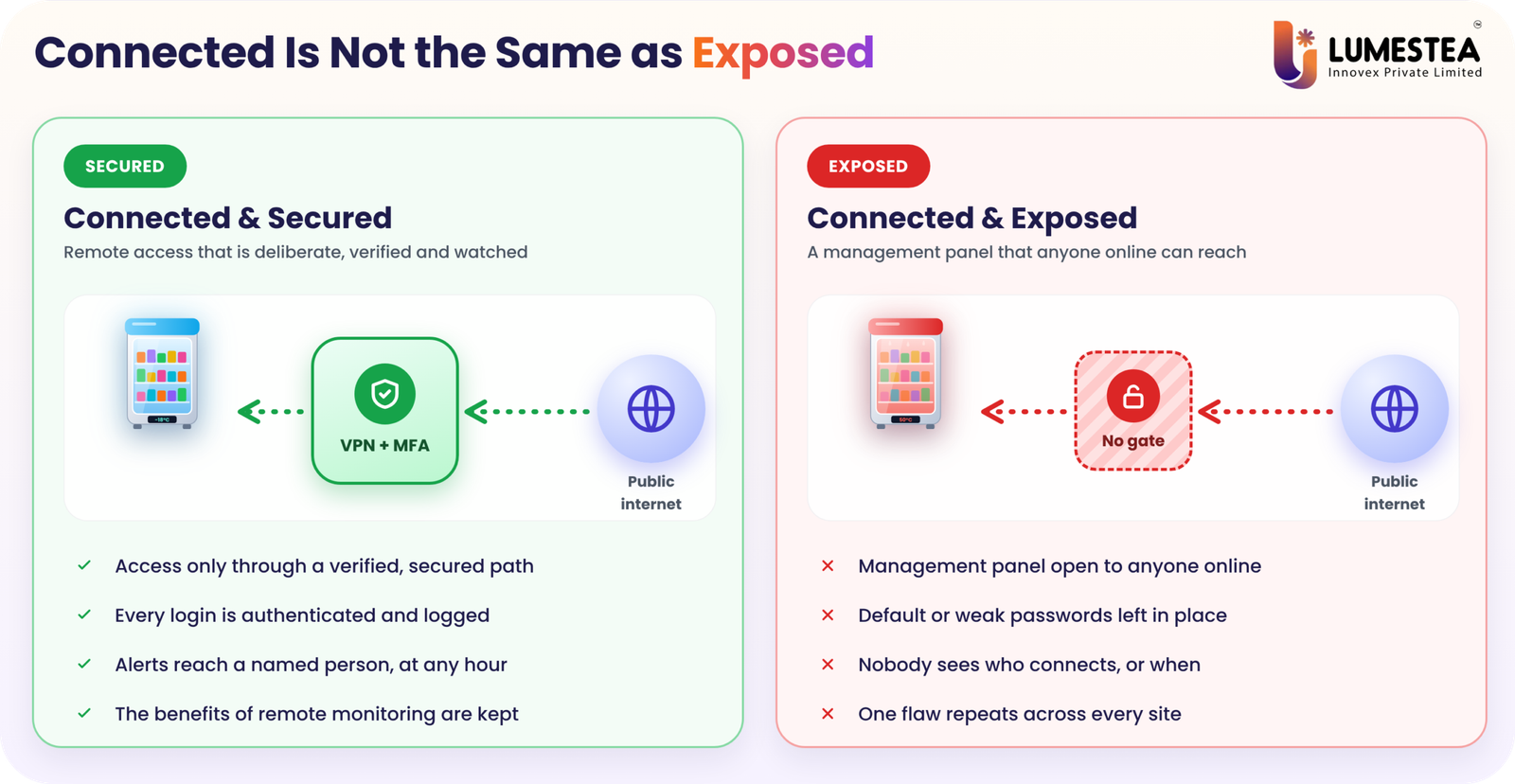
The goal, therefore, is not to unplug the business. It is to make sure every connection is deliberate, authenticated and watched.
Where Operational Risk Hides
Across the incidents and the analysis that followed, five blind spots appear again and again. Each one is common, and each one is fixable.
1. Equipment nobody classifies as “IT”
Refrigeration controllers, door-access panels, building controls, warehouse scanners and vehicle trackers are often installed by facilities contractors and rarely reviewed by the security team. They sit squarely on operations’ list of dependencies and completely off IT’s list of assets. That gap is where risk grows.
2. Vendor and contractor access
External specialists frequently need remote access to maintain equipment, and the business often has little visibility into how those connections are set up or protected. Where the same equipment and settings are repeated across hundreds of sites, a single weakness becomes hundreds of weaknesses at once.
3. Hardware that outlives its software support
Office laptops are replaced every few years. A controller in a cold room can serve for fifteen years or more. When its manufacturer ends support, the device keeps working, only without protection. Some of the affected units reportedly need physical modification rather than a simple software update, which makes “we will patch it next quarter” an unrealistic plan.
This is why a phased modernization roadmap beats waiting for a failure to force the decision. Underestimating legacy and integration complexity is also one of the most common reasons technology projects stall, a pattern we unpack in why software product engineering projects fail.
4. One dashboard, thousands of endpoints
Central management is efficient, but it also concentrates risk. When one platform can command thousands of devices, a single compromise can reach all of them. In these incidents, attackers even turned a routine function, the defrost cycle, into the weapon.
Efficiency should therefore be paired with safeguards: limits the equipment will not exceed no matter what a remote command says. It also pays to think carefully about platform design early, because such choices are hard to reverse later, as we discuss in SaaS architecture decisions you can’t easily walk back.
5. Problems that surface at sunrise
The damage happened overnight, when stores were empty. The businesses that fared better tended to share one trait: monitoring that watches the physical result, such as the real temperature, rather than relying only on a software status screen.
Who Should Pay Attention
Supermarkets were the target this time, but the underlying pattern applies to any business that relies on connected equipment to protect stock, keep schedules or ensure safety.
| Sector | Where the same risk appears |
| Retail and e-commerce | Cold storage, store systems, warehouse automation and order-fulfilment equipment. |
| Logistics and cold chain | Temperature-controlled vehicles and depots, trackers, dock systems and routing platforms. |
| Healthcare and pharma supply | Storage of medicines and other temperature-sensitive products, where a failure can carry safety and compliance consequences. |
| Manufacturing | Production-line controllers, environmental controls and equipment maintained remotely by outside specialists. |
| Hospitality and facilities | Kitchens, HVAC, access control and building management systems. |
The Real Cost Goes Beyond Spoiled Stock
Lost inventory is the visible part of the bill. The less visible parts are often larger:
| Cost area | What it looks like in practice |
| Direct stock loss | Product destroyed and replaced, plus the labour and logistics of clearing and restocking. |
| Lost sales | Empty shelves and thinner ranges while systems are inspected and restored site by site. |
| Operational disruption | Managers improvising manual workarounds at dawn, and suppliers absorbing sudden surges in demand. |
| Customer trust | Shoppers asking whether what is back on the shelf is safe. Trust is slow to build and quick to lose. |
| Compliance and safety | Food-safety and similar obligations, plus questions from regulators, insurers and partners. |
Supply chains have also shown how quickly a cyber incident reaches the shelf. In 2025, a cyberattack on food distributor UNFI disrupted its electronic ordering systems and left stores across North America, including Whole Foods locations, short of stock.
The lesson is that disruption becomes expensive when it stays invisible. Businesses whose ordering, inventory and logistics data is clean and connected can see a problem earlier and respond faster, which is a major reason we recommend building on a solid data foundation, as outlined in our guide to AI order processing.
Myths and Realities
A few assumptions make this kind of risk easy to overlook. Here is how they hold up:
| Common assumption | The reality |
| “Cyber risk is about data, so it is IT’s problem.” | These attacks changed physical conditions. Operations and leadership share ownership of the risk. |
| “We are not a food retailer, so this does not apply to us.” | Exposed equipment was found in 99 countries and across many equipment types. Any connected control can be a target. |
| “The safest fix is to disconnect everything.” | Remote monitoring brings real value. The better answer is to secure, restrict and watch each connection. |
| “Our vendor maintains it, so our vendor secures it.” | Responsibility has to be defined in the contract. Without that, nobody may be accountable. |
| “It still works, so there is no urgency.” | Working is not the same as protected. Unsupported devices keep running while their risk keeps growing. |
The Executive Resilience Checklist
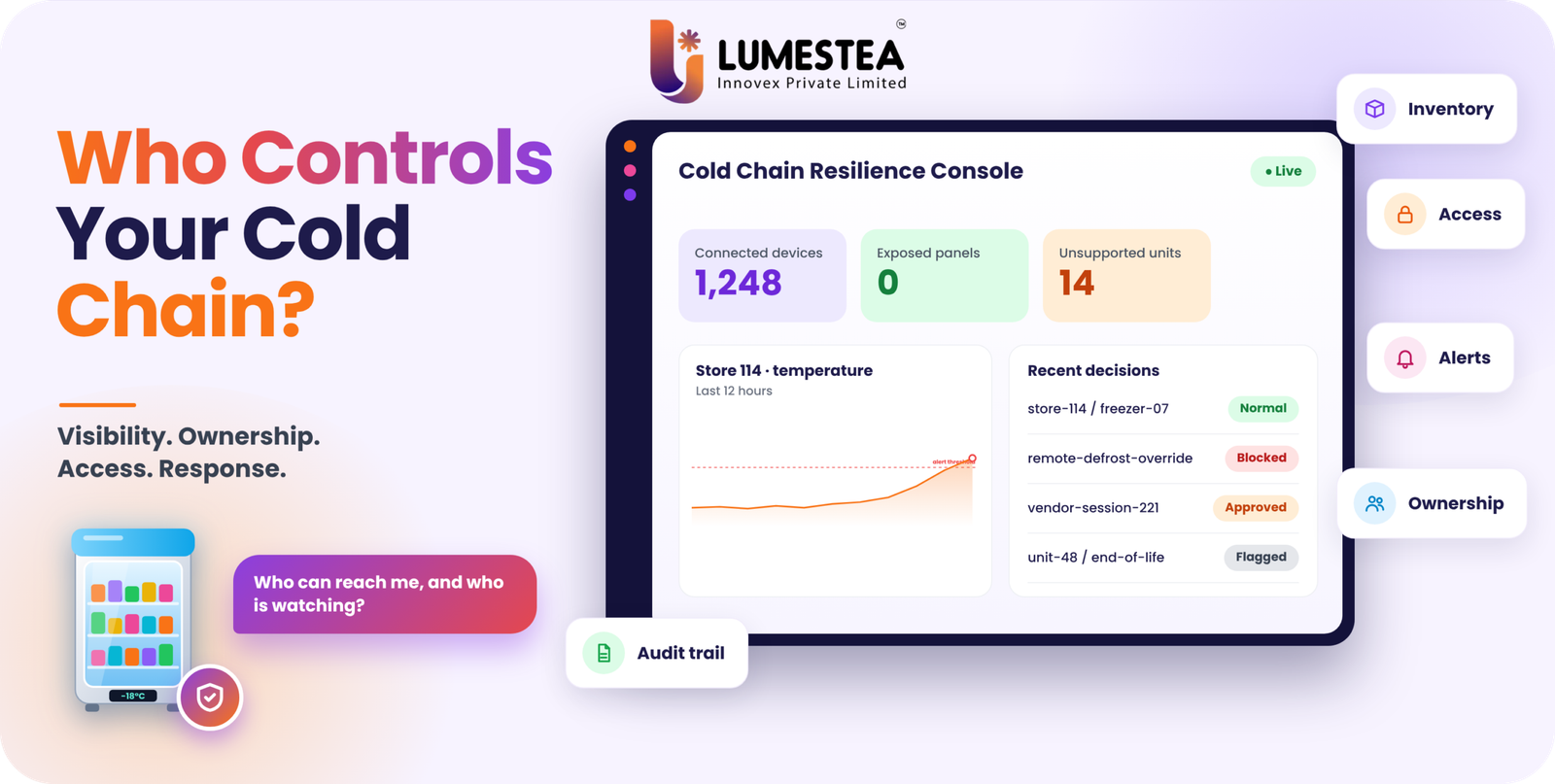
Use this as a ten-minute conversation with your leadership team. Every question is written so that “Yes” is the healthy answer. Each “No” is a conversation worth having.
| # | Question |
| 1 | Do we have a complete inventory of connected equipment, including vendor-managed devices? |
| 2 | Does every system have a named internal owner? |
| 3 | Do we know which systems could affect stock, shipments or safety if tampered with? |
| 4 | Are all management panels kept off the public internet, or reachable only through a secured, verified path? |
| 5 | Have default passwords been replaced and second-factor sign-in enforced for remote access? |
| 6 | Do vendor contracts spell out how contractors connect, authenticate and report incidents? |
| 7 | Are operational systems separated from the general business network? |
| 8 | Do we know which devices run unsupported software, and is there a replacement plan? |
| 9 | Do devices have built-in limits they cannot exceed, whatever a remote command says? |
| 10 | Do temperature and other physical alerts reach an on-call person independently of our main dashboard? |
| 11 | Can we see inventory, logistics and equipment alerts in one unified view? |
| 12 | Do we have a tested manual fallback if a critical system fails overnight? |
| 13 | Is there a person with the authority to act on an alert at any hour? |
| 14 | Have we rehearsed an incident, not just written a plan for one? |
How to read your score
- 12 to 14 “Yes”: a strong position. Keep testing it.
- 8 to 11 “Yes”: real gaps worth closing this quarter.
- Below 8: treat this as a board-level priority and begin with the roadmap below.
A Practical 90-Day Roadmap
Resilience does not require a risky, all-at-once overhaul. The most dependable path is incremental, with each stage building on the last.
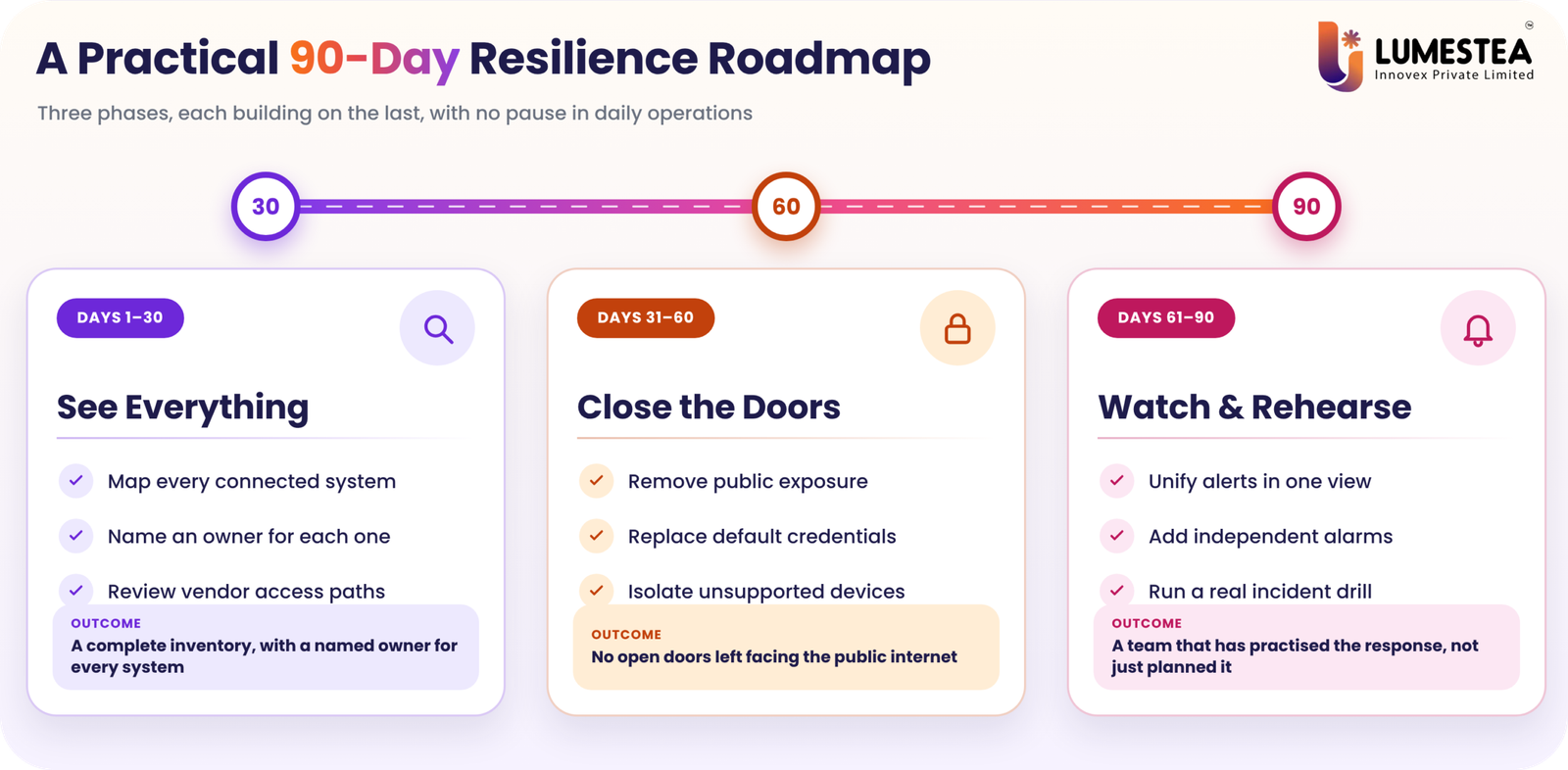
Days 1 to 30: See everything. Map every connected system, its owner, its vendor and its access path. You cannot protect what you have not listed.
Days 31 to 60: Close the doors. Remove public exposure, replace default credentials, and isolate or plan the retirement of unsupported devices.
Days 61 to 90: Watch and rehearse. Bring alerts into one clear view, add independent physical alarms, assign clear ownership and run a realistic incident drill involving operations, IT and leadership together.
Specialist security work, such as network hardening and device-level protection, belongs with dedicated security and equipment partners. The roadmap above is designed to work alongside them and to give them a clear, organised starting point.
Questions to Put to Your Vendors
Contractors and equipment suppliers are part of your risk surface. These questions turn that into a clear conversation:
- How exactly do you connect to our equipment, and how is that access authenticated?
- Are any of our devices reachable directly from the public internet?
- Which of our units are end-of-life, and what is the replacement or protection plan?
- How and how quickly will you tell us if you detect an incident affecting our systems?
- What built-in limits stop equipment from running outside safe operating ranges?
- Who on your side is accountable for security, and how is that written into our agreement?
How Lumestea Helps
Resilience is rarely the product of a single tool. It comes from well-connected, well-maintained systems with clear visibility across them, and that is exactly where Lumestea Innovex focuses.
- Logistics and supply chain platforms that give unified visibility across shipments, warehouses and delivery, so problems surface early instead of at the loading dock.
- System and cloud integration that connects legacy and modern systems into one coherent, observable environment, without a risky rip-and-replace.
- CRM and ERP solutions that modernize the systems of record daily operations depend on.
- Enterprise architecture that keeps complexity manageable as the business grows.
- E-commerce and retail systems that connect inventory, orders and fulfilment, so a disruption in one place is visible everywhere.
We have seen the value of unified visibility first-hand. In our work with TrackingTech, a logistics and courier technology client, bringing shipment tracking, warehouse validation and proof of delivery into a single operational view helped teams catch issues before they left the building. If logistics is central to your operations, our logistics software development guide explains how such platforms are designed and built.
Lumestea builds and integrates secure, observable systems and works alongside your security team and specialist vendors, so that every piece of the puzzle has an owner.
Frequently Asked Questions
1) What happened in the European supermarket cyberattacks?
Attackers remotely tampered with refrigeration and freezer controls at stores across several European countries, driving temperatures up and forcing some stores to discard food. A first wave hit France in October, and a second followed overnight into November 2.
2) Can a cyberattack really affect physical operations?
Yes. Any connected system that controls physical equipment, such as cooling, scanners, trackers or building controls, can become a target if it is poorly secured or exposed to the internet.
3) What is operational cyber resilience?
It is a business’s ability to keep running, or recover quickly, when connected systems that control physical processes are disrupted or tampered with.
4) How is operational risk different from traditional IT security?
Traditional IT security protects data and networks. Operational risk asks what physically stops working, such as stock, shipments or safety, if a connected system fails or is manipulated.
5) Why are third-party vendors a risk?
Many customers rely on the same supplier’s equipment and settings, so one weakness can affect many businesses at once. Contractors also need remote access, which should be defined, authenticated and monitored.
6) Should we disconnect our devices from the internet entirely?
Not necessarily. Remote monitoring and maintenance bring real benefits. The aim is to secure the connection, with strong authentication, restricted access and monitoring, rather than to remove connectivity altogether.
7) Do we need to replace our legacy equipment immediately?
Not all at once. A phased approach works best: isolate and protect the riskiest systems first, then modernize gradually so daily operations are never put at risk.
8) Which businesses should be most concerned?
Any company that depends on connected equipment, including retail, food and cold chain, logistics, warehousing, manufacturing and healthcare supply.
9) Where should a business start?
With a complete inventory of connected systems and a named owner for each, including vendor-managed ones. Visibility comes first, and every other fix builds on it.
10) How long does it take to see improvement?
A focused 90-day plan can close the most obvious gaps. Deeper modernization then continues in phases, alongside normal operations.
Conclusion
The freezers will be repaired and restocked. The lesson should stay.
What happened in Europe is not only a story about spoiled food. It is a clear signal that modern business risk lives in the systems we depend on every day but rarely think of as “IT”: cooling units, scanners, trackers and vendor-managed controllers. When one of them is exposed, the effect lands directly on stock, revenue and customer trust.
That is why operational resilience is now a leadership decision, not an IT detail. The encouraging news is that it does not demand a risky overhaul. It starts with something simple: knowing what is connected, who owns it and where it is exposed. A phased 90-day plan can then close the most urgent gaps without interrupting daily operations.
Lumestea Innovex helps businesses get there through logistics, supply chain, CRM, ERP and system integration work that turns scattered systems into a connected, visible and maintainable environment, so problems are seen before they become losses.
Want an honest look at where your operations are exposed?
We start with visibility, and we only recommend what your situation genuinely needs.