
Who Controls Your AI Agents? Identity, Permissions, and Governance in the Enterprise
Who Controls Your AI Agents? Identity, Permissions, and Governance in the Enterprise
 Deepanshu

Summarize with AI
Not enough time? Get the key points instantly.


Table of Contents
Why AI Agent Governance Matters Now
Give Every Agent a Clear Identity
Apply Least-Privilege Permissions
Separate Planning from Permission to Act
Treat Tool Access as Part of Your Risk Surface
Build Audit Trails That Explain What Happened
Define Human Accountability and Incident Response
A Practical Rollout Framework
Metrics That Show Governance Is Working
Pitfalls Worth Anticipating
FAQs
Conclusion: Thoughtful Boundaries Let Autonomy Scale
Enterprise AI is entering a new and more consequential chapter. AI agents can now retrieve information, draft and update records, trigger workflows, call APIs, and coordinate tasks across the systems an organization depends on every day. That is a genuine opportunity for productivity, and it also invites a thoughtful question: when software acts on behalf of people, who decides what it is permitted to do, and how can the organization demonstrate that each action was appropriate?
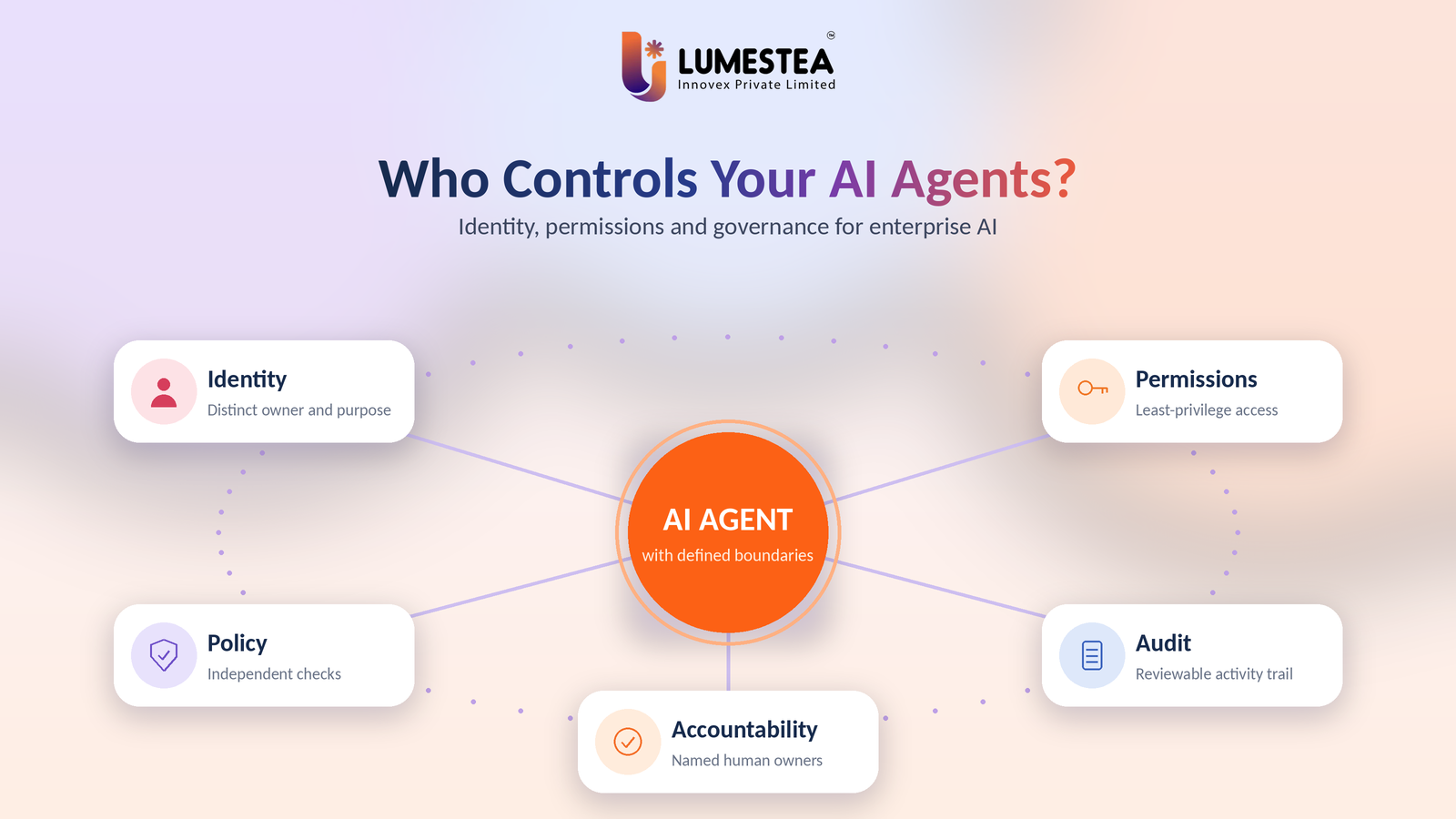
The most constructive answer is neither to hold back every agent nor to extend open-ended trust to every model. It is to treat AI agents as governed participants in the enterprise: each with a clear identity, carefully scoped permissions, observable behavior, and a named person who is accountable for its work. This guide offers a practical framework for achieving exactly that.
Key takeaways
- Give every production agent its own identity, a named owner, and a defined purpose.
- Grant the minimum access each task requires, and enforce it in systems, not only in prompts.
- Let agents propose actions while an independent policy layer decides what proceeds.
- Keep audit trails that are meaningful, protected, and respectful of data privacy.
- Expand autonomy in stages, guided by evidence rather than enthusiasm.
1. Why AI Agent Governance Matters Now
Traditional software follows predefined paths. An AI agent, by contrast, interprets a goal, selects among available tools, and decides which sequence of steps to attempt. That adaptability is precisely what makes agents valuable, and it also changes the risk profile. An agent connected to a CRM, a finance platform, a code repository, or a customer support system can influence real business outcomes, so the breadth of its access and the visibility of its actions deserve careful design.
The central governance question is refreshingly practical: what can this agent access, what can it change, under which conditions, and who is responsible for reviewing the result? Organizations that settle these questions early are far better positioned to turn promising pilots into dependable production systems. The same is true when agents connect to operational platforms, as with the ERP AI chatbots increasingly used to simplify enterprise workflows, where well-defined boundaries make adoption smoother and more trusted.
2. Give Every Agent a Clear Identity
An agent should not operate as an anonymous process, nor share a powerful, long-lived credential with unrelated workloads. Each production agent benefits from a distinct identity that can be linked to an owner, a purpose, an environment, and an approved set of tools.
Identity design also connects naturally to wider architectural choices. Questions of tenancy, role models, and access boundaries are easier to address at the outset than to revisit later, a theme we explore in SaaS Architecture Decisions You Can’t Easily Walk Back. The same foresight serves agent identity well.
A useful agent identity record includes:
- Business owner and technical owner.
- Purpose, supported workflows, and activities that are out of scope.
- Environment and deployment version.
- Approved tools, APIs, data sources, and service identities.
- Credential expiry, rotation, and revocation procedures.
- Escalation contact and scheduled review date.
Distinct identities strengthen traceability. If an agent behaves unexpectedly, security teams can recognize which workload acted, withdraw its access, and review its activity, all without disturbing unrelated services.
3. Apply Least-Privilege Permissions
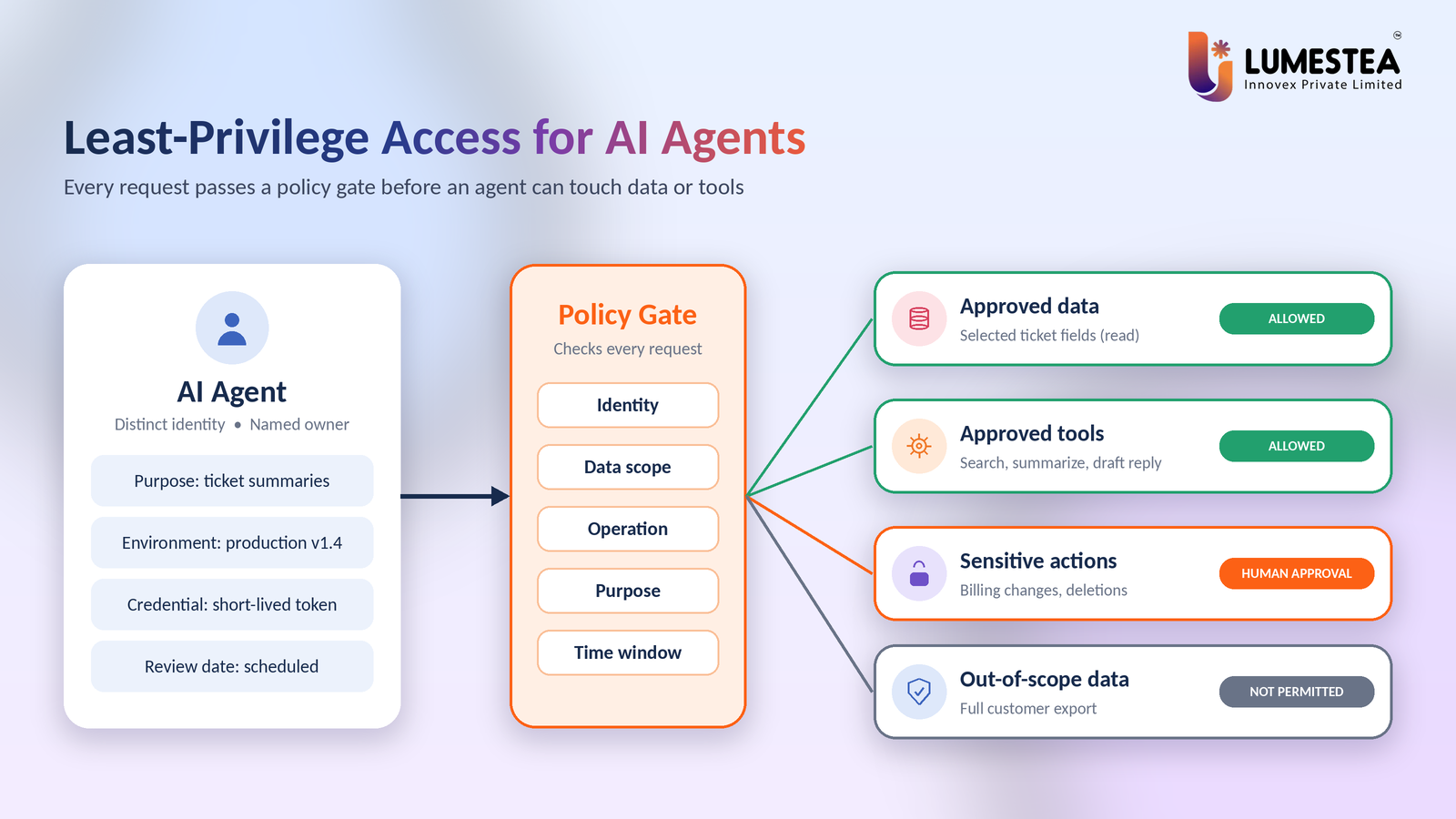
An agent should receive only the permissions its specific task requires. A support-summary agent, for example, may need read access to selected ticket fields; it does not need automatic permission to export the entire customer database, amend billing details, or remove records.
Permissions are most resilient when designed around four boundaries:
- Data boundary: which records, fields, tenants, and classifications are accessible?
- Action boundary: which tools may the agent call, and which operations are read-only versus write-enabled?
- Context boundary: which user, case, transaction, or business purpose justifies the access?
- Time boundary: how long does the permission last, and when must it be re-authorized?
Wherever feasible, these limits belong in the application, API gateway, identity provider, and data layer, not only in a model prompt. Instructions can guide behavior beautifully, but they are not a substitute for technical authorization. Organizations operating in regulated sectors such as healthcare, where sensitive records demand particular care, will find this layered approach especially valuable, as discussed in our AI in Healthcare guide.
4. Separate Planning from Permission to Act
An agent may propose an action, but the system should independently determine whether that action is allowed. This separation is especially important for payments, account changes, production deployments, employee records, regulated data, and customer-impacting decisions.
A dependable control pattern looks like this:
- The agent proposes a structured action along with its stated purpose.
- A policy layer validates the identity, requested operation, data scope, and business rules.
- Low-risk, reversible actions proceed automatically within approved limits.
- High-impact or irreversible actions are routed for human approval or a second control.
- The system records the request, the policy decision, the approver where relevant, and the outcome.
Human review works best when it is proportionate. Requiring approval for every routine step can make a workflow impractical, while allowing every action to proceed unchecked can make it unsafe. Thresholds are best defined by impact, reversibility, uncertainty, and applicable regulation.
5. Treat Tool Access as Part of Your Risk Surface
An agent’s effective capabilities are shaped not only by the model but also by the tools and data it can reach. Every connector, plugin, API, retrieval index, and execution environment widens the surface that needs thoughtful protection.
Before enabling a tool, it helps to ask:
- Does the agent need this tool for a clearly defined business outcome?
- Can the tool be limited to specific operations and data?
- Does it validate inputs and confirm authorization on every request?
- Could untrusted content influence the agent to misuse the tool?
- Are secrets kept outside prompts, logs, and model-visible context?
- Can the connection be paused quickly if a concern arises?
Retrieved documents, emails, web pages, and user-provided files deserve to be treated as untrusted input. Such content may contain misleading instructions, sometimes called prompt injection. The most dependable design ensures that untrusted content can never override system policy or grant new permissions.
6. Build Audit Trails That Explain What Happened
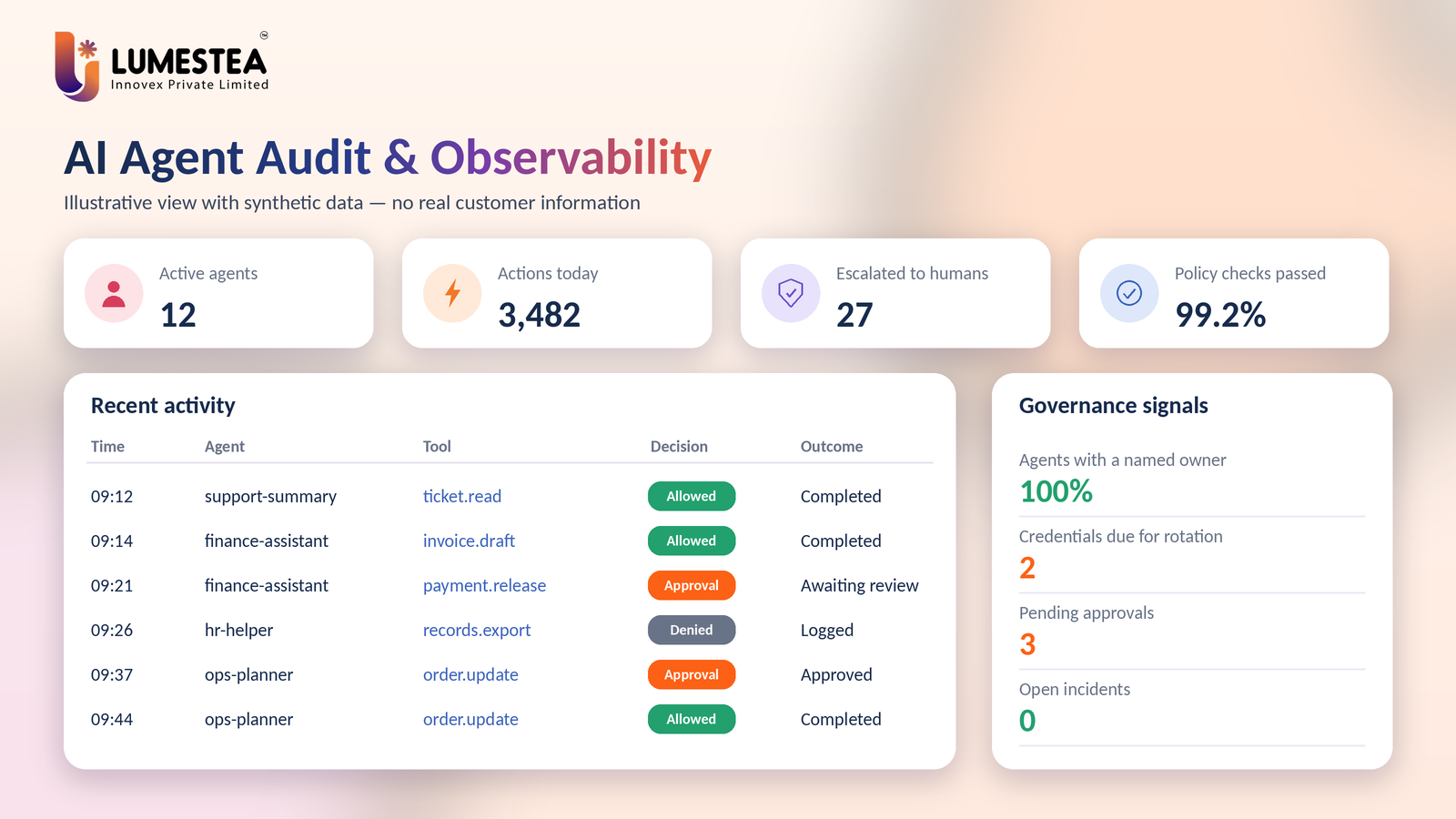
Logging should make an agent’s activity reviewable without collecting more sensitive data than necessary. A well-structured record answers a handful of questions: which agent acted, on whose behalf, which tool was called, which policy was evaluated, what was decided, and what changed.
A useful audit event can include:
- Agent identity, version, environment, and the initiating user or workflow.
- Timestamp, request or correlation ID, and tool or API name.
- Requested action and relevant resource identifiers, with sensitive values minimized or redacted.
- Authorization and policy result, including an approval reference where required.
- Execution status, resulting change, any error, and a rollback reference where available.
Logs deserve defined retention periods, access controls, integrity protections, and alerting. By default, it is wise to avoid storing full prompts, credentials, personal data, or confidential records, keeping only what security, operations, and compliance genuinely need.
7. Define Human Accountability and Incident Response
Governance is at its strongest when ownership is unmistakable. Each production agent should have a named business owner accountable for its purpose and outcomes, a technical owner responsible for reliability, and a security or risk contact who can advise on control requirements. For teams that collaborate across locations, clear ownership matters even more; our Offshore Software Development playbook shares practical thoughts on keeping distributed teams aligned and secure.
The incident plan should describe how to pause an agent, revoke credentials, disable a tool, preserve relevant evidence, assess affected records, inform stakeholders, and restore service with confidence. These steps are best rehearsed before they are needed.
For higher-risk workflows, define an emergency pause control and a safe degraded mode. If a policy service, identity provider, or approval mechanism becomes unavailable, the system should default to restricted behavior and never silently grant broader access.
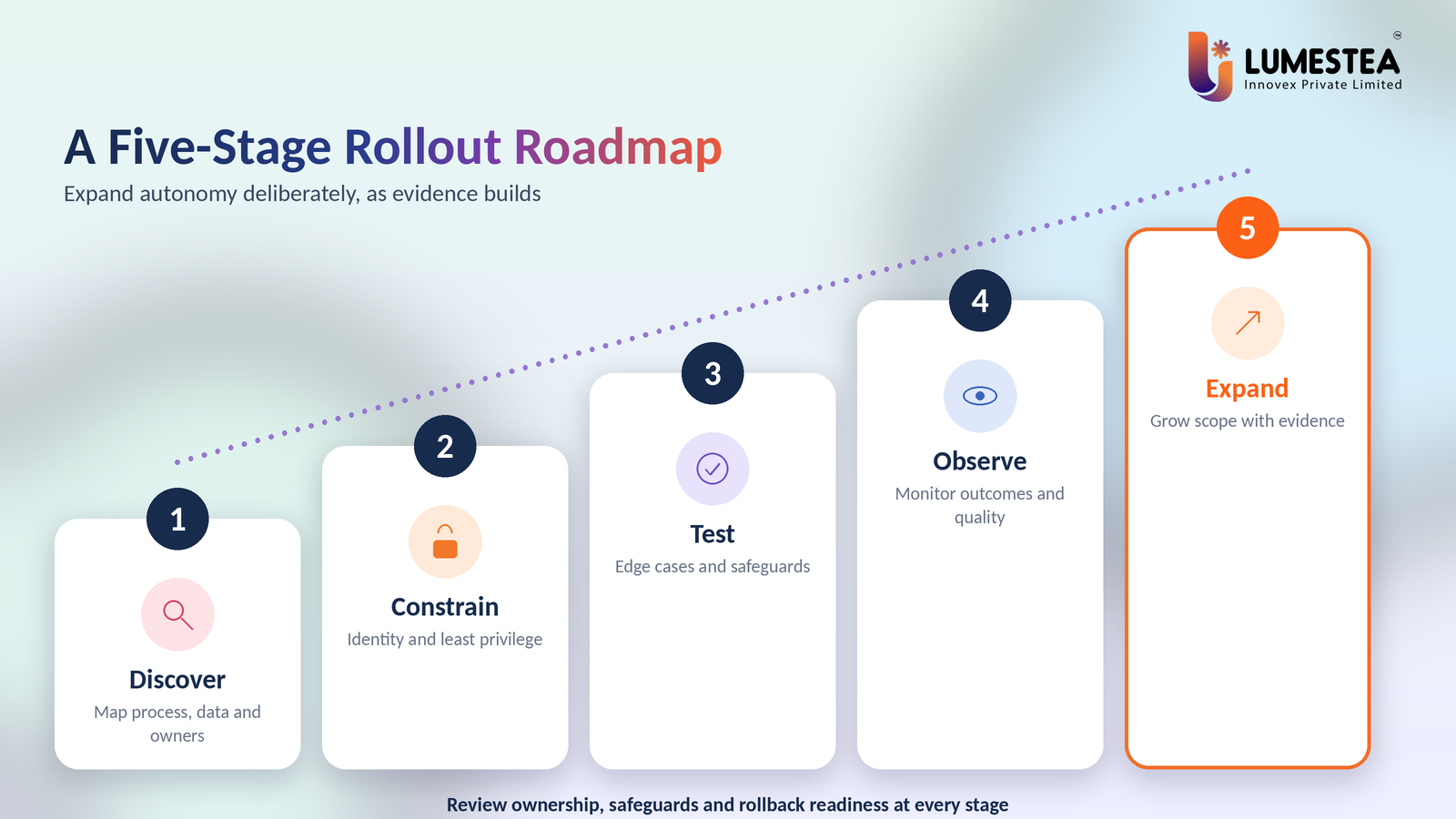
8. A Practical Rollout Framework
A staged approach lets teams learn steadily without extending broad autonomy too early. The sequence below keeps value and safeguards moving together, and it echoes lessons from our article on why software product engineering projects fall short and how to build products that scale.
Stage 1 — Discover: Map the business process, data sensitivity, tools, owners, expected value, and potential failure modes. Choose a focused use case with a measurable outcome.
Stage 2 — Constrain: Create a distinct agent identity, enforce least-privilege access, define allowed actions, and require approval for consequential operations.
Stage 3 — Test: Evaluate normal cases, edge cases, instruction-injection attempts, malformed inputs, permission limits, tool outages, and attempted policy bypasses.
Stage 4 — Observe: Run in a limited environment, monitor outcomes and policy decisions, and compare results with agreed quality, safety, and business metrics.
Stage 5 — Expand deliberately: Increase data scope or autonomy only after the owner has reviewed the evidence, open questions, rollback readiness, and operational support.
9. Metrics That Show Governance Is Working
Governance is best measured alongside usefulness and reliability. A small set of indicators that owners can act on, with a baseline established before rollout, tends to serve teams better than a long dashboard.
- Permission coverage: the share of production agents with a documented owner, identity, and approved tool list.
- Policy enforcement: the number and type of denied or escalated actions, reviewed for both misuse and configuration improvements.
- Human review: approval rate, rejection rate, and time to decision for gated actions.
- Reliability: task completion rate, tool error rate, and recovery time.
- Data protection: confirmed exposure incidents, sensitive-data handling exceptions, and time to remediation.
- Business outcome: cycle time, error reduction, customer experience, or another measure suited to the use case.
It is wise not to optimize for a low number of blocked actions alone. A rise in denials may point to misuse, but it may equally reveal overly broad agent behavior or a workflow that needs refinement. The context behind each metric is what makes it meaningful.
10. Pitfalls Worth Anticipating
- Granting broad service-account access because it is quicker to configure.
- Relying on prompt instructions as the only safeguard for restricted actions.
- Allowing a pilot to become production without a named owner or incident plan.
- Logging too little to investigate an incident, or so much that sensitive data is needlessly exposed.
- Expanding autonomy before tool boundaries, error paths, and rollback procedures have been tested.
- Treating governance as a one-time sign-off rather than a lifecycle responsibility.
That last point deserves emphasis. Good governance thrives on light, consistent routines rather than heavy, occasional reviews, much like the approach described in How to Implement a Tech Process to Avoid Tech Debt (Without Slowing Down).
11. Frequently Asked Questions
1) What is AI agent governance?
AI agent governance is the set of policies, identities, permissions, monitoring practices, and ownership responsibilities that determine what an AI agent may do, under which conditions, and how its actions are reviewed.
2) Why can’t a prompt alone control what an agent does?
Prompts guide behavior, but they are not an enforcement mechanism. Dependable control comes from technical authorization in the application, API gateway, identity provider, and data layer, with prompts acting as a helpful additional layer.
3) Does every agent action need human approval?
No. Approval is most valuable for high-impact or irreversible actions. Low-risk, reversible actions can proceed automatically within approved limits, which keeps workflows efficient while preserving oversight where it matters.
4) Where should an organization begin?
Begin with one focused use case, a named owner, a distinct agent identity, and least-privilege access. Measure the results, learn from the audit trail, and expand scope in stages.
12. Conclusion: Thoughtful Boundaries Let Autonomy Scale
AI agents can help enterprises coordinate work across systems, reduce repetitive effort, and make complex workflows more responsive. Yet enterprise adoption depends on more than model capability. It rests on clear identities, narrowly scoped permissions, independent policy enforcement, reviewable audit trails, and accountable owners.
Start with a bounded use case, define what the agent may and may not do, and measure the results. Expand when the evidence supports it. The aim is not to limit autonomy; it is to make autonomy dependable.
At Lumestea Innovex, our teams bring together AI development, cybersecurity, DevOps, and AI and cloud consulting to help organizations design AI initiatives that are secure, well-governed, and aligned with measurable business goals. If you are evaluating AI agents or modernizing workflows, we would be glad to explore the right starting point with you.