
AI in Mental Health
AI in Mental Health
 Pushpa

Summarize with AI
Not enough time? Get the key points instantly.


Table of Contents
What is AI in mental health?
Why Mental Health Systems Need AI Support Now
Where AI Creates Real Value in Mental Health
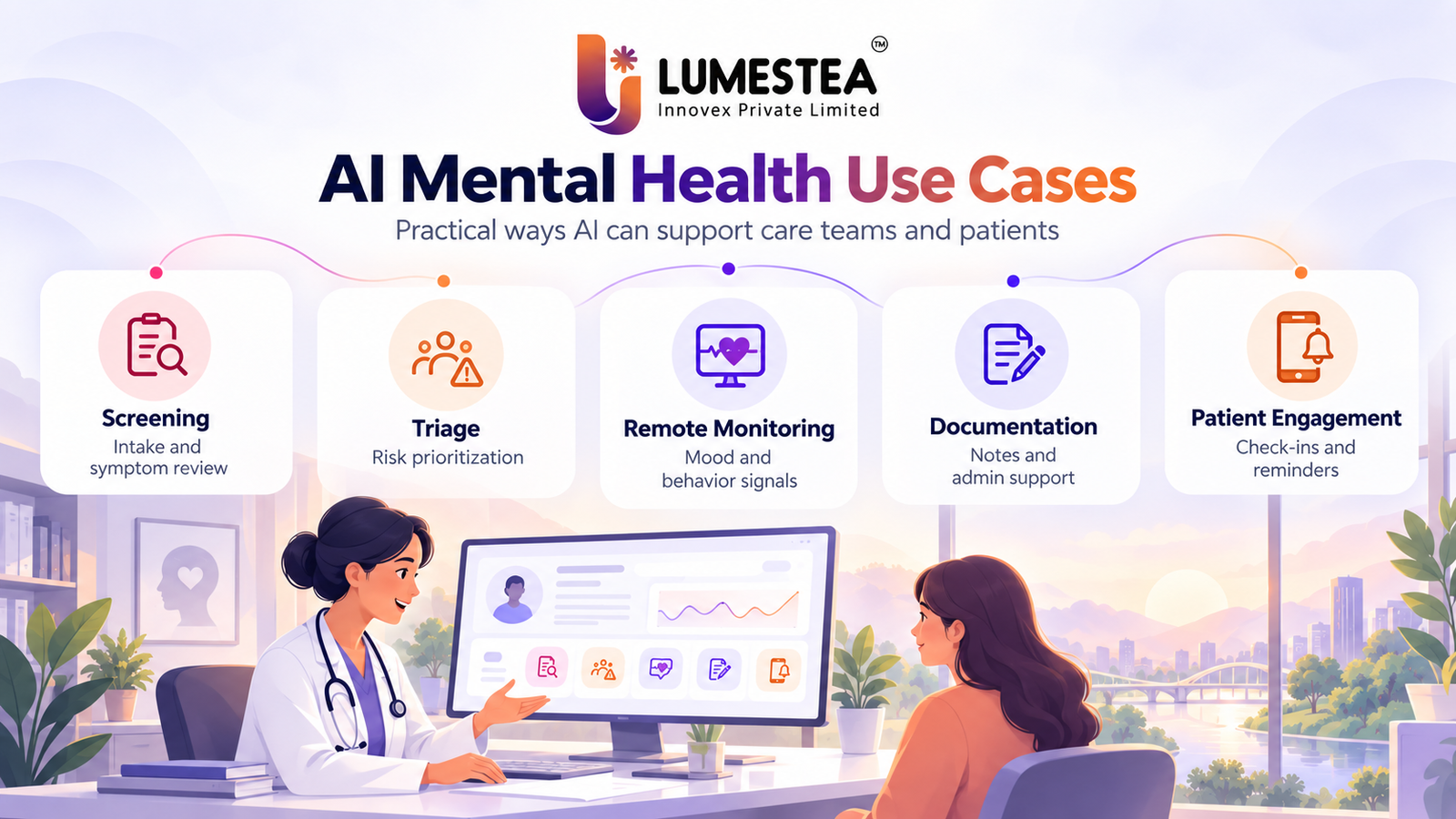
AI Use Cases in Mental Health
What a Secure AI Mental Health Platform Architecture Looks Like
Compliance and Regulatory Considerations
Ethical and Clinical Risks of AI in Mental Health
Measuring ROI for AI in Mental Health
Roadmap to Implement AI in Mental Health Responsibly
When AI Is Not the Right Solution in Mental Health
How Lumestea Can Help Build AI Mental Health Solutions
FAQs on AI in Mental Health
Mental health care is facing a difficult reality: demand keeps rising, but access to timely support is still limited for many people. Clinics are overwhelmed, clinicians are stretched, patients often wait too long, and many people never reach care at all because of cost, stigma, geography, or lack of available professionals.
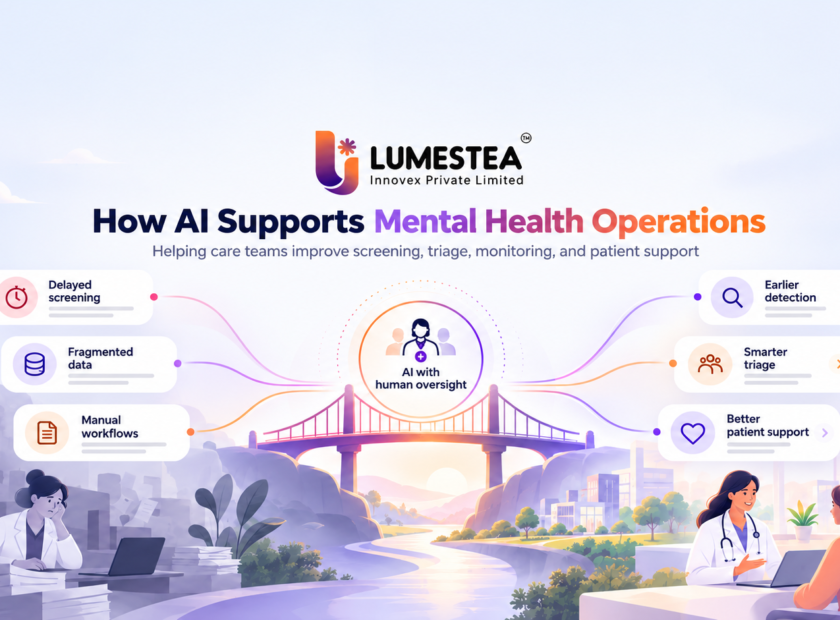
AI in mental health is not a magic fix for that problem. It should not be treated as a replacement for therapists, psychiatrists, crisis teams, or human care. But when used carefully, AI can become a practical support layer that helps healthcare organizations screen earlier, triage faster, monitor patients between sessions, reduce administrative burden, and help clinicians focus their time where it matters most.
The need is real. WHO reported that the first year of the COVID-19 pandemic triggered a 25% increase in global anxiety and depression prevalence, and WHO has also emphasized that mental health systems still need major transformation to expand access and quality of care.
For healthcare leaders, founders, and digital health teams, the important question is no longer “Can AI be used in mental health?” The better question is: “Where can AI create value safely, ethically, and measurably without crossing clinical boundaries?”
At Lumestea Innovex Private Limited, we see AI in mental health as part of a broader digital health transformation. The strongest products will not be isolated chatbots. They will be secure, human-supervised, clinically responsible software systems that combine AI, healthcare data infrastructure, workflow design, privacy controls, and clear escalation paths.
For broader healthcare AI context, connect this section with Lumestea’s guide on AI in Healthcare: Smarter Care with Faster, Data-Driven Decisions
What Is AI in Mental Health?
AI in mental health refers to the use of artificial intelligence technologies to support screening, triage, monitoring, documentation, clinical decision support, engagement, and operational workflows in behavioral health and psychiatric care.
This can include natural language processing that reviews intake forms, machine learning models that identify risk patterns, conversational AI tools that support structured check-ins, digital therapeutics that guide patients through evidence-based exercises, or predictive analytics that help clinicians identify patients who may need faster follow-up.
The key word is support.
AI should assist clinicians, care teams, administrators, and patients. It should not independently diagnose, prescribe, or replace professional judgment. Mental health care involves context, empathy, safety, trauma awareness, cultural understanding, and clinical responsibility. AI can help surface signals, reduce friction, and improve visibility, but final clinical decisions must remain human-led.
Why Mental Health Systems Need AI Support Now
Mental health systems are under pressure from multiple sides. Patient demand has increased. Provider shortages remain a serious issue. Administrative work consumes clinician time. Digital therapy programs often struggle with engagement. Patient data is fragmented across EHRs, telehealth systems, mobile apps, wearable devices, and manual records.
That fragmentation makes early detection difficult. A patient may show warning signs through sleep disruption, reduced activity, missed check-ins, text sentiment changes, or appointment patterns, but those signals often live in separate systems. Without automation, care teams may only notice deterioration when the patient reaches a crisis point.
AI can help by connecting and interpreting signals more quickly. It can support earlier screening, prioritize high-risk cases, automate repetitive documentation, and provide clinicians with structured summaries instead of overwhelming them with raw data.
This is especially important in mental health because deterioration often builds gradually. A person may not openly report worsening symptoms, but behavior, language, sleep, and engagement patterns may change over time. AI can help detect those changes earlier, while clinicians decide what they mean and how to respond.
For healthcare organizations still working with fragmented systems, link this section to Lumestea’s guide on modernizing legacy systems in healthcare
Where AI Creates Real Value in Mental Health
AI creates the most value in mental health when it improves speed, visibility, consistency, and operational capacity without pretending to replace clinical care.
The strongest use cases are usually not the most futuristic ones. They are often practical workflows where AI reduces manual work or helps care teams respond faster.
Early detection and screening
AI can review intake forms, patient-reported symptoms, message content, voice patterns, and behavioral data to identify possible signs of depression, anxiety, stress, deterioration, or elevated risk. This does not replace diagnosis. It helps clinicians prioritize who may need faster review.
Triage and risk prioritization
Mental health teams often deal with more demand than they can handle immediately. AI can support triage by helping sort cases based on urgency, symptom severity, risk signals, history, and engagement patterns. This helps teams focus on patients who may need attention sooner.
Continuous monitoring between visits
Traditional mental health care often depends on scheduled sessions. But a lot can happen between visits. AI-supported monitoring can track mood check-ins, sleep patterns, activity levels, communication changes, and engagement trends, then alert clinicians when there may be a meaningful shift.
Clinical decision support
AI can help clinicians review patient history, symptom progression, medication risks, prior outcomes, and care pathway options. These systems should remain advisory. The clinician should always make the final decision.
Patient engagement and guided support
AI-powered tools can support structured check-ins, psychoeducation, CBT-style exercises, reminders, and self-management guidance. These tools are most appropriate when they are clearly limited, transparent, and connected to escalation workflows.
Administrative automation
Mental health providers spend a lot of time on notes, intake processing, billing documentation, referral workflows, and insurance paperwork. AI can reduce repetitive admin load so clinicians have more time for patient care.
For automation and workflow examples beyond healthcare, this section can internally connect to Lumestea’s AI Order Processing Guide 2026
AI Use Cases in Mental Health
1. AI-Assisted Screening and Intake
creening is one of the most practical entry points for AI in mental health. Many organizations still rely on manual intake forms, long questionnaires, and delayed review. AI can help process this information faster and organize it for clinicians.
An AI-assisted intake system may review free-text responses, structured questionnaires, symptom history, appointment reasons, medication notes, and risk indicators. Natural language processing can identify patterns in how patients describe their mood, stress, sleep, anxiety, self-harm thoughts, or daily functioning.
This does not mean the AI diagnoses the patient. It means the system helps highlight what a clinician should review sooner.
A strong AI intake workflow should include:
– Clear patient consent
– Defined risk categories
– Human review of flagged cases
– Explainable scoring
– Audit logs
– Escalation rules for urgent cases
– Privacy-first data handling
The goal is not to automate empathy. The goal is to reduce delays and help care teams start with better organized information.
2. Clinical Decision Support for Mental Health Professionals
Clinical decision support systems can help mental health professionals review patient data more consistently. These systems may analyze prior treatment response, symptom clusters, medication history, comorbid conditions, side-effect risks, and care plan changes.
For example, a psychiatrist may use an AI-assisted tool to review medication interaction risks. A therapist may use a dashboard to see symptom trends across sessions. A care coordinator may use AI-generated summaries to understand which patients need follow-up.
The FDA describes clinical decision support software as tools that provide knowledge and person-specific information to healthcare professionals or patients to enhance health and healthcare; depending on intended use and risk, some software functions may fall under device oversight.
That is why mental health CDSS tools should be built with care. They should be transparent, clinically validated, explainable where possible, and designed to support—not override—professional judgment.
3. Conversational AI and Digital Mental Health Assistants
Conversational AI in mental health is one of the most visible use cases, but also one of the most sensitive. A chatbot can help with guided check-ins, mood tracking, psychoeducation, coping exercises, journaling prompts, and structured CBT-style workflows.
But a mental health chatbot is not a therapist.
The safest conversational AI tools are designed with boundaries. They clearly explain what they can and cannot do. They avoid diagnosis or treatment claims. They escalate high-risk conversations to human support. They do not encourage emotional dependency. They do not pretend to be a licensed professional.
Useful conversational AI features may include:
– Mood check-ins
– Guided breathing exercises
– CBT-style reflection prompts
– Psychoeducation modules
– Medication reminder support
– Appointment reminders
– Crisis keyword detection
– Human handoff triggers
WHO’s guidance on AI for health emphasizes governance, ethics, transparency, safety, privacy, and accountability, which is especially important for generative AI and large multimodal models used in health.
For a related AI product architecture perspective how to build an AI companion platform
4. Predictive Risk Modeling and Suicide Prevention Support
Predictive modeling is one of the highest-stakes AI use cases in mental health. AI models can analyze clinical history, prior crisis events, medication changes, missed appointments, patient messages, wearable signals, and behavioral trends to estimate whether a patient may be at elevated risk.
This can help care teams intervene earlier. However, this area requires extreme caution.
False positives can create unnecessary distress, stigma, or over-intervention. False negatives can be dangerous. Predictive models must be tested, monitored, reviewed for bias, and used only as one input into a human-led care process.
A responsible risk prediction system should include:
– Clinical validation
– Bias and fairness testing
– Human review of high-risk outputs
– Clear threshold logic
– Continuous model monitoring
– Drift detection
– Escalation pathways
– Documentation of model limitations
AI should never be the only decision-maker in suicide prevention workflows. It should help clinicians see signals earlier, not replace crisis care.
5. Behavioral Analytics and Remote Monitoring
Mental health signals often appear outside the clinic. Changes in sleep, activity, communication patterns, mood check-ins, heart rate variability, app engagement, and social withdrawal may indicate that a patient needs support.
AI can help analyze these signals across time and identify patterns that may not be visible during a single appointment.
Remote monitoring tools may collect data from:
– Patient-reported mood check-ins
– Wearable devices
– Sleep and activity data
– App engagement patterns
– Voice check-ins
– Telehealth session data
– Secure messaging patterns
The most useful systems do not send clinicians a flood of raw data. They translate changes into structured alerts, trends, and summaries. This helps clinicians act earlier without increasing cognitive overload.
Data consent matters heavily here. Patients should understand what is being collected, how it is used, who can see it, and how they can opt out.
6. AI-Powered Documentation and Administrative Automation
For many mental health organizations, the first high-ROI AI use case may not be clinical. It may be operational.
Clinicians spend significant time documenting sessions, reviewing forms, completing insurance paperwork, routing referrals, and updating care records. AI can help summarize notes, extract structured information, classify documents, draft administrative text, and reduce repetitive manual entry.
This can support:
– Intake form processing
– Referral routing
– Session note summarization
– Billing documentation
– Insurance document review
– Care plan updates
– Follow-up reminders
– Compliance reporting
Administrative AI should still be reviewed by staff, especially when documentation affects care, billing, or legal records. But when implemented well, it can reduce burnout and create more time for patient-facing work.
For more on AI-powered document and workflow automation, link to Lumestea’s AI Order Processing Guide
7. Personalized Care Planning
Mental health treatment is not one-size-fits-all. Two patients with similar symptoms may respond differently to therapy styles, medication, coaching, lifestyle changes, or digital interventions.
AI can support personalization by analyzing symptom history, treatment response, engagement patterns, preferences, and progress over time. It can help clinicians identify what may be working, where engagement is dropping, and when a care plan may need adjustment.
Personalized AI support may help with:
– Matching patients to care pathways
– Identifying disengagement risk
– Recommending follow-up timing
– Supporting stepped-care models
– Adapting digital therapy content
– Tracking symptom response over time
Again, AI should not decide treatment alone. It should help clinicians make more informed, timely decisions.
What a Secure AI Mental Health Platform Architecture Looks Like
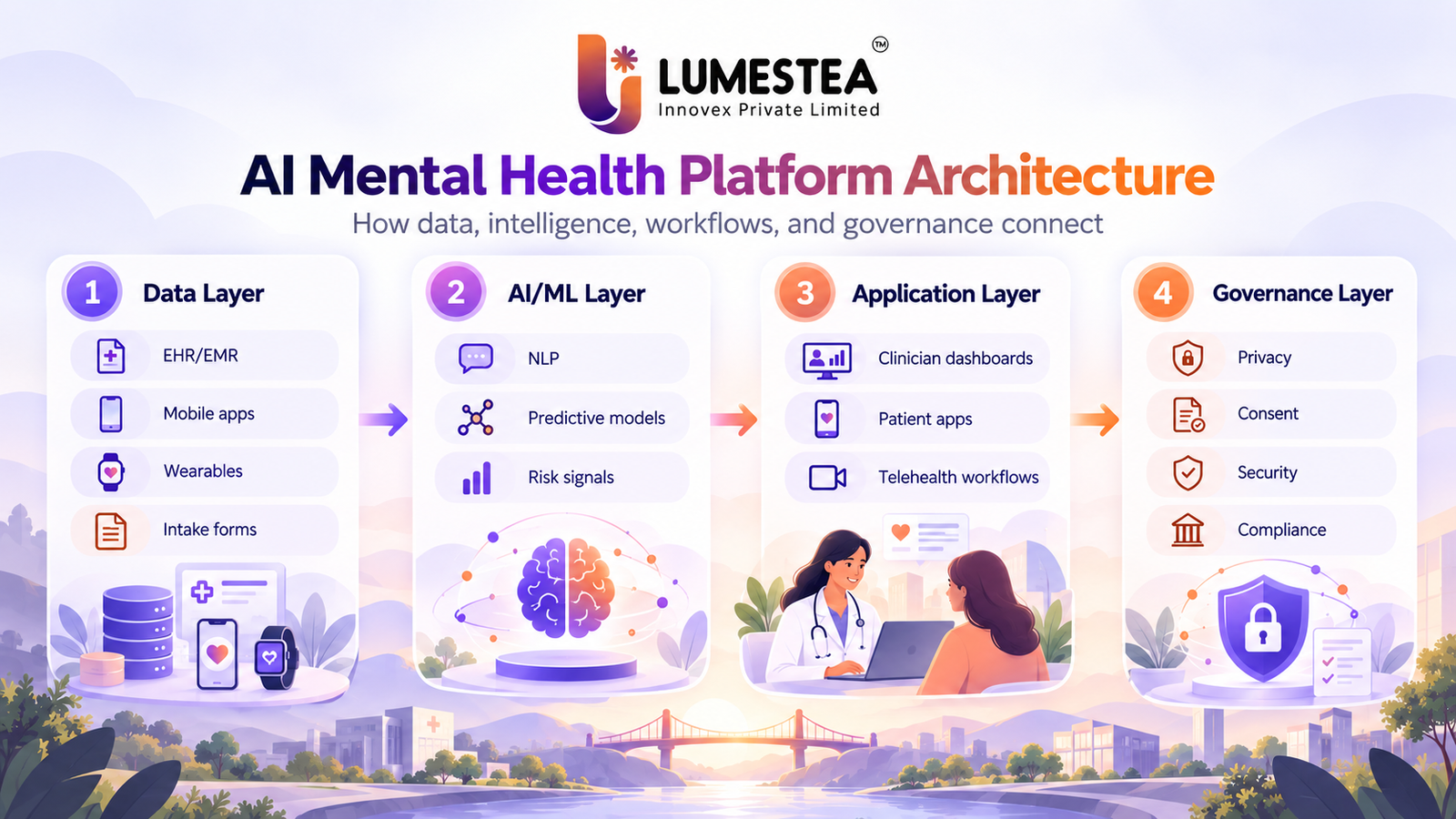
A safe AI mental health platform is not just a chatbot connected to an LLM. It is a layered system designed around privacy, clinical safety, interoperability, governance, and human oversight.
Data layer
The data layer connects information from EHR systems, intake forms, telehealth platforms, mobile apps, wearable devices, questionnaires, and secure messages. Mental health data is highly sensitive, so the architecture must support encryption, access controls, audit logs, consent management, and secure data storage.
Healthcare systems may also need interoperability through standards like FHIR or HL7 so AI insights can fit into existing care workflows rather than sitting in a disconnected tool.
AI and analytics layer
This layer may include NLP models, risk scoring models, behavioral analytics, summarization tools, predictive models, and retrieval-augmented generation systems. For mental health, the AI layer should include explainability, guardrails, monitoring, and bias evaluation.
The model should be evaluated not only for accuracy, but also for safety, fairness, clinical usefulness, and failure modes.
Application layer
The application layer delivers insights to users. This may include clinician dashboards, patient mobile apps, admin portals, triage queues, care coordination dashboards, and reporting tools.
The interface must be clear. A clinician should understand why a patient was flagged, what signals contributed, and what action is recommended. Confusing AI outputs reduce trust and increase risk.
Governance and safety layer
Mental health AI needs strong governance. This includes model monitoring, incident reporting, human escalation, clinical review, policy controls, data retention rules, consent tracking, and regular audits.
NIST’s AI Risk Management Framework is a useful reference for building AI systems with trustworthiness considerations such as validity, reliability, safety, security, resilience, accountability, transparency, explainability, privacy, and fairness.
For architecture planning, link this section to Lumestea’s SaaS Architecture Decisions You Can’t Easily Walk Back
Compliance and Regulatory Considerations
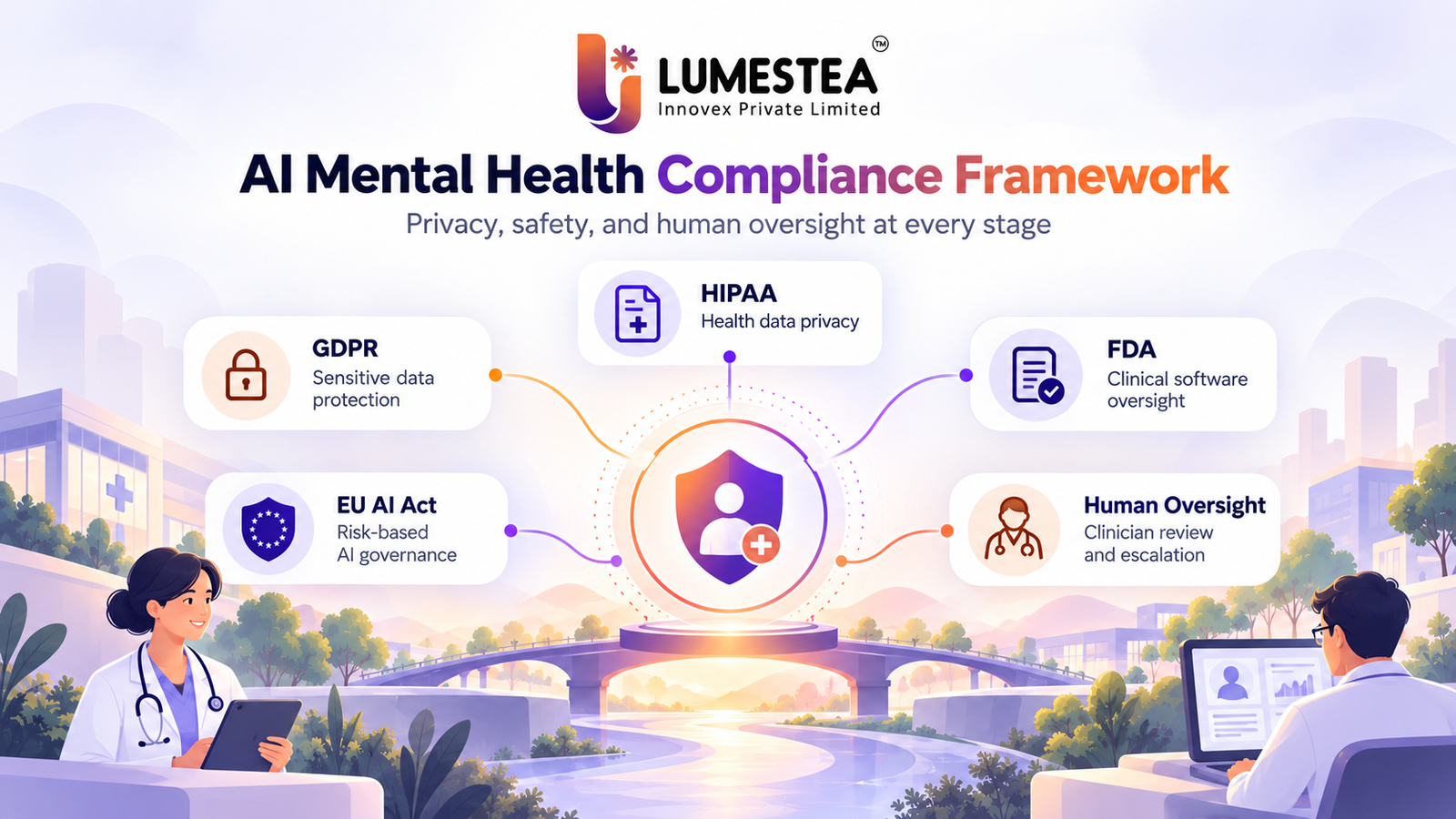
AI in mental health is sensitive because it may involve protected health information, high-risk clinical decisions, vulnerable users, and regulated healthcare workflows.
HIPAA and protected health information
In the U.S., systems that process protected health information must be designed with HIPAA privacy, security, and breach notification requirements in mind. HHS explains that the HIPAA Privacy, Security, and Breach Notification Rules help protect the privacy and security of protected health information.
This means AI mental health platforms need secure data handling, role-based access, encryption, audit logs, breach procedures, and vendor agreements where applicable.
FDA and software as a medical device
If an AI tool provides clinical decision support, diagnosis, treatment recommendations, or risk outputs, regulatory review may be required depending on intended use and risk. The FDA provides guidance for digital health products and clinical decision support software.
A wellness chatbot and a suicide-risk prediction tool are not the same regulatory category. Intended use matters.
GDPR and EU AI Act
In Europe, health data receives special protection under GDPR. The European Commission notes that sensitive personal data categories, including health-related data, receive specific protections.
The EU AI Act also creates risk-based obligations, and AI systems that can affect health, safety, or fundamental rights may fall into high-risk categories depending on context and intended use.
Practical compliance checklist
A mental health AI platform should include:
– Clear intended use
– Patient consent flow
– Privacy policy and data handling rules
– Role-based access control
– Encryption at rest and in transit
– Audit logs
– Human escalation path
– Clinical validation plan
– Bias and fairness testing
– Model monitoring
– Data retention policy
– Incident response process
– Regulatory review where required
Compliance should be designed from the start. Adding it later is expensive and risky.
Ethical and Clinical Risks of AI in Mental Health
AI in mental health carries risks that are more serious than ordinary software errors. A poor recommendation, missed warning sign, biased model, or unsafe chatbot response can affect real people in vulnerable moments.
False positives and false negatives
Risk prediction is never perfect. A false positive may cause distress, stigma, or unnecessary intervention. A false negative may allow a serious situation to go unnoticed. Both must be measured and reviewed continuously.
Hallucination and unsafe advice
Generative AI can produce confident but incorrect information. In mental health, that is especially dangerous. AI should not provide unsupported therapy advice, medication guidance, diagnosis, or crisis handling without human oversight.
Over-dependence on AI
Patients may become emotionally attached to conversational agents, especially if they are lonely, distressed, or socially isolated. Product design must avoid encouraging dependency or replacing human relationships.
Bias and fairness
Mental health datasets may underrepresent certain groups. If models are trained on biased data, outputs may be less accurate or less safe for minority populations, non-native speakers, neurodivergent users, or culturally diverse communities.
Privacy and surveillance concerns
Monitoring mood, language, sleep, location, activity, or communication patterns can feel invasive if not handled transparently. Patients must understand what is collected and why.
Human oversight
The safest systems keep humans in control. AI should surface signals and organize information. Clinicians should make clinical decisions.
Measuring ROI for AI in Mental Health
AI in mental health should not be evaluated only by technology performance. It should be measured by clinical, operational, financial, and user-experience outcomes.
Clinical metrics
Clinical metrics may include earlier detection, faster triage, reduced time to first assessment, improved follow-up rates, better adherence, fewer missed appointments, lower crisis escalation, and improved symptom tracking.
Operational metrics
Operational metrics may include reduced intake processing time, fewer manual documentation hours, faster referral routing, reduced admin workload, improved clinician capacity, and better patient communication.
Financial metrics
Financial outcomes may include reduced readmissions, reduced emergency intervention costs, lower administrative overhead, improved appointment utilization, and better scalability of digital care programs.
User experience metrics
Patients and clinicians both matter. Measure patient trust, engagement, completion rates, satisfaction, opt-out rates, and clinician confidence in AI outputs.
A system that looks accurate in a lab but is ignored by clinicians in practice is not successful.
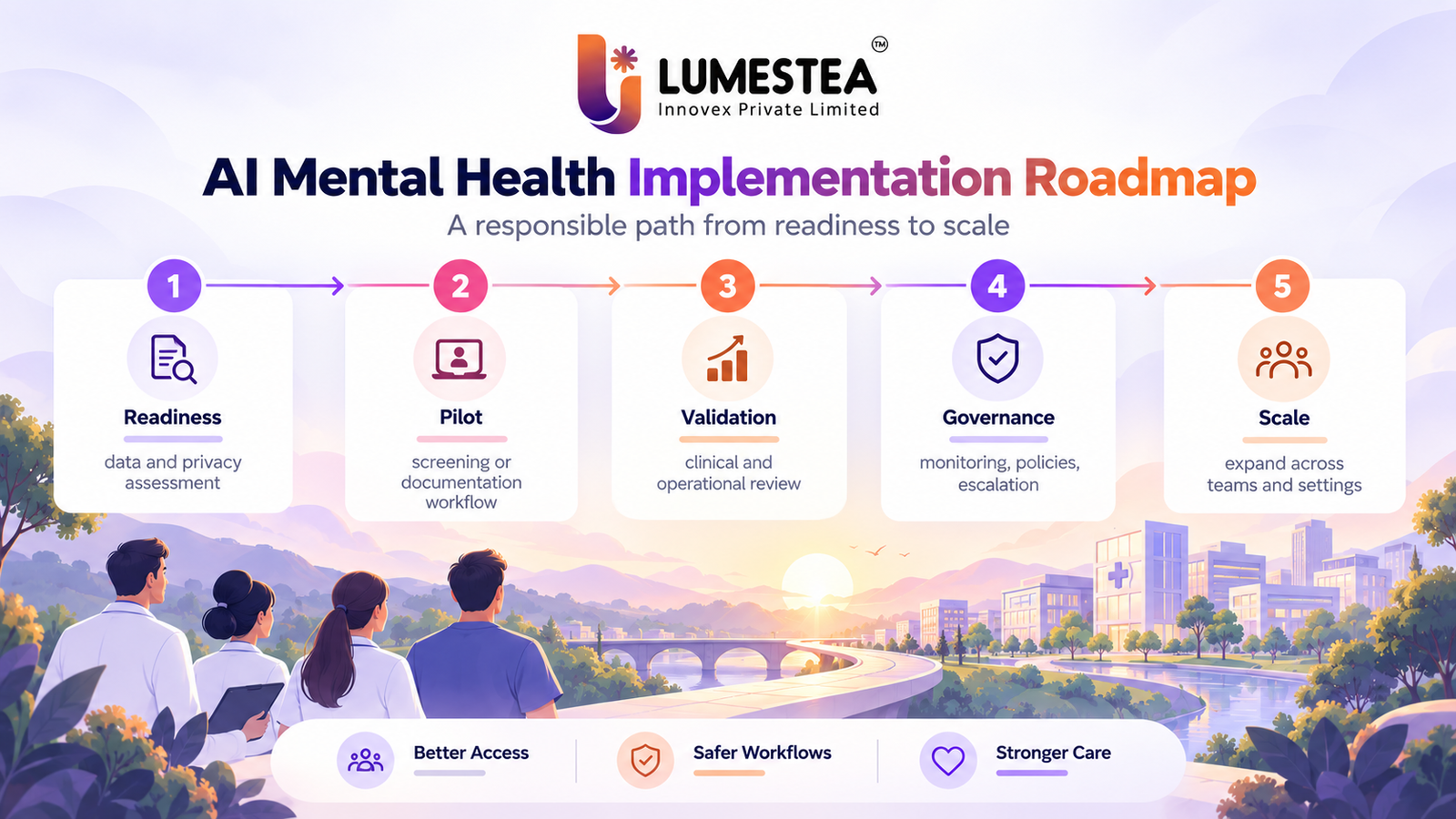
Roadmap to Implement AI in Mental Health Responsibly
AI adoption in mental health should be phased. Starting too broadly creates risk and confusion. The safest approach is to begin with a clear, measurable use case.
Phase 1: Readiness and risk assessment
Start by reviewing data quality, systems, workflows, privacy requirements, compliance obligations, and clinical risks. Define what problem the AI should solve and what it must not do.
Phase 2: Choose a safe first use case
Start with a workflow where risk is manageable and value is measurable. Good starting points include intake automation, appointment follow-up, documentation support, or structured triage assistance.
Phase 3: Build with human oversight
Every AI output that affects care should include human review. Design escalation paths, override controls, and transparent explanations for clinicians.
Phase 4: Validate clinically and operationally
Test the system with real workflows. Compare AI outputs against standard processes. Review bias, false positives, false negatives, usability, and clinician trust.
Phase 5: Deploy in a limited pilot
Launch with a small team or controlled patient group. Monitor safety, workflow fit, performance, and user feedback before expanding.
Phase 6: Scale with governance
As the system expands, establish AI governance, continuous monitoring, audit reviews, model updates, incident tracking, and regulatory checks.
For healthcare organizations building new digital platforms, connect this section to Lumestea’s Healthcare Solutions
When AI Is Not the Right Solution in Mental Health
AI should not be used everywhere. Some situations require direct human care from the beginning.
AI should not independently handle acute crisis intervention. It should not diagnose complex psychiatric conditions without clinician validation. It should not provide medication instructions or treatment decisions without medical oversight. It should not replace therapy. It should not be deployed without consent, privacy controls, or escalation pathways.
AI is also not a good solution when an organization has poor data quality, unclear workflows, no clinical governance, or no plan for monitoring model behavior after launch.
In mental health, “move fast and break things” is the wrong mindset. Responsible AI should move carefully, validate continuously, and keep humans in control.
How Lumestea Can Help Build AI Mental Health Solutions
Building AI for mental health requires more than model integration. It needs healthcare workflow understanding, secure architecture, privacy-first engineering, UX design, compliance planning, human oversight, and long-term monitoring.
Lumestea Innovex Private Limited can help healthcare organizations, digital health startups, and wellness platforms plan and build responsible AI-powered mental health systems.
We can support:
– AI mental health product strategy
– Workflow discovery and AI readiness assessment
– Secure healthcare software architecture
– AI-assisted intake and triage systems
– Conversational AI with guardrails
– Clinical dashboard design
– EHR/EMR and healthcare system integration
– Risk monitoring workflows
– Documentation automation
– Patient engagement tools
– Privacy, access control, and audit logging
– Testing, deployment, and post-launch optimization
AI should not replace mental health professionals. But it can help them see earlier signals, reduce administrative load, support continuity of care, and make digital mental health systems more responsive.
Planning to build an AI-powered mental health or wellbeing product? Lumestea can help you design a secure, responsible, and scalable solution from discovery to deployment.
FAQs on AI in Mental Health
1) What is AI in mental health?
AI in mental health refers to the use of artificial intelligence to support screening, triage, remote monitoring, documentation, patient engagement, clinical decision support, and operational workflows in behavioral health care.
How is AI used in mental health care?
AI is used for intake automation, early screening, risk prioritization, mood tracking, conversational support, clinical decision support, documentation, remote monitoring, and patient engagement.
Can AI replace therapists or psychiatrists?
No. AI should not replace therapists, psychiatrists, crisis teams, or licensed professionals. It should assist care teams by organizing information, surfacing risk signals, reducing admin work, and supporting follow-up workflows.
What are the benefits of AI in mental health?
The main benefits include faster screening, earlier detection, better triage, continuous monitoring, reduced administrative burden, improved patient engagement, and more scalable care delivery.
What are the risks of AI in mental health?
Risks include false positives, false negatives, bias, privacy issues, unsafe chatbot responses, hallucinated advice, emotional dependency, and over-reliance on automated outputs without human review.
Is AI mental health software regulated?
It can be. Regulation depends on intended use, risk level, and whether the system supports diagnosis, treatment decisions, clinical decision support, or medical device functionality.
What data is needed for AI mental health platforms?
Useful data may include intake forms, patient-reported outcomes, clinical notes, appointment history, symptom tracking, wearable signals, mood check-ins, and secure communication data. Consent, privacy, and security controls are essential.
How can healthcare organizations implement AI responsibly?
They should start with a narrow use case, assess data readiness, design privacy controls, keep humans in the loop, validate outputs, monitor bias and drift, pilot carefully, and scale with governance.