

Offshore Software Development: The 2026 Playbook to Build, Scale & Secure Distributed Teams
Offshore Software Development: The 2026 Playbook to Build, Scale & Secure Distributed Teams
 Pushpa
Offshore software development means building software with a team located in another country—often across time zones—to access specialized skills, expand capacity faster than local hiring allows, and deliver cost-efficient scale.
But here’s the truth: offshore success is rarely about “cheaper developers.”
It’s about better operating discipline —clear scope, strong ownership, reliable QA, security controls, and a delivery rhythm that survives distance.
At Lumestea Innovex, we set up offshore teams that function like a real extension of your engineering org—shipping consistently with predictable quality.
1) Why Companies Choose Offshore Development
Offshore becomes a strong option when you need one (or more) of the following:
- Faster scaling when local hiring is slow or expensive
- Specialized talent (cloud, DevOps, AI/ML, security, data engineering)
- Parallel delivery across multiple workstreams
- Flexible capacity (scale up for launches, scale down after)
When offshore is done right, it improves both speed and delivery consistency—without ballooning overhead.
Onshore vs Nearshore vs Offshore (Which model fits you?)
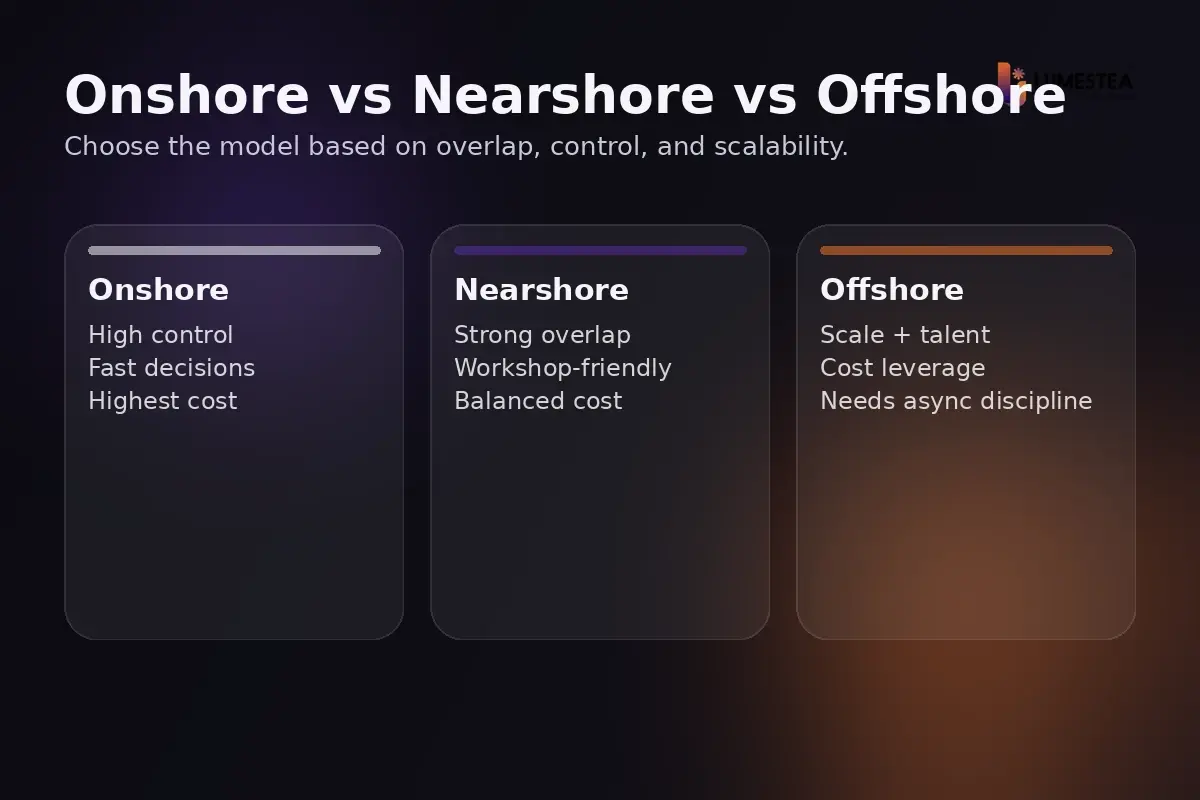
Use this decision guide:
- Onshore: best when daily workshops, fast stakeholder approvals, and close collaboration are mandatory
- Nearshore: best when you want meaningful time overlap but still want cost flexibility
- Offshore: best when you can work async-first and want scale + specialization
- Hybrid: best when you want leadership onshore + delivery offshore (but it needs strong coordination)
Key rule: The less mature your product processes are, the more overlap you need.
Offshore Engagement Models (Choose the Right One)
Below are common offshore engagement options and when to use them:
| Model | Best For | Pros | Watch-outs |
| Staff Augmentation | You already run strong product + engineering | Flexible, fast ramp-up | Needs solid internal leadership |
| Dedicated Team | You want steady velocity + ownership | Stable squad, lower churn | Needs clear governance + roadmap |
| Offshore Development Center (ODC) | Scaling multiple teams long-term | Large capacity, strong continuity | Requires mature processes + tooling |
| Build–Operate–Transfer (BOT) | You want to own the team later | Great long-term capability | Needs legal/HR planning + timelines |
| Fixed Scope (Project-based) | Very clear scope + requirements | Predictable cost | Risk of change requests & ambiguity |
Lumestea recommendation: Start with a Pilot Sprint(2–4 weeks). Prove delivery, then scale.
Cost vs TCO: What You Should Actually Compare
Many teams evaluate offshore by hourly cost. That’s incomplete.
TCO (Total Cost of Ownership) includes:
- rework due to unclear requirements
- quality issues found during UAT
- slow decision-making across time zones
- onboarding churn
- release risks and incident handling
A “cheap team” becomes expensive when:
- defects escape into production
- scope gets rebuilt repeatedly
- releases slip due to unclear ownership
Better approach: Compare vendors by predictability + quality KPIs, not only price.
The Lumestea Offshore Playbook (How we run predictable delivery)
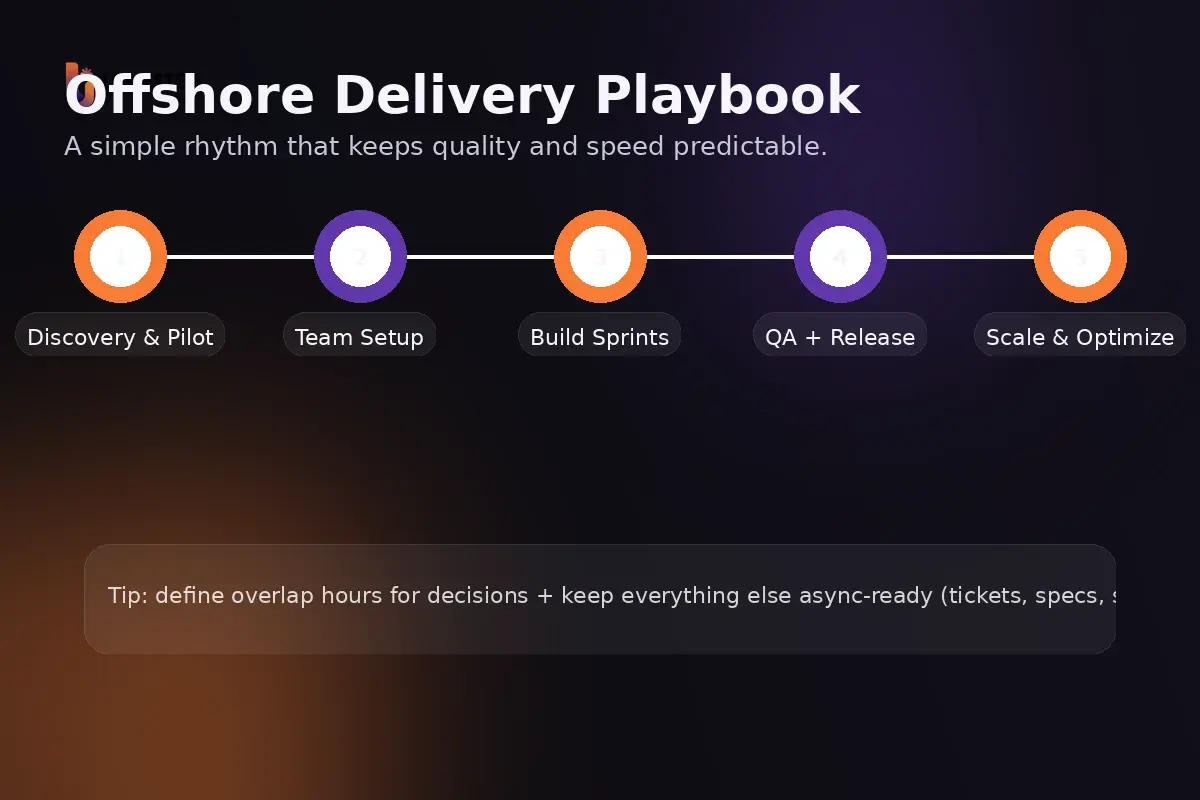
Step 1: Discovery & Pilot Sprint
We begin with a small real-scope pilot:
- define goals and success criteria
- confirm tech stack + repos + environments
- ship measurable output (not just progress screenshots)
Step 2: Make Work Async-Ready
Offshore fails when context lives only in calls.
We convert work into clear artifacts:
- user stories with acceptance criteria
- Figma references / annotated screenshots
- short videos for complex behavior
- “Definition of Done” (DoD) agreed by all
Minimum operating rule:
✅ 2–4 hours of overlap for decisions
✅ everything else must work async
Step 3: Build a Delivery Rhythm
- Weekly planning + sprint goals
- Demo/review based on working software
- Risk review: top 3 blockers + mitigation
- Daily async standup (written)
Step 4: Quality is built into the pipeline (not argued later)
- code reviews + protected branches
- automated tests where it matters
- staging environment parity
- release checklist
- QA evidence before handoff
Security & Governance (Reducing offshore risk without slowing delivery)
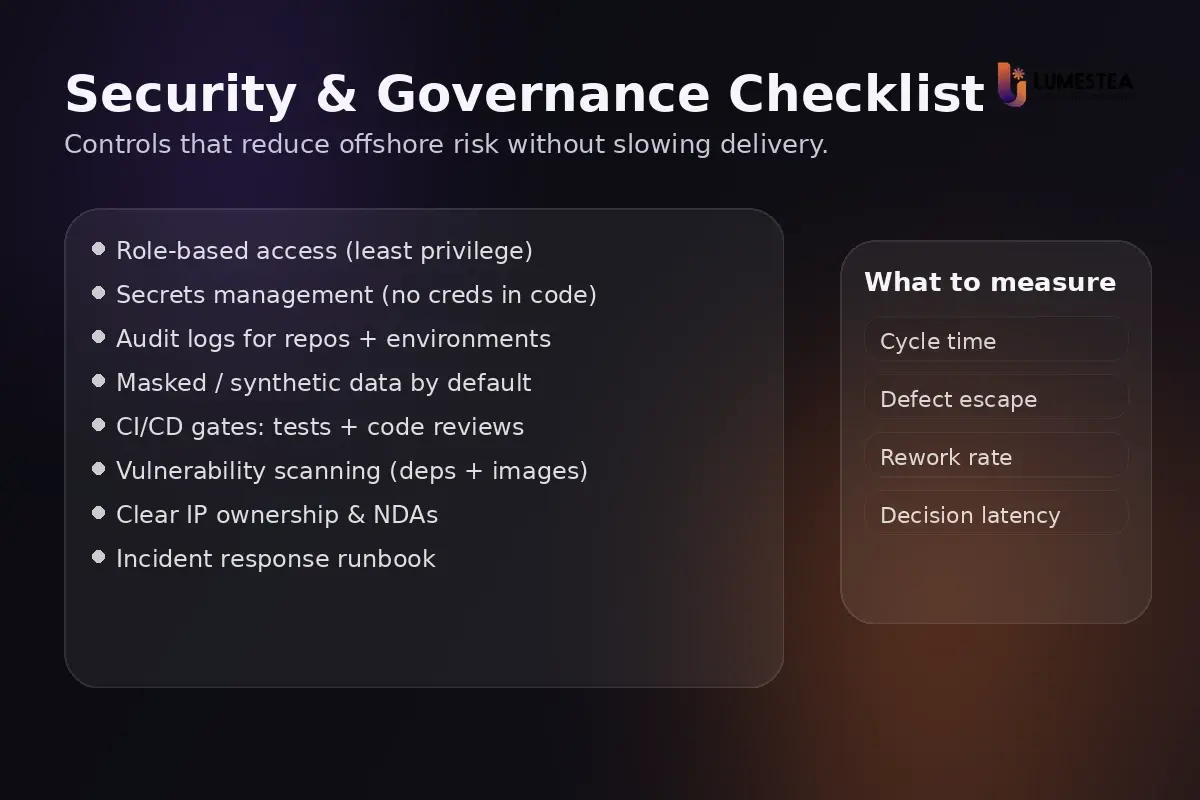
Offshore delivery touches IP, source code, credentials, and sometimes customer data—so governance must be intentional from day one.
Team Structure (What a good offshore squad looks like)
A strong offshore setup usually includes:
- Tech Lead / Architect (ownership, quality, decisions)
- Backend Engineer(s)
- Frontend Engineer(s)
- QA Engineer (automation + functional)
- DevOps / Cloud Engineer (as needed)
- PM / Delivery Owner (visibility, governance)
Tip: Avoid scaling engineers before you establish:
- stable requirements format
- QA flow
- CI/CD pipeline
- release ownership
Communication that works across time zones
Offshore communication should reduce ambiguity, not create more meetings.
What should be written (always)
- acceptance criteria
- edge cases and validations
- API contracts + error states
- “what does done mean?”
- release notes
What should be synchronous (only)
- decisions, trade-offs, and blockers
- sprint planning and demos
- architecture review checkpoints
Simple policy: If a decision repeats twice, document it.
KPIs That Predict Offshore Success
Track these weekly:
- Cycle time: from “in progress” → “released”
- Defect escape rate: bugs found after UAT/production
- Rework rate: tasks reopened due to unclear scope
- Decision latency: time to resolve product/tech questions
- Deployment frequency: releases per sprint/month
You’ll know offshore is working when:
- rework drops
- releases become routine
- velocity increases without QA pain
How to Choose an Offshore Partner (Checklist)
Before scaling beyond a pilot, validate:
- Can they produce artifacts, not only promises? (docs, ADRs, runbooks, QA evidence)
- Do they show clean PR discipline and review culture?
- Can they explain trade-offs clearly?
- Do they work with CI/CD gates and access control?
- Do they commit to measurable KPIs and reporting cadence?
Best practice: Run a pilot sprint with real requirements and real release constraints.
Common Offshore Mistakes (and how Lumestea prevents them)
– Mistake: treating offshore like “task throwing”
Fix: ownership model + DoD + accountability per workstream
– Mistake: unclear scope and late changes
Fix: acceptance criteria + weekly roadmap alignment
– Mistake: quality happens at the end
Fix: pipeline-first quality: PR review + CI + staged releases
– Mistake: security is an afterthought
Fix: least privilege + secrets + audited environments
Conclusion
Offshore software development can be a growth engine—when it’s operated like a system:
- right engagement model
- async-ready work
- measurable KPIs
- security and governance as baseline
- quality built into CI/CD
If you want to scale engineering without sacrificing quality, Lumestea can help you run a pilot sprint and build a dedicated offshore delivery model that ships reliably.
Want a dedicated team shortlist + pilot plan?
Frequently Asked Questions
1) Is offshore software development the same as outsourcing?
Not always. Outsourcing can mean many things. Offshore development typically refers to working with a team in another country. The best offshore setup behaves like distributed product engineering, not task handoffs.
2) Which model is best: staff augmentation or dedicated team?
If you already have strong engineering leadership, staff augmentation works well. If you want stable delivery with lower churn, a dedicated team is usually better.
3) How do we handle time-zone differences?
Use 2–4 overlap hours for decisions and keep everything else async-ready using written specs, tickets, and short recorded walkthroughs. Enforce a 24-hour rule for blockers.
4) How do we protect IP and data?
Use least-privilege access, audited repos/environments, secrets management, masked/synthetic data for dev, and legal terms defining IP ownership.

Sid did an outstanding job creating and refining the Talk About Prayer brand identity. He delivered high-quality logo designs, complete brand guides, and was always professional, responsive, and open to feedback. Communication was clear and consistent throughout the entire project. I’m really happy with the final results and would definitely work with him again in the future. Highly recommended!

Very serious and got job done in time, would recommend

Good work and worked very hard
Our first time working with Upwork and with foreigners was a pure learning experience, and the work was completed. We continue working on the project. Siddharth and his team were incredibly helpful, and we will definitely work together again.
Working with Siddharth has been a great experience. He’s highly skilled, communicative, and proactive—exactly what you want in a collaborator. He quickly understood our goals and contributed valuable input to help shape the product. I look forward to continuing our collaboration and would definitely recommend him to others.