
Food Ordering App Development Cost in Saudi Arabia (2026): Full Breakdown for Restaurants & Chains
Food Ordering App Development Cost in Saudi Arabia (2026): Full Breakdown for Restaurants & Chains
 admin@lumestea.com
Table of Contents
How Much Does It Cost to Develop a Food Ordering App Like Hardee’s Saudi Arabia
- Price Chart: Food Ordering App Cost in Saudi Arabia (SAR)
Cost of Key Features in a Hardee’s-Like Food Ordering App
Hidden Cost to Develop a Food Ordering App Like Hardee’s
Factors That Affect Food Ordering App Development Cost
- 1. The Features You Choose
- 2. Design That Matches Your Brand
- 3. Choosing the Right Technologies
- 4. Backend Systems & Integrations
Timeline to Build (Realistic Project Plan)
How to Reduce Cost Without Reducing Quality
Recommended MVP Feature Set (Best ROI in Saudi Arabia)
Saudi Arabia has become one of the fastest-moving markets for online ordering and delivery. Restaurants and multi-branch brands are increasingly investing in their own ordering app to reduce dependency on marketplaces, improve margins, and build direct customer loyalty.
But one question comes up every time:
“How much does it cost to build a food ordering app in Saudi Arabia?”
This guide explains the real cost drivers, feature-wise pricing, timeline, and practical ways to reduce budget without sacrificing UX or performance.
Key Takeaways (Quick Summary)
- Cost depends mainly on features, number of branches, integrations, and UX quality.
- MVP apps are more affordable; advanced apps get expensive due to tracking, loyalty, and integrations.
- The best approach is Phase 1 (MVP) → Phase 2 (Growth features) → Phase 3 (Scale/Enterprise).
- Arabic + English UX and reliable payments are essential for KSA users.
- Costs rise fastest with multi-branch delivery rules, loyalty, real-time tracking/status flows, and POS/CRM integrations.
- Budget for hidden costs like OTP/SMS, payment gateway fees, hosting, and ongoing maintenance.
- A realistic timeline is 10–20 weeks, depending on complexity.
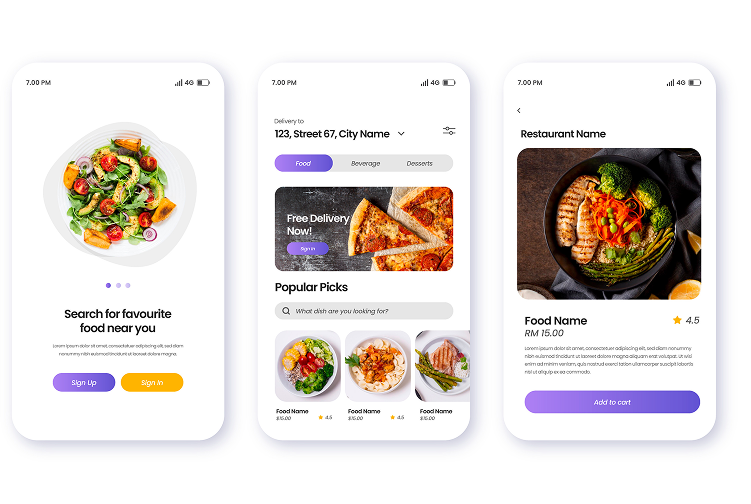
Price Chart: Food Ordering App Cost in Saudi Arabia (SAR)
These are practical ranges used in planning. Final pricing depends on exact scope and integrations.
| Package | Best For | Estimated Cost (SAR) | Includes |
| MVP (Basic) | Single brand, quick launch | 120,000 – 220,000 | Customer app core ordering + basic admin + standard payments |
| Growth (Mid-Level) | Multi-branch + marketing features | 230,000 – 380,000 | Branch selection, delivery zones, coupons, better admin reporting |
| Advanced (Scale) | High orders/day + automation | 400,000 – 550,000 | Loyalty, advanced status flow, analytics, stronger admin controls |
| Enterprise | Large chains + complex workflows | 550,000 – 750,000+ | Custom routing rules, deeper integrations, scalability & observability |
Best practice: Launch with MVP, then add loyalty + integrations in Phase 2.
What You’re Actually Building (Modules)
A complete system usually has 3 parts:
1) Customer App (Mobile/Web)
- Browse menu, customize items, cart, checkout
- Delivery/pickup selection
- Address + map pin + notes
- Order history + reorder
- Real-time updates (status notifications)
2) Admin Panel (Operations Dashboard)
- Live orders screen (filters, printing, status updates)
- Menu/item management
- Branch management (hours, delivery fees, zones)
- Offers/coupons management
- Reports (sales, cancellations, best sellers)
3) Backend + Integrations
- User accounts, order engine, pricing rules
- Payment gateway integration
- OTP/SMS
- Maps & location services
- Notifications + email/SMS flows
- POS/CRM integrations (optional)
Key Feature Cost Table (SAR)
A) Customer App Features
| Feature | Why it matters | Cost Range (SAR) |
| Login/OTP (SMS) | Fast onboarding, reduces drop-offs | 6,000 – 15,000 |
| Menu + categories + search | Core browsing experience | 12,000 – 28,000 |
| Item customization (add-ons) | Increases AOV, reduces mistakes | 10,000 – 25,000 |
| Cart + checkout | Core conversion point | 15,000 – 35,000 |
| Address + map pin + notes | Delivery accuracy | 10,000 – 22,000 |
| Delivery / pickup toggle | Covers common models | 8,000 – 18,000 |
| Order history + reorder | Boosts repeat orders | 8,000 – 18,000 |
| Push notifications | Status updates + marketing | 6,000 – 12,000 |
| Offers/coupons | Growth lever | 10,000 – 25,000 |
| Loyalty & rewards | Long-term retention | 15,000 – 40,000 |
| Arabic + English (RTL) | Wider adoption in KSA | 12,000 – 30,000 |
B) Admin Panel Features
| Feature | Why it matters | Cost Range (SAR) |
| Orders dashboard (live) | Operational control | 18,000 – 40,000 |
| Menu management | Update items/pricing fast | 15,000 – 35,000 |
| Branch management | Multi-branch control | 12,000 – 28,000 |
| Delivery zones + fees rules | Reduces delivery errors | 15,000 – 35,000 |
| Offers/coupon management | Marketing control | 10,000 – 25,000 |
| Basic reporting | Daily decisions | 10,000 – 22,000 |
| Role-based access | Security + operations | 8,000 – 18,000 |
| Audit logs (who changed what) | Critical for pricing/orders | 10,000 – 25,000 |
C) Integrations (Optional but cost-impacting)
| Integration | Notes | Cost Range (SAR) |
| Payment gateway | Cards/wallets/COD rules | 12,000 – 30,000 |
| SMS/OTP provider | Depends on vendor | 6,000 – 15,000 |
| Maps/geocoding | Address accuracy | 8,000 – 20,000 |
| POS integration | Complex, varies widely | 25,000 – 90,000+ |
| CRM/marketing tools | Automation & retention | 15,000 – 60,000 |
| Delivery fleet system | If you manage riders | 30,000 – 120,000 |
Hidden Costs (Monthly/Annual) You Must Budget For
These costs are not always included in development quotes:
| Hidden Cost | Typical Billing | What it covers |
| SMS/OTP usage | Monthly | OTP verification, alerts |
| Payment gateway fees | Per transaction | Payment processing + settlement |
| Cloud hosting | Monthly | Servers, storage, CDN, backups |
| Monitoring & error tracking | Monthly | Performance, uptime, crash reports |
| Maps API usage | Monthly | Geocoding, address validation |
| Maintenance & updates | Annual (or monthly retainer) | Bug fixes, security patches, upgrades |
| App store accounts | Annual | Developer account fees |
| Customer support ops | Ongoing | Tickets, chat ops, SLA |
Factors That Affect Food Ordering App Development Cost
1) MVP vs Advanced Scope
- More features = more screens, logic, testing, and edge cases.
2) Multi-Branch Complexity
- Costs rise when each branch has:
- different menu/pricing
- different hours
- different delivery zones/fees
- stock availability rules
3) UI/UX Quality
- A premium UX takes time: research, prototyping, micro-interactions, performance polish, and usability testing.
4) Integrations
- Payments, OTP, POS, CRM, delivery fleet tools—each integration adds effort and testing.
5) Real-Time Systems
- Live order status flows, high order volume, and stable backend scaling increase engineering and DevOps scope.
6) Admin Panel Depth
- A simple admin panel is cheaper. A powerful ops dashboard (roles, logs, reporting, exports) costs more but saves money operationally.
7) Security & Compliance
- Secure APIs, rate limiting, encryption, audit logs, and secure storage impact time and complexity.
Timeline to Build (Realistic Project Plan)
A clean build typically takes 10–20 weeks. Here’s a practical timeline your clients understand:
| Phase | Duration | Deliverables |
| Discovery & Scope | 1–2 weeks | PRD, user flows, MVP definition, tech plan |
| UI/UX Design | 2–4 weeks | Wireframes → UI screens → clickable prototype |
| Backend Setup | 2–4 weeks | Database, APIs, auth, admin foundations |
| App Development | 4–8 weeks | Customer app + admin panel modules |
| Integrations | 2–5 weeks | Payment, OTP/SMS, maps, optional POS/CRM |
| QA & Testing | 2–3 weeks | Device testing, load testing, edge cases |
| Launch & Stabilization | 1–2 weeks | Production release, monitoring, fixes |
How to Reduce Cost Without Reducing Quality
Here’s the smartest strategy:
1) Customer App (Mobile/Web)
- Launch MVP with core ordering and simple admin
- Add loyalty, advanced tracking, and POS integrations after launch
- Keep animations minimal; focus on speed and clarity
- Use reliable third-party providers for OTP/payment rather than custom systems
- Build a strong admin panel early (saves ops cost long-term)
Recommended MVP Feature Set (Best ROI in Saudi Arabia)
Here’s the smartest strategy:
Customer App (MVP)
- OTP login
- Menu + customization
- Cart + checkout
- Delivery + pickup
- Address + map pin + delivery notes
- Order history
- Push notifications
Admin Panel (MVP)
- Orders dashboard
- Menu management
- Branch management
- Basic offers (optional)
Lumestea
At Lumestea, we build food ordering apps with:
1) Customer App (Mobile/Web)
- Conversion-focused UI/UX
- Scalable backend and clean admin workflows
- Integration-ready architecture (payments, OTP, POS/CRM)
- Phase-wise roadmap to control cost
- Post-launch support and monitoring
If you share:
- Number of branches
- Expected orders/day
- Delivery model (own fleet or partner)
- Languages (Arabic/English)
- We’ll propose a clear MVP + Growth roadmap with a realistic estimate.
Frequently Asked Questions
1) What increases cost the most?
1) What increases cost the most?
Multi-branch delivery rules, loyalty systems, and integrations like POS/CRM.
2) Can I launch without loyalty?
Yes—launching without loyalty is common. Add it after you validate traction.
3) Is Arabic RTL necessary?
For mass adoption in KSA, Arabic UX is strongly recommended.

Sid did an outstanding job creating and refining the Talk About Prayer brand identity. He delivered high-quality logo designs, complete brand guides, and was always professional, responsive, and open to feedback. Communication was clear and consistent throughout the entire project. I’m really happy with the final results and would definitely work with him again in the future. Highly recommended!

Very serious and got job done in time, would recommend

Good work and worked very hard

Our first time working with Upwork and with foreigners was a pure learning experience, and the work was completed. We continue working on the project. Siddharth and his team were incredibly helpful, and we will definitely work together again.
Working with Siddharth has been a great experience. He’s highly skilled, communicative, and proactive—exactly what you want in a collaborator. He quickly understood our goals and contributed valuable input to help shape the product. I look forward to continuing our collaboration and would definitely recommend him to others.