
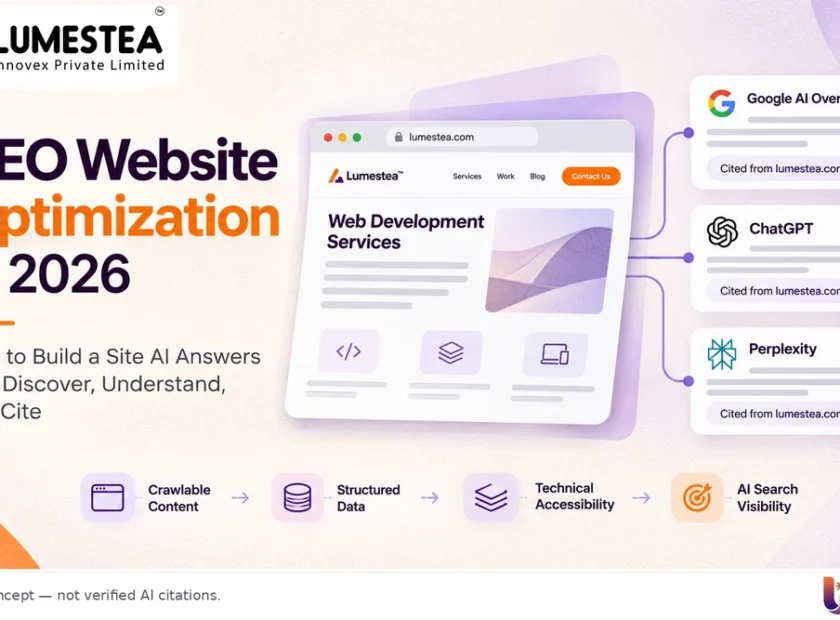
AEO Website Optimization: Build an AI-Ready Website in 2026
AEO Website Optimization: Build an AI-Ready Website in 2026
 Pushpa

Summarize with AI
Not enough time? Get the key points instantly.


Table of Contents
What Is AEO Website Optimization?
Understanding the Difference Between SEO, AEO, and GEO
How AI Search Engines Discover and Understand Websites
Building an AEO-Ready Website: Where Development Meets Marketing
Can AI Crawlers Read JavaScript Websites?
How Developers Can Test Whether AI Crawlers Can Read a Website
AI Crawlers Explained: Search, Training, and User-Requested Access
How to Configure robots.txt for AI Search Visibility
CDN, Firewall, and Hosting Settings Can Affect AEO
Structured Data for AI Search: What It Actually Does
How to Design an Answer-First Website Template
Semantic HTML and Accessibility: An Overlooked Part of AEO
Entity Optimization: Helping Search Systems Understand Your Business
XML Sitemaps, Canonical URLs, and IndexNow
Website Performance and Core Web Vitals
Common AEO Myths Businesses Should Avoid
How to Measure AI Search Visibility in 2026
AEO Website Optimization Checklist for Developers
Practical Roadmap to Build or Upgrade an AEO-Ready Website
How Lumestea Helps Businesses Build AI-Ready Websites
Conclusion
Frequently Asked Questions About AEO Website Optimization
A business website used to have a relatively straightforward job. It needed to explain what the company offered, build trust with visitors, rank for relevant keywords, and turn that traffic into enquiries or customers.
That job is changing.
People are increasingly asking tools such as ChatGPT, Google AI Mode, Perplexity, Claude, and Microsoft Copilot questions that previously began with a traditional Google search. They compare software development companies, research implementation costs, evaluate products, and look for technical recommendations without necessarily opening ten different websites.
For businesses, this introduces another layer of competition. Ranking on a search results page is still valuable, but being discoverable as a credible source within an AI-generated answer is becoming important too.
The challenge is that a visually impressive website is not automatically an AI-readable website. A page might have polished animations, interactive pricing tools, beautifully designed service cards, and a modern JavaScript framework while still making essential information difficult for some automated systems to retrieve.
This is where Answer Engine Optimization, or AEO, becomes part of website development rather than just another marketing activity.
In May 2026, Google published dedicated guidance on optimizing websites for generative AI search, reinforcing that established SEO practices remain fundamental to visibility in its AI-powered search experiences.
The implication for businesses is practical: instead of chasing shortcuts that promise instant AI citations, invest in websites that are technically accessible, well structured, factually reliable, and genuinely useful.
At Lumestea Innovex Private Limited, we approach this challenge through website architecture, content management, user experience, technical SEO, and scalable software engineering.
This guide explains what an AEO-ready website actually needs, how developers and content teams should work together, which AI crawler settings matter, and how to measure whether the investment is producing meaningful business results.
What Is AEO Website Optimization?
AEO website optimization is the process of improving a website’s content, technical architecture, accessibility, and information structure so that search engines and AI-powered answer systems can discover, interpret, retrieve, and potentially cite its information.
An AEO-ready website typically includes crawlable HTML, descriptive headings, direct answers, reliable supporting evidence, consistent business information, appropriate structured data, and correctly configured crawler permissions.
AEO does not replace traditional SEO. It builds on it by placing additional emphasis on information retrieval, answer clarity, entity consistency, and visibility across AI-assisted search experiences.
Google does not require a separate AI-specific schema or special website file for inclusion in its AI search features. Its official AI search documentation explains that existing search eligibility requirements and helpful content practices continue to apply.
No website configuration can guarantee that an AI assistant will cite a particular page.
Understanding the Difference Between SEO, AEO, and GEO
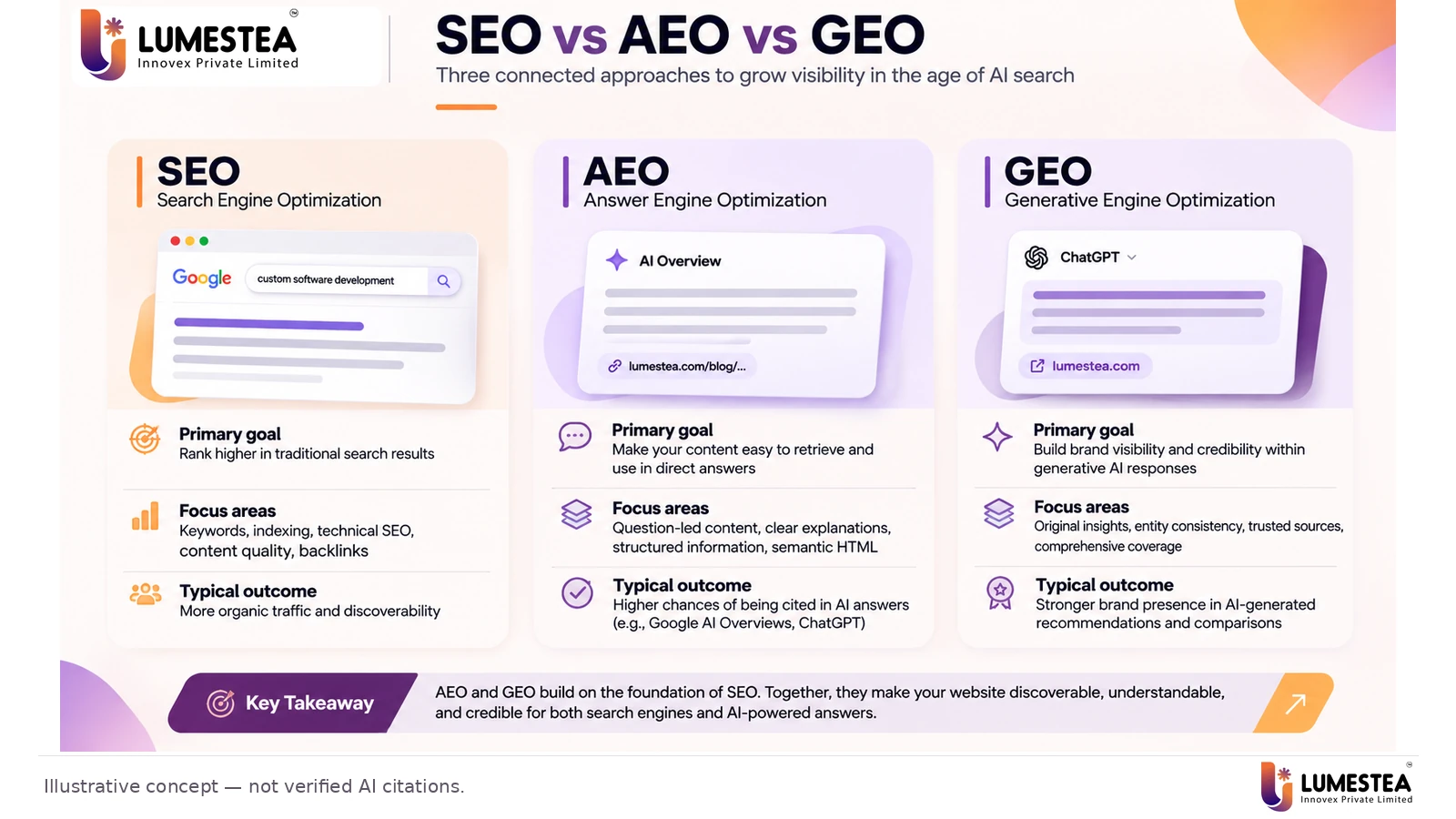
Businesses often encounter three overlapping terms when discussing modern search visibility: Search Engine Optimization, Answer Engine Optimization, and Generative Engine Optimization.
Although these approaches share many foundations, they emphasize different outcomes.
| Optimization Approach | Primary Objective | Main Areas of Focus |
|---|---|---|
| SEO | Improve visibility in traditional search results | Keywords, indexing, technical SEO, content quality, backlinks, website experience |
| AEO | Make content easier to retrieve and use in direct answers | Question-based content, clear explanations, semantic HTML, credible sources |
| GEO | Improve brand and content visibility within generative AI responses | Original insights, entity consistency, source credibility, AI search accessibility |
| Technical SEO | Ensure websites can be discovered, processed, and indexed | Rendering, crawling, canonical URLs, sitemaps, performance and status codes |
Consider a business researching the cost of developing a custom SaaS platform.
Traditional SEO helps a relevant article appear when someone searches for software development pricing. AEO helps the article communicate a clear answer about cost ranges and pricing factors. GEO focuses more broadly on whether the information or company becomes part of a generated response that compares different development options.
These are not three completely separate engineering projects. A well-built website can support all three.
The strongest strategy is to combine reliable technical foundations with content that answers real buyer questions, rather than building separate pages simply to target slightly different search phrases.
How AI Search Engines Discover and Understand Websites
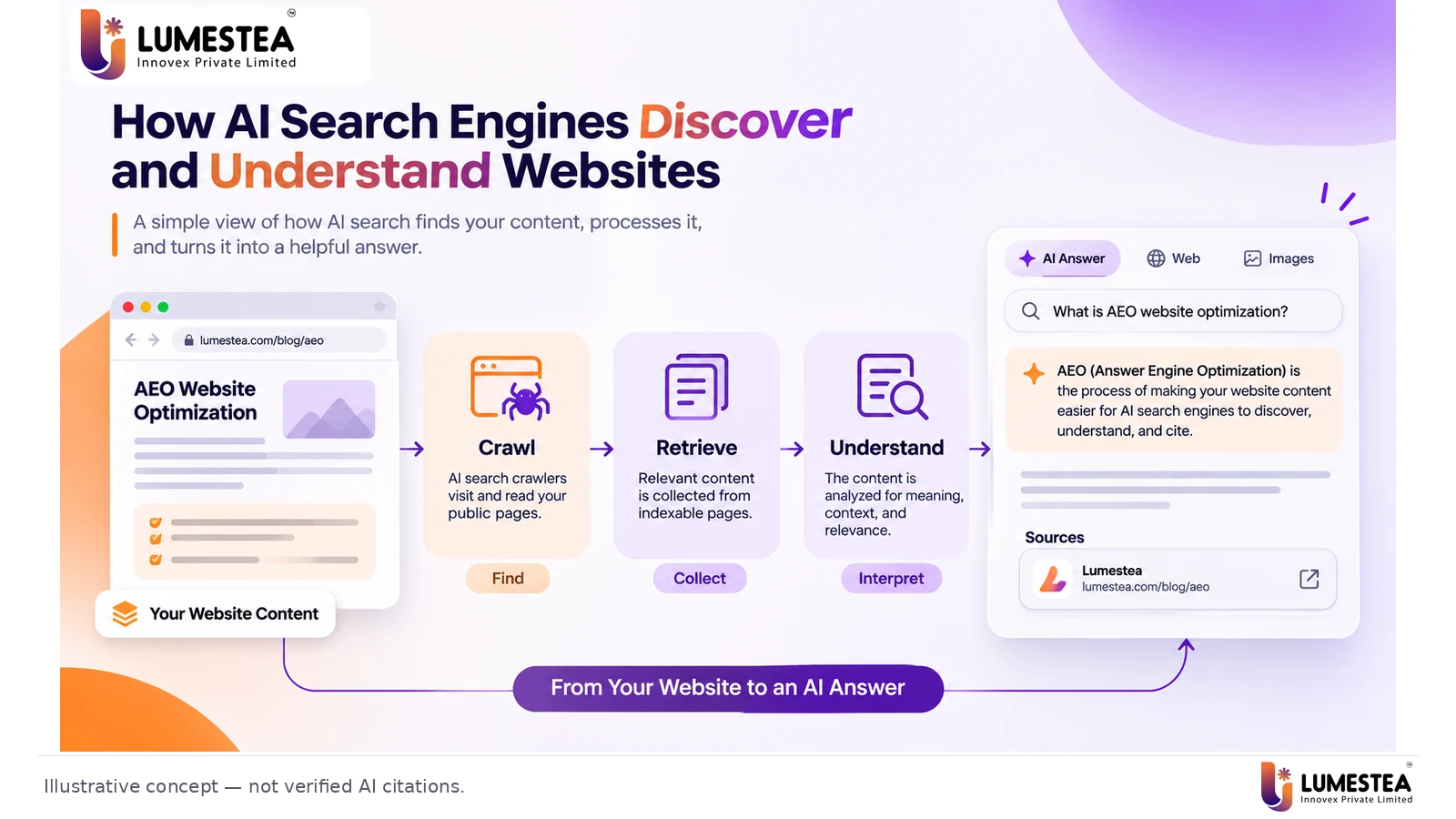
AI-powered search systems do not necessarily retrieve website information in the same way.
Some rely heavily on established search indexes. Others use dedicated crawlers, third-party search providers, direct webpage retrieval, or a combination of these methods.
A simplified AI search workflow involves understanding the user’s question, finding relevant information, retrieving accessible content, evaluating available sources, and generating a response that may include supporting citations.
Website owners do not control the complete process. However, they can influence whether their information is accessible, understandable, accurate, and eligible to appear.
For example, a software development company might display its engagement models through interactive design cards. If the actual pricing information only becomes available after JavaScript executes or a visitor clicks a button, certain retrieval systems may never receive that information.
A similar problem occurs when important technical specifications are embedded exclusively inside images or downloadable brochures.
The practical objective is to make essential information available in a form that both human readers and automated systems can understand.
This is closely connected to modern website development services, where architecture decisions influence discoverability long before the marketing team begins optimizing individual pages.
Building an AEO-Ready Website: Where Development Meets Marketing
AEO is not something that can be completed entirely through a WordPress SEO plugin. It requires cooperation between developers, designers, technical SEO specialists, and content teams.
Developers control the way pages are delivered and interpreted. Content teams determine whether the information is accurate, distinctive, and useful enough to answer a question.
The following responsibilities should be agreed upon before development begins.
| Website Component | Development Responsibility | Content and Marketing Responsibility |
|---|---|---|
| Website rendering | Deliver meaningful HTML from the server | Ensure important information is available as text |
| Crawl accessibility | Configure robots.txt, server responses and CDN rules | Define the organization’s AI content access policy |
| Content structure | Build semantic headings, tables and article templates | Write clear explanations and direct answers |
| Structured data | Generate and validate JSON-LD markup | Maintain accurate business facts and author details |
| Website identity | Connect organization, author and service entities | Keep company information consistent across platforms |
| Content discovery | Maintain sitemaps, canonicals and submission mechanisms | Update outdated information |
| Performance | Optimize loading, interaction and visual stability | Select appropriate images and media |
| Measurement | Configure analytics and monitoring | Track search visibility, enquiries and content outcomes |
A frequent mistake is treating technical SEO as a task that begins after the website has already been designed and developed.
By that stage, the team may discover that page content is hidden behind client-side interactions, that the CMS does not support individual metadata, or that hundreds of URLs have inconsistent canonical tags.
Correcting those issues later is usually harder than including them in the original web application development lifecycle.
Can AI Crawlers Read JavaScript Websites?
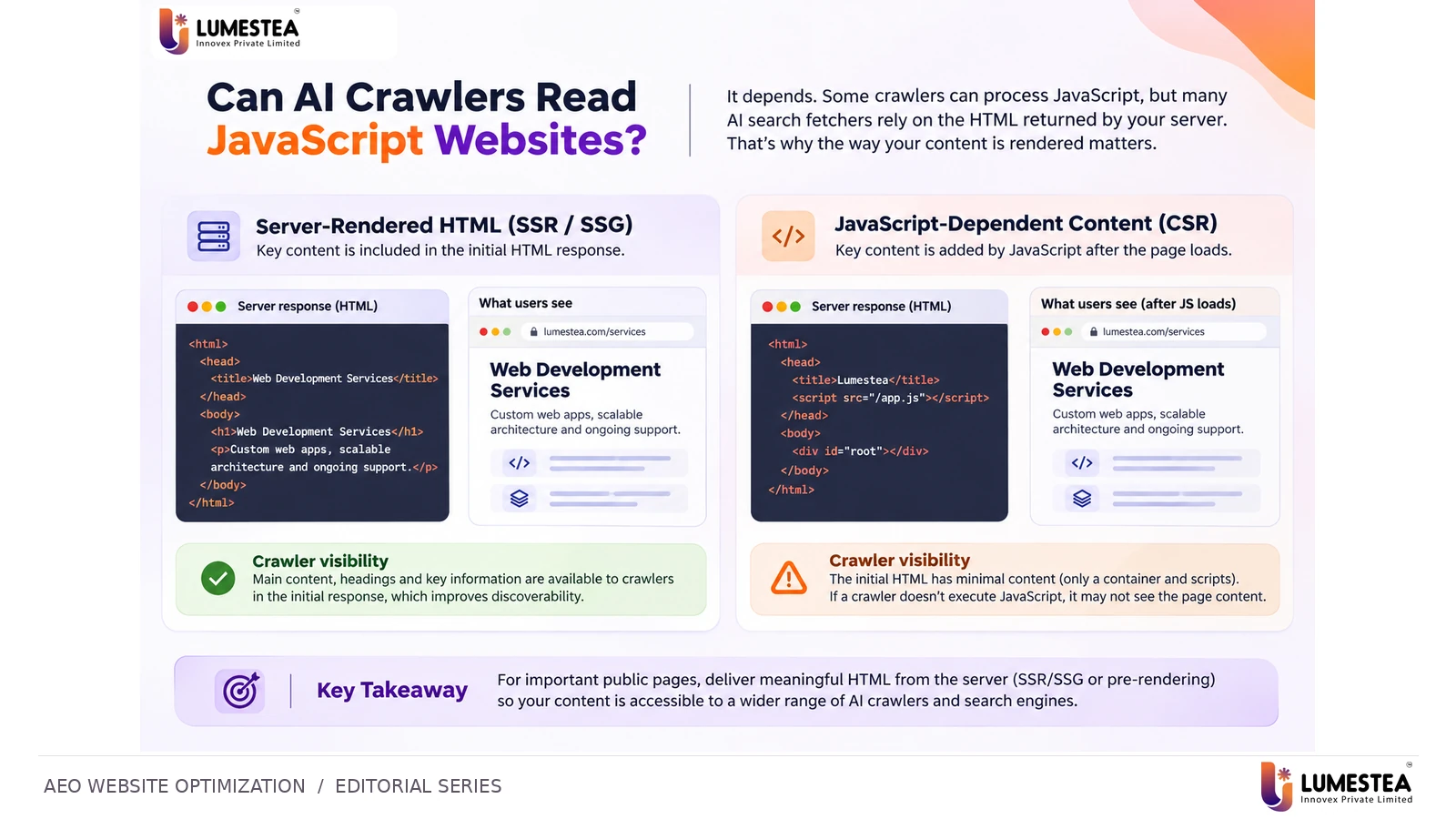
Yes, some automated systems can process JavaScript-rendered content, but website owners should not assume that every search crawler or AI retrieval system has the same rendering capabilities.
Googlebot can render JavaScript as part of its indexing process. Other AI crawlers and direct webpage fetchers may operate differently, depending on their infrastructure and retrieval methods.
A December 2024 crawler research study published by Vercel and MERJ observed that the major AI crawlers examined did not execute JavaScript during the study.
That research represents observed behavior at a particular time, not a permanent limitation of every AI platform. Nevertheless, it highlights a genuine architectural risk.
Google’s own JavaScript SEO documentation continues to recommend considering server rendering or pre-rendering because JavaScript processing capabilities vary across automated systems.
For public-facing pages, the safest engineering approach is to deliver essential content in the initial HTML response.
Client-Side Rendering vs. Server-Side Rendering vs. Static Generation
| Rendering Method | How It Works | Suitability for Public AEO Pages |
|---|---|---|
| Client-Side Rendering (CSR) | JavaScript builds the content in the browser | Requires careful implementation; content may be unavailable to basic fetchers |
| Server-Side Rendering (SSR) | The server generates HTML before delivering the page | Strong option for dynamic, content-rich public pages |
| Static Site Generation (SSG) | Complete HTML pages are generated ahead of requests | Suitable for blogs, documentation and marketing websites |
| Incremental Static Regeneration (ISR) | Previously generated pages can be refreshed as content changes | Useful for larger websites requiring periodic content updates |
There is no requirement to rebuild every React application simply to improve AEO. What matters is how public content is delivered.
A customer dashboard behind authentication can continue using client-side rendering where appropriate. Public service pages, pricing pages, case studies, documentation, and blog articles deserve greater attention because they are intended to be discovered externally.
Why the Initial HTML Response Matters
Imagine two websites publishing the same guide on software development pricing.
The first website returns a minimal HTML document containing an empty application container and a JavaScript bundle. The actual heading, pricing information, and article text appear only after that bundle runs.
The second returns the article heading, paragraphs, pricing table, and relevant metadata immediately. JavaScript then adds optional features such as a calculator, animations, or interactive filters.
Both websites can look identical to a human visitor. Their accessibility to a basic HTML retrieval system can be very different.
These decisions belong in early software architecture planning, particularly when changing the delivery model later would require considerable engineering work. We explore similar long-term trade-offs in our guide to SaaS architecture decisions you cannot easily reverse.
How Developers Can Test Whether AI Crawlers Can Read a Website
Before purchasing an AEO monitoring platform or redesigning an entire website, inspect what the server actually returns.
A simple command-line test can reveal whether important content is included in the initial response.
Step 1: Retrieve the Website HTML
Run the following command using a public URL that you own or have permission to test:
curl -sS -L --max-time 30 \
  -A "OAI-SearchBot" \
  -o page-response.html \
  -w "Status: %{http_code}\n" \
  https://example.com/services/
Open the downloaded HTML file and check whether it contains the main heading, service description, important answers, internal links, and metadata.
The same test can be repeated with Googlebot, Bingbot, Claude-SearchBot, and PerplexityBot user-agent strings.
However, changing a user-agent string does not turn a request into a verified crawler. A firewall may apply different rules based on source IP addresses or other verification signals. Server logs should therefore be reviewed to understand how genuine crawler requests are handled.
Step 2: Compare Server HTML With the Rendered Browser Page
Open the webpage in a browser and compare the original page source with the document shown in Developer Tools.
If a critical section exists only in the rendered document, it depends on JavaScript execution. Decide whether that information should instead be included in the initial HTML.
Step 3: Review HTTP Status Codes
A public page intended for search discovery should normally return a successful HTTP response. Unexpected 403 responses, server errors, redirect loops, and bot challenge pages can interfere with retrieval.
The final destination should also be consistent with the page’s canonical URL.
Step 4: Inspect Search Engine Rendering
Use Google Search Console to inspect important pages and review indexing problems.
This is particularly valuable after a CMS migration, JavaScript framework upgrade, redesign, or deployment involving changes to routing.
Step 5: Validate Structured Data
Use Google’s Rich Results Test to inspect supported structured data and identify implementation errors.
For schema types that are not associated with Google rich results, use the Schema Markup Validator.
Passing these tests does not guarantee an AI citation. It helps confirm that important technical components are implemented correctly.
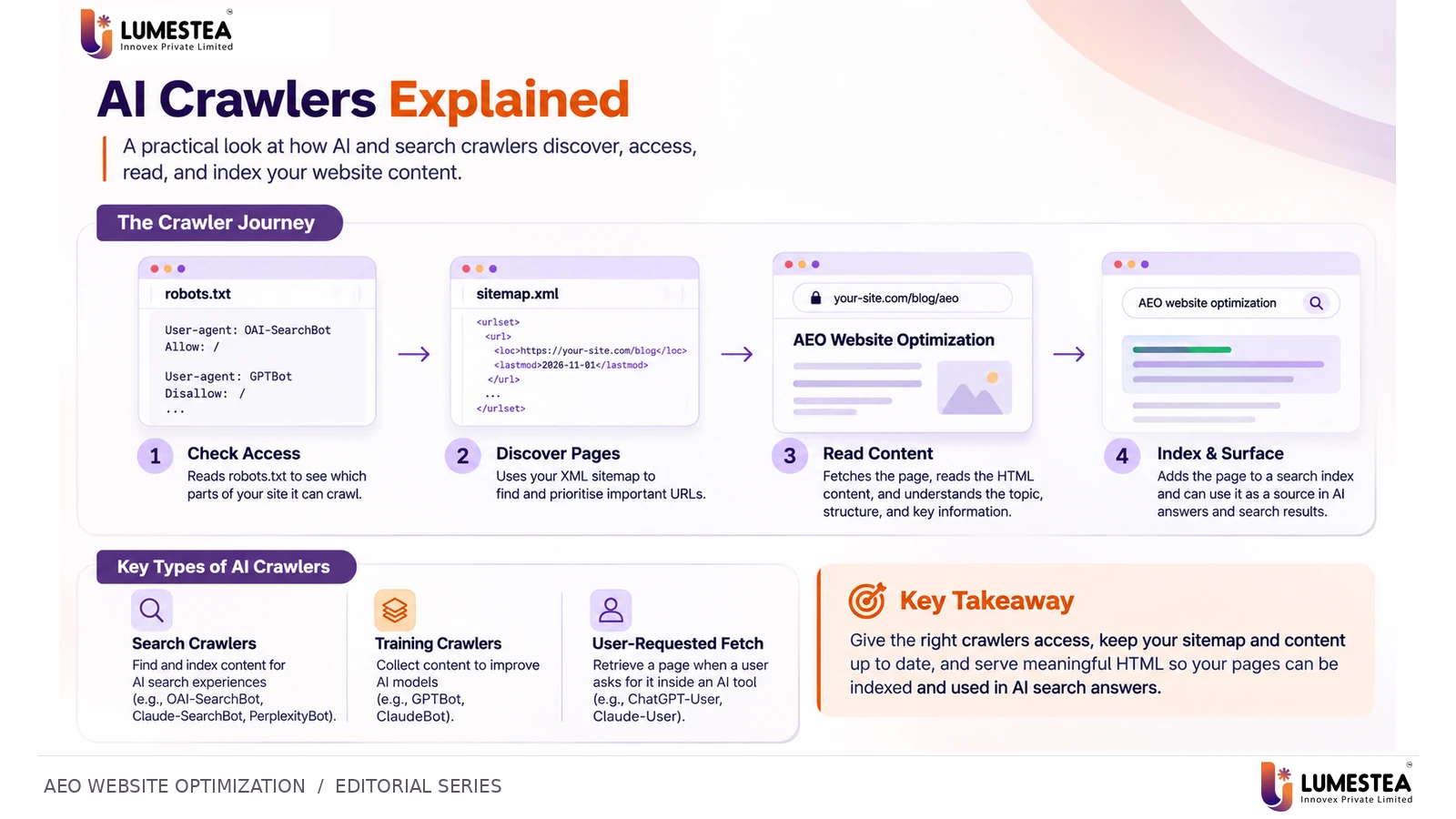
AI Crawlers Explained: Search, Training, and User-Requested Access
One of the more important changes in website optimization is the increasing separation between AI search crawlers and crawlers used for model development.
Businesses sometimes block every AI-related user agent because they want to prevent their content from being used for training. That decision may also reduce opportunities for visibility in AI-powered search systems.
A better approach is to understand what each crawler does before establishing a website access policy.
OpenAI explains the distinction in its official crawler documentation. Anthropic and Perplexity also publish information about their respective crawling systems.
Major AI and Search Crawlers
| Crawler or Control Token | Platform | Primary Purpose |
|---|---|---|
| Googlebot | Search crawling and indexing, including the search foundation used by Google AI features | |
| Google-Extended | Controls certain uses of crawled content for Gemini model development and grounding | |
| Bingbot | Microsoft | Search indexing and related search experiences |
| OAI-SearchBot | OpenAI | Discovery of content for ChatGPT search |
| GPTBot | OpenAI | Collection of content for model training |
| ChatGPT-User | OpenAI | Page retrieval initiated by user requests |
| Claude-SearchBot | Anthropic | Improving Claude search results |
| ClaudeBot | Anthropic | Collection of content for model development |
| Claude-User | Anthropic | Retrieval requested by Claude users |
| PerplexityBot | Perplexity | Search discovery rather than model training |
| Perplexity-User | Perplexity | Retrieval initiated by users |
Google-Extended is a control token rather than a separate HTTP crawler.
For Anthropic, review its web crawler and access control documentation.
For Perplexity, refer to the official Perplexity crawler documentation.
User-requested retrieval may be handled differently from ordinary automated crawling. Some providers state that robots.txt restrictions may not apply to particular user-initiated requests.
How to Configure robots.txt for AI Search Visibility
A robots.txt file communicates crawling preferences to automated systems. It can help website owners distinguish between public areas intended for discovery and paths that should not be routinely crawled.
Organizations that want AI search visibility but prefer to restrict certain model-training crawlers can configure those user agents independently where supported.
The following is an illustrative configuration, not Lumestea’s verified production robots.txt file.
Example: Allow Search Crawlers While Restricting Selected Training Crawlers
# OpenAI search discovery
User-agent: OAI-SearchBot
Disallow: /internal/

# Anthropic search discovery
User-agent: Claude-SearchBot
Disallow: /internal/

# Perplexity search discovery
User-agent: PerplexityBot
Disallow: /internal/

# Restrict selected AI training crawlers
User-agent: GPTBot
Disallow: /

User-agent: ClaudeBot
Disallow: /

# General crawling rules
User-agent: *
Disallow: /internal/

# Replace with the verified production sitemap
Sitemap: https://example.com/sitemap.xml
This approach leaves ordinary public content available to search crawlers while expressing a preference against crawling by selected training bots.
Google-Extended should be evaluated separately because its settings can also affect grounding in certain Gemini products. Blocking it does not directly remove a website from ordinary Google Search.
Google explains these distinctions in its generative AI content controls documentation.
robots.txt Is Not a Security System
A robots.txt file does not protect private information. It is publicly readable and relies on crawlers following its instructions.
Customer records, admin dashboards, employee information, private API responses, and confidential documentation must be protected through proper authentication and authorization.
Website owners should also understand that a crawler-specific group may not inherit restrictions from the general wildcard group. Any applicable shared restrictions should be repeated where necessary.
For WordPress websites, preserve existing rules that allow access to resources required for rendering, including legitimate administrative AJAX endpoints where applicable.
CDN, Firewall, and Hosting Settings Can Affect AEO
A correctly configured robots.txt file is only one part of crawler accessibility.
Modern websites often operate behind content delivery networks, web application firewalls, automated bot protection systems, rate limits, and reverse proxies.
These systems are useful for security and availability, but an overly restrictive configuration can unintentionally block legitimate search crawlers.
For example, robots.txt might permit OAI-SearchBot while the CDN returns a challenge page or HTTP 403 response to the actual request. In that situation, changing the robots.txt file alone will not solve the problem.
Development teams should review genuine crawler traffic using provider verification methods, published IP information where available, and infrastructure logs.
An appropriate implementation should preserve protection against malicious automated traffic without unnecessarily preventing legitimate search discovery.
Google AI Search Controls
Google provides controls for whether content participates in its generative AI search features.
Website owners who want this visibility should review the Search generative AI settings in Search Console alongside indexing and snippet controls.
A website may be technically crawlable while still restricting particular uses of its content.
Microsoft’s Upcoming AI Content Controls
On October 30, 2026, Microsoft announced separate preferences for AI training and grounding.
Microsoft plans to begin honoring these new preferences as it crawls websites from February 1, 2027. Existing NOARCHIVE and NOCACHE controls are scheduled to stop acting as training or grounding preferences from March 1, 2027.
Website owners should review the transition before those deadlines instead of assuming their existing settings will continue producing the same behavior.
Structured Data for AI Search: What It Actually Does
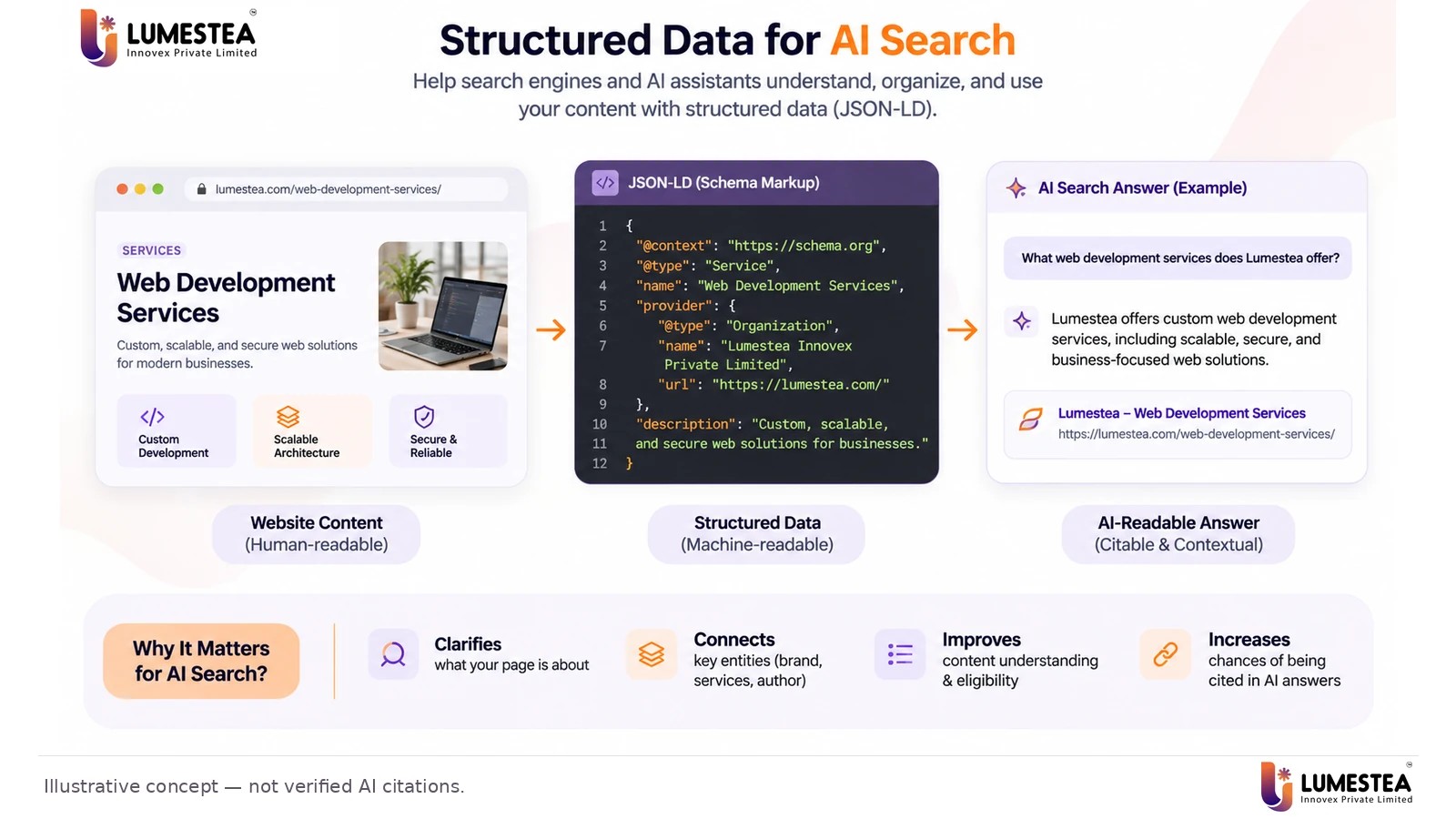
Structured data provides machine-readable descriptions of information already present on a website.
It can identify an organization, article, product, author, breadcrumb navigation, or other supported content types.
For example, a human reader can understand that a company’s name, website address, and logo belong to the same organization. Structured data expresses those relationships more explicitly.
Google’s structured data documentation explains how this markup helps its systems understand page content and determine eligibility for supported search features.
However, adding structured data does not automatically improve AI citations.
There is no universal AEO schema that guarantees visibility in ChatGPT, Google AI Overviews, Claude, or Perplexity.
Recommended Structured Data for Business Websites
| Schema Type | Recommended Location | Purpose |
|---|---|---|
| Organization | Homepage or organization profile | Describes the business and its identity |
| WebSite | Homepage | Identifies the website |
| WebPage | Appropriate public pages | Describes the individual page |
| BlogPosting | Blog articles | Identifies article information and publication details |
| Person | Author profile pages | Describes real authors and their expertise |
| BreadcrumbList | Relevant internal pages | Communicates the page’s location within the website |
| Service | Relevant service pages | Describes the services offered |
| Product | Genuine product pages | Describes product details and applicable commercial information |
| FAQPage | Pages containing genuine eligible FAQs | Describes question-and-answer content; visibility is not guaranteed |
Schema should always reflect the actual website content. Do not add fictitious reviews, unsupported ratings, invented authors, misleading pricing, or unverified company credentials.
Example: Lumestea Organization Schema
The following is a basic Organization schema using the company’s name and website.
{
  "@context": "https://schema.org",
  "@type": "Organization",
  "@id": "https://lumestea.com/#organization",
  "name": "Lumestea Innovex Private Limited",
  "alternateName": "Lumestea",
  "url": "https://lumestea.com/",
  "description": "Lumestea provides web development, mobile application development, artificial intelligence solutions and custom software engineering services."
}
The production version should also include the verified public logo URL, relevant contact information, and genuine official social profile links where appropriate.
A stable organization identifier should be reused across relevant website templates rather than generating a different organization identity on every page.
How to Design an Answer-First Website Template
AEO-friendly content structure begins with understanding how people ask questions.
A prospective customer searching for the cost of developing an ERP platform probably wants a realistic price range, the factors influencing cost, implementation timelines, and an explanation of what is included.
A page that spends several paragraphs discussing unrelated technology trends before addressing cost creates unnecessary friction.
An answer-first template addresses the main question early, then provides supporting detail, examples, comparisons, and limitations.
This is not about making every paragraph sound like a search snippet. It is about helping readers find meaningful information without unnecessary effort.
Recommended AEO Blog Page Structure
| Page Element | Recommended Content |
|---|---|
| H1 heading | A specific title aligned with the user’s search intent |
| Author information | Real author or accountable editorial team |
| Publication information | Accurate published and updated dates |
| Quick answer | A concise explanation of the main question |
| Introduction | Context and why the subject matters |
| Table of contents | Navigable links to major sections |
| H2 sections | Distinct questions or important subtopics |
| Supporting paragraphs | Detailed explanations, examples and limitations |
| Data tables | Useful comparisons presented as real HTML tables |
| Research links | Original studies, official documentation or reliable evidence |
| FAQs | Direct answers to genuine related questions |
| CTA | A relevant next step for interested readers |
Visual design should support this information structure rather than compete with it.
For example, accordion interfaces can be useful on mobile, but the important answer text should still be present in the page HTML. Critical product details should not require a separate network request simply because the visitor expands a card.
The same principle applies to animations, interactive charts, and visual pricing calculators.
Our article on UX trends shaping 2026 explores how thoughtful interface design can reduce friction while preserving a strong brand experience.
An AEO-ready website should achieve both objectives: an engaging experience for people and a meaningful document structure for automated retrieval systems.
<img src="https://lumestea.com/wp-content/uploads/2026/11/07-answer-first-website-template.webp" alt="Answer-first page wireframe showing the main heading, direct answer, evidence and FAQ."
Semantic HTML and Accessibility: An Overlooked Part of AEO
Modern websites can appear polished while being difficult to interpret at the document level.
A heading that is visually large but implemented as an ordinary div does not communicate the same structural meaning as a properly marked heading. A navigation button that has no accessible name creates a similar problem for assistive technologies and some automated interaction systems.
Semantic HTML provides clear information about the purpose of different page elements.
Article content should use meaningful headings, paragraphs, sections, navigational links, tables, and form controls. Images should have descriptive alternative text when they convey meaningful information.
Consider the difference between a pricing comparison displayed only as an image and one presented through an accessible HTML table. The table provides readable relationships between software types, prices, and delivery timelines without requiring image interpretation.
Accessibility should be treated as a product quality requirement rather than an AI-specific trick.
The W3C Web Content Accessibility Guidelines provide a useful foundation for building interfaces that work for a wider range of people and assistive technologies.
Entity Optimization: Helping Search Systems Understand Your Business
A search engine needs to understand more than what an individual page says. It also needs to establish who published it, what organization it represents, and how that information relates to other sources.
An entity can represent a business, person, product, service, or another identifiable subject.
For a software development company, consistent business information helps establish a clearer connection between its homepage, service pages, blog articles, case studies, professional profiles, and external business listings.
Problems arise when the company uses different names across platforms, publishes conflicting service descriptions, lacks author information, or changes important business details without updating older pages.
A consistent entity strategy includes a clear company name, stable website address, appropriate organization markup, accurate contact details, genuine author profiles, and consistent service descriptions.
Original content also matters. A company that publishes real engineering insights, useful implementation examples, and documented technical decisions provides more distinctive information than one that simply repeats broad industry definitions.
This is why AEO should involve subject-matter experts rather than being assigned exclusively to a content production team.
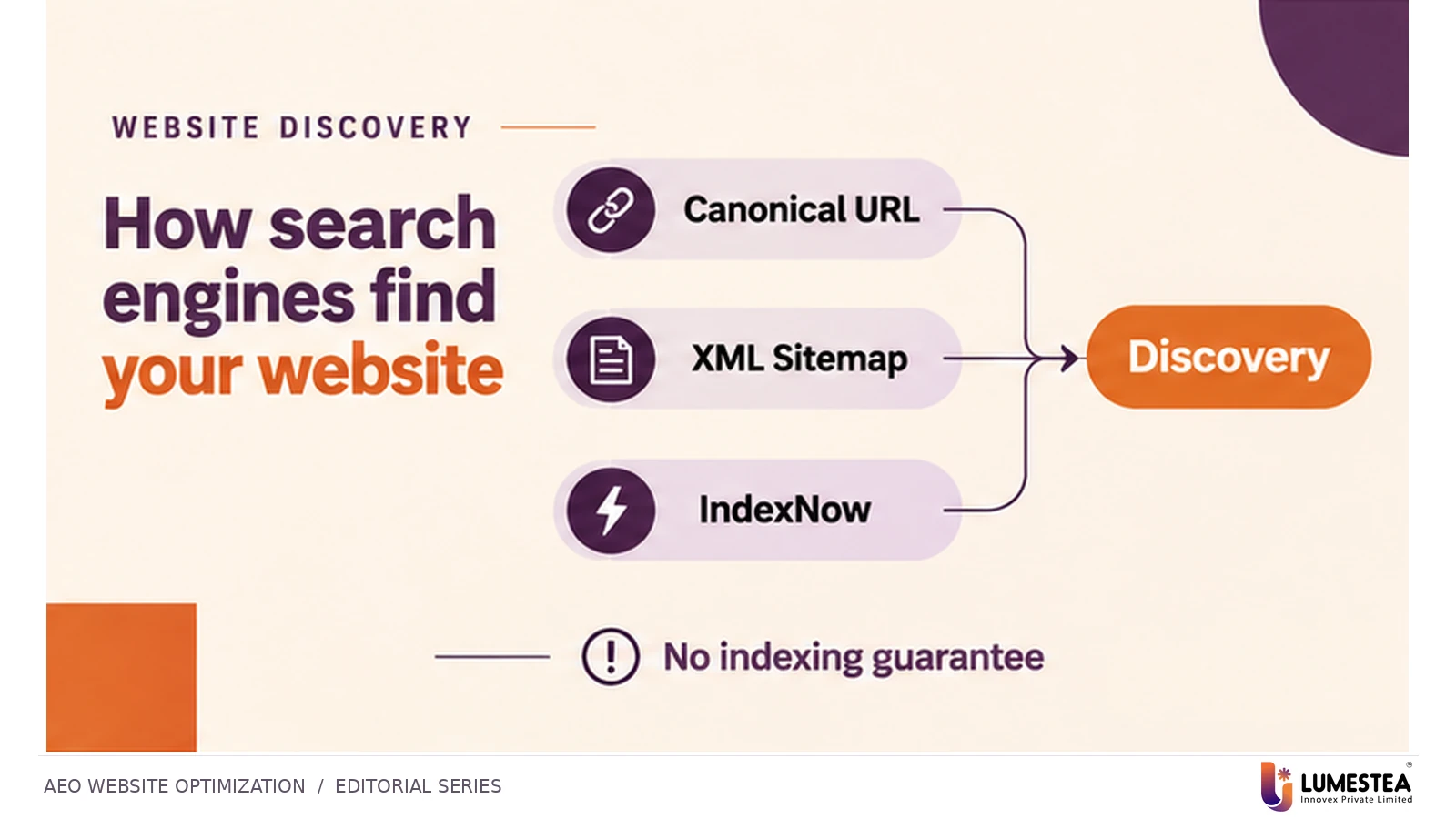
XML Sitemaps, Canonical URLs, and IndexNow
Publishing a useful webpage does not necessarily mean that search engines will discover it immediately.
Website discovery depends partly on internal linking, sitemap accuracy, crawl accessibility, and the search engine’s own processing systems.
XML Sitemaps
An XML sitemap provides search engines with a list of relevant website URLs.
A well-maintained sitemap should prioritize canonical, indexable pages and exclude URLs that are private, broken, or unnecessary duplicates.
Google’s sitemap documentation also explains that modification dates should accurately reflect meaningful page updates.
Changing every lastmod value whenever the website is deployed can make those dates less useful.
Canonical URLs
A canonical URL helps communicate which version of a page is preferred when similar or duplicate URLs exist.
This becomes particularly important when websites use tracking parameters, filtering options, pagination, alternate routes, or multiple versions of the same article.
A consistent canonical configuration also makes analytics and content maintenance easier.
IndexNow
IndexNow allows website owners to notify participating search engines when URLs are added, updated, or removed.
For websites that publish frequently, this can provide a more direct discovery signal than relying exclusively on ordinary crawling.
IndexNow does not guarantee indexing or ranking, and it does not replace a properly maintained sitemap.
Google is not currently listed as an IndexNow participant, so Google Search Console and XML sitemaps remain important for Google discovery.
For CMS-driven websites, these mechanisms can be incorporated into publishing workflows rather than relying on editors to submit URLs manually. A flexible content management system makes that type of automation easier to maintain.
Website Performance and Core Web Vitals
Website performance remains relevant even as search experiences evolve.
A website that loads slowly, shifts unexpectedly, or responds poorly to interaction creates a weaker experience for visitors.
Performance optimization also helps reduce unnecessary complexity in public page delivery.
Google’s Core Web Vitals documentation defines three important measurements.
| Performance Metric | What It Measures | Recommended Good Threshold |
|---|---|---|
| Largest Contentful Paint (LCP) | How quickly the primary visible content loads | 2.5 seconds or less |
| Interaction to Next Paint (INP) | How responsive the page is during interactions | 200 milliseconds or less |
| Cumulative Layout Shift (CLS) | Unexpected visual movement during loading | 0.1 or less |
These thresholds are assessed using the 75th percentile of relevant page-load measurements.
Developers can improve performance through appropriately sized images, efficient caching, reduced JavaScript overhead, optimized fonts, better server response times, and careful management of third-party scripts.
Core Web Vitals should be treated as measurable user-experience targets, not a guarantee of AI citations.
Common AEO Myths Businesses Should Avoid
The growing interest in AI search has created a market for optimization techniques that sometimes make promises unsupported by official documentation.
Before investing development time or marketing budget, businesses should distinguish useful engineering work from speculative tactics.
| Common AEO Claim | What Businesses Should Understand |
|---|---|
| Adding llms.txt guarantees AI citations | There is no demonstrated universal citation guarantee, and Google Search does not require this file |
| Special AEO schema is mandatory | Standard structured data remains useful; there is no special Google AI citation schema |
| Every JavaScript website is invisible to AI | Rendering capabilities differ; essential HTML availability is the safer approach |
| Publishing hundreds of AI-generated pages improves visibility | Scaled, low-value content may create search quality and policy problems |
| Blocking GPTBot automatically blocks ChatGPT search | OpenAI provides separate controls for training and search |
| Adding FAQ schema guarantees AI answers | FAQ content can be useful, but markup does not guarantee inclusion |
| An AEO agency can guarantee first-position AI citations | AI responses vary by question, provider, context, location and time |
| Traditional SEO is obsolete | Search accessibility, indexing, useful content and website quality remain fundamental |
Does a Website Need an llms.txt File?
An llms.txt file is a proposed way of presenting useful website or documentation information in a language-model-friendly format.
It may have practical uses for particular documentation environments and tools that explicitly support it. However, its usefulness depends on whether the receiving system actually reads and uses the file.
Google’s generative AI website optimization guide specifically advises against treating additional AI text files as a requirement for Google Search visibility.
A company should therefore prioritize accessible public content, useful information, correct crawl settings, and established search fundamentals before investing heavily in experimental discovery mechanisms.
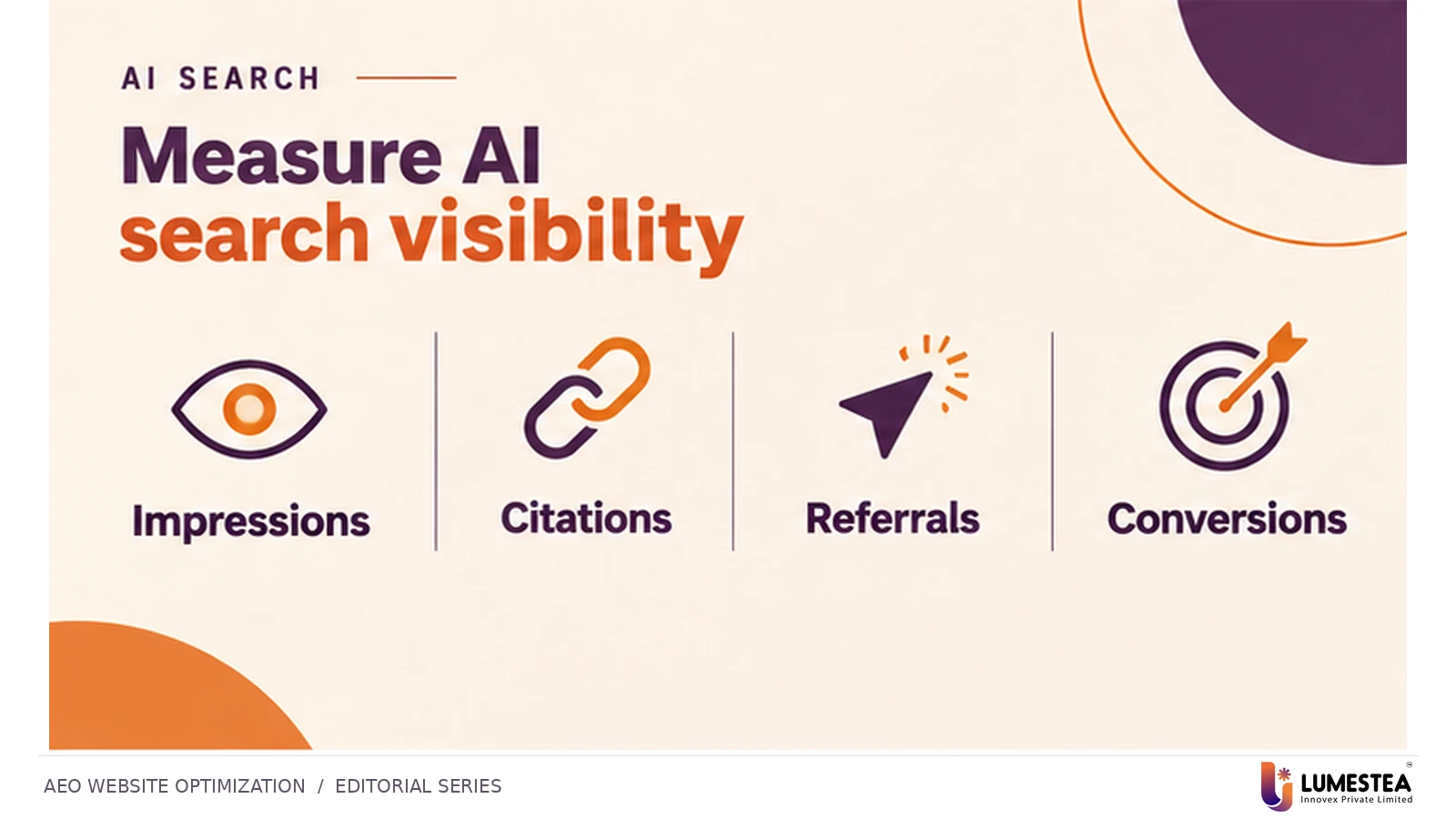
How to Measure AI Search Visibility in 2026
Traditional website analytics cannot explain every interaction that takes place inside an AI assistant.
A business might receive a brand mention without a website visit. A page could be cited without producing a click. A crawler might request hundreds of pages without any of them appearing in a generated response.
A reliable AEO measurement strategy therefore needs several data sources.
Tools for Tracking AI Search Performance
| Measurement Platform | What It Helps Track | Important Limitation |
|---|---|---|
| Google Search Console | Website impressions in supported Google generative AI search features | Does not provide a complete view of independent AI assistants |
| Bing Webmaster Tools | Citations, referenced pages and available grounding-query information | Does not represent every AI platform |
| Google Analytics 4 | Visits from recognized AI assistant traffic sources and resulting website activity | Cannot measure mentions that do not produce visits |
| Server and CDN logs | Genuine crawler activity, response codes and access problems | A successful crawler request does not establish that a page was cited |
| Manual AI visibility testing | Brand mentions, source citations and answer accuracy for selected questions | Results may vary between sessions and are not a complete market-wide measure |
| CRM and conversion tracking | Enquiries, qualified leads and conversions attributed to measurable AI referrals | Attribution may be incomplete |
Google Search Console
Google’s Generative AI performance report provides impression data for supported generative AI experiences in Google Search.
Google states that these insights became available to websites worldwide on August 31, 2026.
This gives website owners an additional way to monitor how their content appears in Google’s evolving search environment.
Bing Webmaster Tools
In February 2026, Microsoft introduced its AI Performance reporting capability.
The reporting helps website owners understand citation activity across supported Microsoft AI experiences and identify pages referenced in generated answers.
This is valuable because citation visibility and ordinary organic search rankings are not identical measurements.
Google Analytics 4
Google introduced an AI Assistant channel in its analytics reporting in May 2026.
The current GA4 default channel definitions help businesses understand how recognized AI assistant referrals are classified.
Marketing teams should review the actual source and medium values in their properties instead of assuming every AI platform is automatically categorized in the same way.
The more useful question is not simply how much AI referral traffic the website receives. It is whether those visitors read relevant service pages, complete enquiry forms, schedule consultations, or become qualified customers.
Establishing an AI Visibility Benchmark
Choose a manageable collection of questions that represent genuine customer intent.
For a software development company, those questions might include:
- What does custom software development cost?
- Which architecture is suitable for a multi-tenant SaaS platform?
- How should a business modernize a legacy application?
- What should companies consider before outsourcing software development?
- Which technical requirements matter for an AEO-ready website?
Review responses periodically across relevant AI search platforms. Record whether the company appears, whether a page is cited, which URL is referenced, and whether the information about the business is accurate.
Use the same testing methodology each month, while recognizing that generated answers can change.
The goal is to identify meaningful visibility improvements, not manufacture impressive-looking statistics.
AEO Website Optimization Checklist for Developers
The following checklist can be incorporated into a website development project, redesign, or technical audit.
| Audit Area | Development Acceptance Criteria |
|---|---|
| HTML rendering | Essential public content is present in the initial HTML response |
| HTTP responses | Valid public pages return appropriate successful responses |
| Crawl access | Relevant search crawlers are permitted according to company policy |
| Bot verification | Legitimate crawler requests are verified using supported methods |
| CDN and WAF | Search crawlers are not unintentionally challenged or blocked |
| Indexability | Public pages do not contain accidental noindex restrictions |
| Snippet controls | Content intended for AI search is not unintentionally restricted |
| Canonical URLs | Each indexable page identifies its preferred URL |
| Structured data | Markup is valid and consistent with visible content |
| Semantic HTML | Headings, articles, tables, links and forms are meaningful |
| Answer-first content | Important questions receive clear, early explanations |
| Organization identity | Business details remain consistent across relevant pages |
| Author information | Articles identify accountable, genuine authors |
| XML sitemap | Canonical and indexable URLs are maintained accurately |
| IndexNow | Changed URLs are submitted to participating engines where configured |
| Accessibility | Meaningful images, forms, navigation and controls are accessible |
| Core Web Vitals | Performance is measured against established thresholds |
| Mobile experience | Content and interactive elements function on mobile devices |
| Analytics | Search Console, Bing and GA4 are configured appropriately |
| Conversion tracking | Relevant enquiries and business outcomes can be measured |
| Deployment testing | Changes to rendering, metadata and crawl rules are checked before release |
Treat these acceptance criteria as part of the normal development process.
They should not become a separate optimization exercise that begins months after the website has launched.
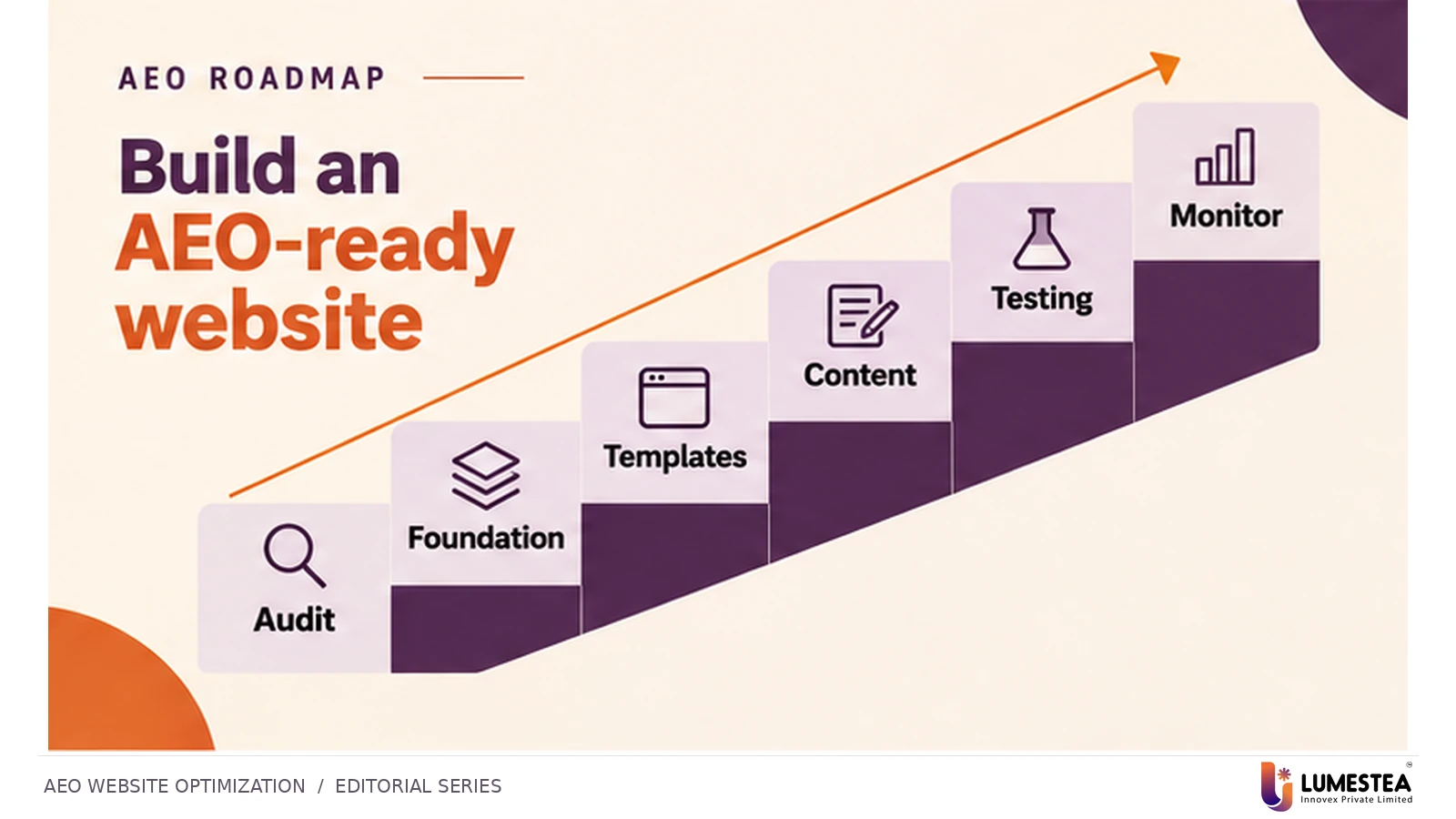
Practical Roadmap to Build or Upgrade an AEO-Ready Website
Phase 1: Audit the Existing Website
Start with the current page rendering, crawler accessibility, indexing status, site architecture, content inventory, structured data, and website performance.
Identify which pages already support important business questions and which pages require improvement.
Phase 2: Establish the Technical Foundation
Choose an appropriate rendering strategy for public pages, correct URL and canonical issues, configure crawler permissions, and resolve unnecessary JavaScript dependencies.
For an existing website, focus on the changes that create meaningful improvement without rebuilding components that already work correctly.
Phase 3: Build Reusable Content Templates
Create templates that support headings, direct answers, author information, publication dates, responsive tables, internal links, FAQs, and appropriate structured data.
The content team should be able to publish a well-structured article without requiring a developer to manually modify every new page.
Phase 4: Improve Content and Evidence
Update outdated articles, provide clearer answers, include relevant external references, and connect related service pages and blog posts.
Where the organization has genuine research, experience, technical examples, or case studies, incorporate those materials to make content more distinctive.
Phase 5: Test Before Deployment
Validate page rendering, crawl settings, mobile usability, accessibility, structured data, performance, and analytics.
Ensure that the website’s security controls remain effective while public content is discoverable.
Phase 6: Monitor and Improve Continuously
Track impressions, citations where available, referral traffic, crawl activity, content accuracy, and qualified enquiries.
Use this information to improve existing content and prioritize future development.
AEO is not a one-time installation. It is an ongoing process involving engineering, content quality, and changing search-platform capabilities.
How Lumestea Helps Businesses Build AI-Ready Websites
Building a website for the AI search era requires more than installing an SEO plugin or adding a few question-and-answer sections.
It requires an understanding of website architecture, content delivery, user experience, search accessibility, structured information, security, and long-term maintainability.
Lumestea Innovex Private Limited offers web development services that can support businesses planning new websites or modernizing existing platforms.
For CMS-driven businesses, the focus can include reusable article templates, content publishing workflows, technical SEO configuration, structured data integration, and performance improvements.
For custom web applications, the development approach can include appropriate server-side rendering, public-page architecture, API integrations, secure content management, and monitoring.
Whether the website uses WordPress, React, Next.js, or another suitable technology, the objective remains the same: make information accessible without compromising functionality, security, or the human experience.
A successful website should not have to choose between strong design and technical discoverability. Both should be considered from the beginning.
Planning a New Website or Struggling With AI Search Visibility?
Lumestea can help evaluate your existing website architecture, identify technical content-accessibility problems, and plan improvements that support traditional SEO and emerging AI search experiences.
Discuss Your Website Development Requirements →
Conclusion
AEO website optimization is becoming an important part of modern website development, but its foundations are not entirely new.
Search engines and AI-assisted retrieval systems need access to useful, trustworthy information. Human visitors need clear answers, reliable experiences, and websites that are easy to navigate.
The businesses best positioned for emerging search experiences will be those that take both requirements seriously.
Instead of chasing guaranteed AI citations, focus on delivering meaningful HTML, maintaining accurate structured data, establishing consistent business information, supporting legitimate search discovery, and publishing content that answers genuine customer questions.
Technical architecture determines whether information can be accessed. Content quality determines whether that information deserves attention.
A website that succeeds at both is better prepared for traditional search, conversational discovery, and the continued evolution of AI-powered search experiences.
Frequently Asked Questions About AEO Website Optimization
What is AEO website optimization?
AEO website optimization is the process of improving a website’s technical accessibility, content structure, and information quality so that search engines and AI-powered answer systems can discover, understand, and potentially cite its content.
Is AEO different from SEO?
AEO builds on traditional SEO but emphasizes clear answers, retrievable information, and visibility in AI-powered search experiences. Both depend on accessible websites, reliable content, indexing, and good user experience.
How can my website appear in ChatGPT search answers?
Allow OAI-SearchBot to access appropriate public pages, make essential content available in readable HTML, and publish useful, accurate information. Correct crawler access improves eligibility, but ChatGPT citations and placement are not guaranteed.
How can websites appear in Google AI Overviews?
Websites should meet Google’s search eligibility requirements, remain indexable and eligible for snippets, and avoid unintentionally excluding relevant content from generative AI search features. Google does not require a separate AEO schema or AI-specific submission process.
Can AI crawlers read JavaScript websites?
Some systems can process JavaScript, while others may depend on the HTML returned directly by the server. Server rendering and static generation help make essential public content more accessible across different retrieval systems.
Does structured data improve AI search visibility?
Structured data helps supported systems understand website information and may improve eligibility for certain search features. It does not independently guarantee AI citations, rankings, or generated-answer placement.
Is llms.txt necessary for AEO?
No. An llms.txt file is optional and may be useful for specific supported tools or documentation environments. Google does not require it for its AI search features.
Can I block AI training without blocking AI search?
Certain providers offer separate controls for training and search crawlers. For example, websites can restrict GPTBot while permitting OAI-SearchBot. The exact implications depend on each provider’s documented behavior.
Is WordPress suitable for AEO website optimization?
Yes. WordPress can support AEO through accessible server-generated content, semantic templates, suitable SEO plugins, structured data, internal linking, website performance optimization, and accurate crawler settings.
Is Next.js better for AI-ready website development?
Next.js supports rendering approaches such as SSR, SSG, and ISR that can make public content available in initial HTML responses. However, framework selection alone does not guarantee AI search visibility. Implementation quality matters more.
How do businesses measure AEO performance?
Businesses can combine Google Search Console, Bing Webmaster Tools, GA4, server logs, manual AI visibility testing, and conversion tracking. These sources measure different parts of discoverability, citations, traffic, and business outcomes.
How long does AEO website optimization take?
The timeline depends on the website’s size, rendering architecture, content quality, indexing status, and existing technical issues. Smaller improvements may be completed relatively quickly, while major architecture changes require more development and testing. Search visibility changes follow separate platform-dependent timelines.